
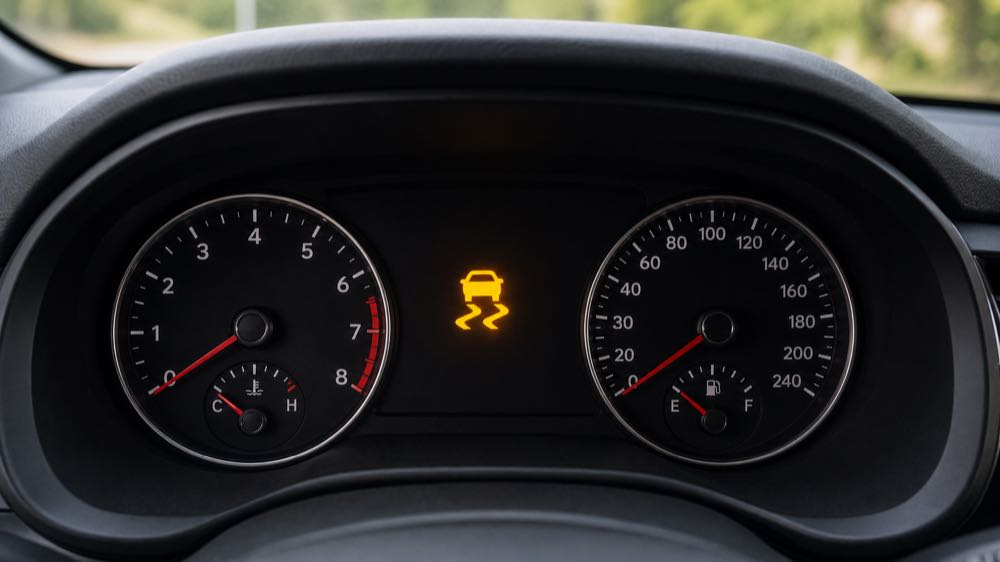
The traction control light is one of the common dashboard warning lights and means the traction control system is active, turned off, or has detected a fault. If it flashes briefly while driving on rain, snow, ice, gravel, or loose pavement, the system may simply be working. If the light stays on, the system may be disabled or needs diagnosis.
Traction control helps reduce wheel spin. It can cut engine power or apply braking to a spinning wheel so the tires regain grip. When the system is not working, the car may be easier to spin or slide on slippery roads.
Flashing vs Steady Traction Control Light
The way the light behaves is the first clue.
| Light Behavior | What It Usually Means | What to Do |
|---|---|---|
| Flashes briefly while accelerating | System is reducing wheel spin | Drive smoothly and slow down |
| Stays on after startup | System may be off or faulty | Check traction control button, inspect soon |
| Traction light plus ABS light | Shared sensor or brake-system fault possible | Drive carefully and scan codes |
| Traction light plus check engine light | Engine/powertrain fault may disable traction control | Diagnose engine codes |
| Light comes on in snow/ice | Tires may be slipping | Reduce throttle and increase distance |
What Traction Control Actually Does
Traction control watches wheel speed and looks for a wheel spinning faster than the others. If the system sees slip, it may reduce throttle, apply brake pressure to one wheel, or work with stability control to help the car stay pointed where you intend.
It is not the same as all-wheel drive, and it cannot create traction if the tires have no grip. Bad tires, ice, deep snow, standing water, or aggressive throttle can still overwhelm the system.
Common Causes of a Traction Control Light
Normal Wheel Slip
If the light flashes for a moment during acceleration, cornering, or slippery-road driving, the system may be doing its job. Ease off the accelerator and drive more smoothly.
Traction Control Turned Off
Many vehicles have a traction control or stability control button. If the system was turned off, the light may stay on to remind you.
Check your owner’s manual before pressing buttons repeatedly. Some vehicles use short press, long press, or menu settings for different stability-control modes.
Bad Wheel Speed Sensor
Wheel speed sensors are shared by traction control, ABS, and stability control on many vehicles. If one sensor fails or reads incorrectly, several warning lights can appear together.
Sensor problems may come from road debris, corrosion, wiring damage, wheel bearing issues, or connector problems.
ABS or Stability Control Fault
Traction control often works with the anti-lock braking system and electronic stability control. A problem in one system can disable another.
If the ABS light is also on, braking behavior in hard stops or slippery conditions may change.
Engine or Throttle Problem
Some engine faults can disable traction control because the system needs control over throttle or engine torque. If the check engine light appears with the traction control light, scan engine diagnostic trouble codes too.
Low Tire Grip or Mismatched Tires
Worn tires, incorrect tire size, uneven tread depth, or mismatched tires can confuse traction and stability systems. Tire pressure and tread condition matter too.
Can You Drive With the Traction Control Light On?
You may be able to drive carefully if the light is on but the car brakes normally and no red warning lights are present. However, you should assume traction assistance may be reduced.
Drive more cautiously if:
- roads are wet, icy, snowy, or gravel-covered
- the ABS light is also on
- the check engine light is also on
- the car pulls, hesitates, or limits power
- tires are worn or mismatched
Avoid aggressive acceleration and leave more stopping distance until the system is inspected.
Traction Control Light vs ABS Light
The traction control light and ABS light are connected, but they do not mean the same thing.
The traction control light deals with wheel spin during acceleration and stability events. The ABS light deals with anti-lock braking during hard stops. Because both systems use wheel speed data, one bad sensor can trigger both lights.
If both lights are on, drive carefully and have the vehicle scanned with a tool that can read ABS/stability-control codes.
Traction Control vs Stability Control
Traction control mainly helps reduce wheel spin during acceleration. Electronic stability control is broader. It can compare steering angle, yaw, wheel speed, and vehicle movement to help reduce a slide.
Many vehicles connect these systems. A slip indicator light, stability control warning, ABS light, or traction control warning may all depend on shared wheel speed sensor data and brake intervention.
If the car shows a stability control off message or feels less stable in bad weather, drive conservatively until it is scanned.
On some vehicles, the traction control system may also use throttle control to reduce engine power while the anti-lock braking system manages wheel lockup. That is why snow and ice can trigger warning lights even when nothing feels broken.
Tire Conditions That Can Make It Worse
Traction control depends on accurate wheel speed data and available tire grip. Problems are more likely if tires are worn, underinflated, mismatched, or different sizes.
Before blaming an expensive module, check the simple things: tire pressure, tread depth, tire size, and whether one tire was recently replaced. A mismatched tire can rotate at a slightly different speed and confuse the system.
What a Mechanic May Check
Diagnosis may include:
- ABS and stability-control diagnostic trouble codes
- wheel speed sensor data
- sensor wiring and connectors
- tire size and tread depth
- brake system condition
- ABS module communication
- steering angle sensor data
- throttle or engine-related codes
A basic engine-only OBD2 scanner may not read traction-control or ABS codes.
When to Get Help Quickly
Get the car inspected soon if:
- the light stays on
- ABS light is also on
- red brake warning light is on
- the car limits power
- the car pulls or brakes oddly
- the light appeared after wheel, brake, bearing, or suspension work
- warning lights return after being cleared
If braking feels unsafe, pull over and call roadside assistance.
FAQ
What does the traction control light mean?
It can mean the traction control system is actively reducing wheel spin, turned off, or has a fault. A flashing light often means the system is working; a steady light may mean a problem.
Is it safe to drive with the traction control light on?
It may be safe to drive carefully if the brakes feel normal and no red warning lights are on. Use extra caution on wet, icy, snowy, or gravel roads.
Why are my traction control and ABS lights on together?
They often share wheel speed sensor data. A bad sensor, wiring issue, ABS fault, or wheel bearing/tone ring issue can trigger both lights.
Can bad tires cause the traction control light?
Yes. Worn, mismatched, incorrectly sized, or underinflated tires can affect traction-control behavior and may contribute to warning lights.
Why did my traction control light come on with the check engine light?
Some engine or throttle faults can disable traction control. Scan engine codes as well as ABS/stability-control codes if both lights are on.
Should I turn traction control off?
Usually, no. It is a safety system. Some drivers temporarily turn it off in deep snow or when trying to free a stuck vehicle, but it should normally stay on for regular driving.
Final Takeaway
A traction control light that flashes briefly can be normal on slippery roads. A light that stays on usually means the system is off or has a fault.
Drive gently, avoid aggressive acceleration, and be extra careful in bad weather. If the ABS light, red brake light, or check engine light is also on, get the vehicle scanned and inspected.