
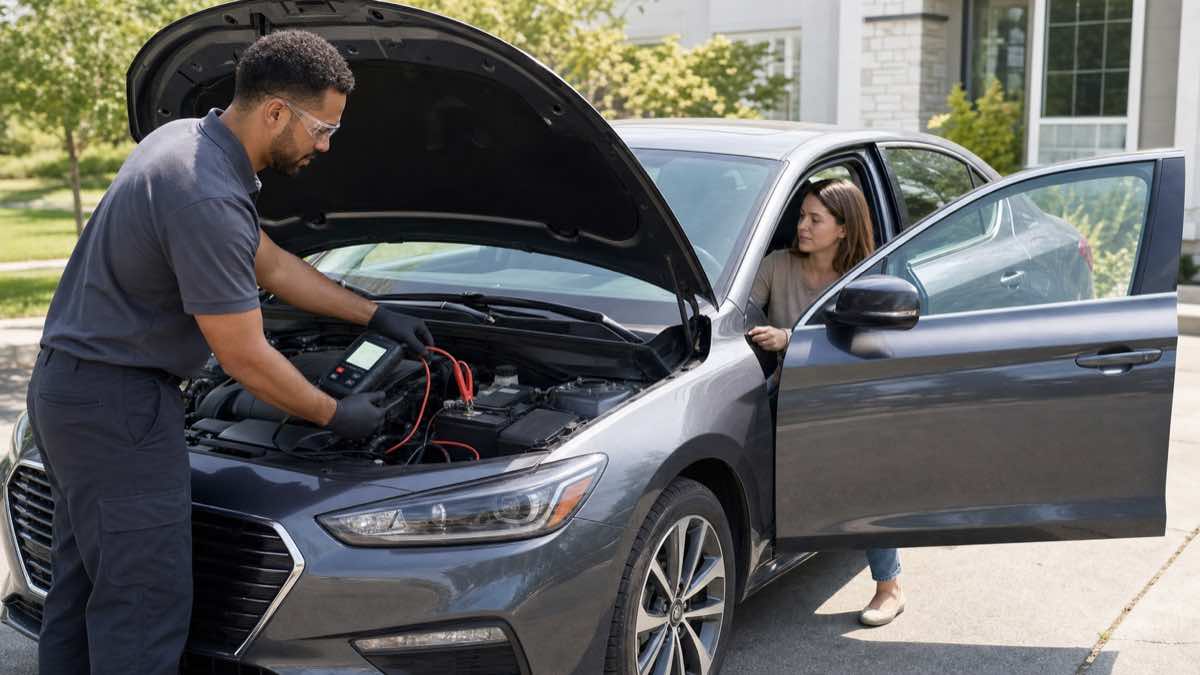
When a car clicks but won’t start, the click pattern is the first useful clue. Rapid repeated clicking most often means voltage collapses when the starter tries to draw current. One heavy click can still come from a weak battery or poor cable connection, but it also raises suspicion of the starter, solenoid, or an engine that cannot turn normally.
Do not buy a battery or starter from the sound alone. Record whether the click is rapid or single, where it comes from, whether the engine moves at all, and what the lights do during the attempt. Then test the battery, connections, high-current cables, control circuit, and starter in order. Stop immediately for smoke, a hot cable, melting insulation, fuel odor, or a harsh mechanical clunk.
Quick Click-Sound Guide
| What you hear | What happens | First area to test |
|---|---|---|
| Rapid click-click-click | Engine does not crank; lights may flicker or dim | Battery charge and health, terminals, grounds, positive cable |
| One solid click | No crank, or a tiny movement then silence | Battery under load, cable voltage drop, starter and mechanical rotation |
| Click from fuse or relay box | Starter area stays quiet | Start relay, control signal, interlock, wiring, module commands |
| Click followed by slow cranking | Engine turns too slowly to start | Battery, connections, starter current draw, oil or mechanical load |
| Normal cranking but no start | Engine spins at normal speed | Different diagnostic path: fuel, spark, timing, compression, security |
This article is for a click with little or no engine cranking. If the engine turns over at normal speed but does not fire, the click is not the main symptom and replacing starting-system parts is unlikely to solve it.
What Is Making the Clicking Sound?
In a conventional gasoline or diesel vehicle, the start command energizes a relay and starter solenoid. The solenoid moves the starter drive toward the engine’s ring gear and closes a high-current electrical path to the starter motor. The motor then turns the engine.
If available voltage falls as the heavy starter load is applied, the solenoid may release. With the load removed, voltage recovers enough for the solenoid to engage again, creating rapid chatter. A single click means something energized once, but it does not prove that full current reached the starter or that the starter itself failed.
Some clicks come from a relay inside a fuse box or beneath the dashboard, not from the starter. Sound location matters. Record a short video from a safe position while another person makes one brief start attempt; do not place hands, clothing, a phone, or tools near belts, fans, or hot components.
Rapid Clicking: Test the Power Supply First
Rapid clicking commonly occurs when the battery cannot sustain starter load, but “dead battery” is a description, not always the root cause. The battery may be discharged because a light was left on, repeated short trips did not restore charge, the vehicle sat for weeks, a parasitic draw remained active, or the charging system did not replenish it. The battery may also be charged but internally weak.
1. Weak, discharged, or internally failed battery
Headlights, screens, locks, and cabin lights need far less current than the starter. They can operate while the battery still fails under cranking load. A resting voltage reading helps assess state of charge, but it does not replace a proper load or conductance test. Temperature, surface charge, battery chemistry, and recent charging affect interpretation.
2. Loose or corroded battery terminals
A connection can pass enough current for accessories yet create a large voltage drop when the starter is commanded. Look for a clamp that moves by hand, white or green deposits, a cracked terminal, damaged cable strands, or a loose ground connection. Do not work near the battery while someone operates the ignition, and remove jewelry before service.
3. High resistance in positive or ground cables
Corrosion can hide inside insulation or at the engine-to-body ground strap. A cable may look acceptable from above while losing too much voltage under load. A technician should perform voltage-drop tests on both the positive and ground sides during a controlled start attempt rather than replacing cables based only on appearance.
4. Charging problem that left the battery low
The alternator does not crank the parked engine; the battery does. However, a charging fault during the previous drive can leave the battery too low for the next start. If the battery symbol appeared, lights changed brightness, or electrical systems weakened while driving, use our battery light guide and test the complete charging system after the engine is running.
One Solid Click: Battery Tests Still Come First
A single heavy click often shifts attention toward the starter, but it does not clear the battery or cables. A severely discharged battery, poor ground, loose terminal, damaged cable, or control-circuit fault can produce one click. Confirm power delivery before authorizing a starter.
Starter solenoid or motor fault
Worn solenoid contacts, brushes, bearings, windings, or starter-drive components can allow an audible engagement without motor rotation. Heat can make an intermittent fault more obvious after a drive, while another attempt may work after the vehicle cools. That pattern is useful evidence, not a complete diagnosis.
Starter control or relay problem
A relay may click even when its high-current contacts fail to carry the required current. The vehicle may also withhold or interrupt the start command because of a park/neutral switch, clutch switch, brake input, immobilizer, ignition switch, damaged wiring, or module decision. Clicking from the relay box rather than the starter helps separate this path.
Mechanical resistance or a locked component
Less commonly, the starter cannot rotate the engine because of internal mechanical damage, fluid in a cylinder, an accessory that has seized, or another abnormal load. A hard clunk, recent overheating, sudden shutdown, missing oil, coolant ingestion, or prior mechanical noise makes this possibility more urgent. Do not keep trying the starter or attempt to rotate the engine unless you have the correct procedure and training.
Safe Checks You Can Make Without Guessing
- Stop repeated attempts. One or two brief observations are enough. Repeated engagement can heat the starter, cables, and connections.
- Secure the vehicle. Select Park or Neutral as instructed, apply the parking brake, and keep clear of traffic.
- Record the exact sound. Note rapid versus single, loud versus faint, and engine bay versus dash or fuse box.
- Watch the lights. Heavy dimming or reset screens supports a supply or connection problem, but bright lights do not prove the battery is healthy.
- Inspect visible battery connections. Look for looseness, corrosion, damaged insulation, leakage, swelling, or a cracked case without touching unsafe components.
- Try the approved alternate gear position. On some automatic vehicles, an attempt in Neutral can reveal an intermittent range-switch issue. Keep the brake firmly applied and follow the manual.
- Check the owner’s manual. Confirm jump points, battery location, electronic key procedure, and warnings for that exact vehicle.
Photograph any warning messages before disconnecting or charging the battery, because low voltage and power loss can change what the dashboard displays. Our dashboard warning lights guide can help identify the symbol, but low-voltage cascades still require testing rather than replacing every system named by a message.
Should You Try a Jump Start?
A correctly performed jump start may help when the battery is discharged, but it is not a universal test or repair. Follow the exact owner’s manual because connection points and procedures differ, especially on vehicles with remote battery terminals, start-stop systems, hybrids, or sensitive electronics.
Do not jump a battery that is frozen, swollen, cracked, leaking, hissing, unusually hot, or physically damaged. Stop for smoke, sparks away from the intended final connection, melting insulation, or cables that heat quickly. Keep flames and ignition sources away, use eye protection, and never improvise polarity.
If a jump starts the car, it proves that added electrical support changed the symptom. It does not by itself prove the battery is bad or the alternator is good. Test battery state of charge and health, charging output under appropriate conditions, connections, and possible key-off draw. If the vehicle still only clicks with a correctly connected, suitable source, stop and diagnose rather than repeatedly trying.
What the Click Does Not Prove
| Assumption | Why it is incomplete |
|---|---|
| “Rapid clicks mean buy a battery.” | A discharged healthy battery, bad connection, charging fault, or parasitic draw can create the same result. |
| “One click means the starter is bad.” | Low battery output, cable resistance, control faults, or mechanical resistance can also produce one click. |
| “The lights are bright, so the battery is good.” | Lighting load is much lower than starter load. |
| “It started with a jump, so the alternator is fine.” | The battery and charging system still need separate tests. |
| “A new battery rules out battery problems.” | A new battery can be undercharged, incorrectly specified, poorly connected, or repeatedly drained. |
How a Shop Should Diagnose a Clicking No-Start
A good diagnosis follows the current path instead of guessing from noise. The technician should document the click pattern, battery state, temperature, warning messages, and whether the fault is consistent or intermittent. Then the test sequence normally includes:
- Visual inspection for battery damage, loose terminals, corrosion, cable damage, grounds, and aftermarket wiring.
- Battery state-of-charge and battery-health testing with equipment suitable for the battery type.
- Voltage measurement during the start attempt and voltage-drop tests across positive and ground paths.
- Verification that the starter receives the correct control command and high-current supply.
- Starter current-draw and starter-operation testing where safe and appropriate.
- Mechanical rotation check when electrical supply is correct but the starter cannot turn the engine.
- Charging-system and parasitic-draw testing after the vehicle starts, when the history suggests repeated discharge.
The Delco Remy starting-system diagnostic manual treats click/no-crank as a test category rather than a part verdict. That is the right principle for passenger vehicles too: prove power, ground, control, starter condition, and mechanical freedom before replacing components.
When to Stop and Call for Help
- The battery is swollen, cracked, leaking, frozen, hissing, or unusually hot.
- You see smoke, smell burning insulation or fuel, or a cable becomes hot.
- The starter makes a grinding sound or a heavy mechanical clunk.
- The engine stopped suddenly after overheating, loss of oil pressure, or severe mechanical noise.
- Jump points, polarity, battery type, or manufacturer procedure are unclear.
- The vehicle is in an unsafe traffic location or cannot be secured against movement.
- A hybrid or EV displays a high-voltage, isolation, or propulsion-system warning.
Interstate Batteries advises stopping repeated ignition attempts because they can overheat an already stressed starter. Its no-start guidance also emphasizes testing rather than assuming a new battery will solve every problem.
Frequently Asked Questions
What does rapid clicking mean when a car won’t start?
It usually means available voltage drops when the starter load is applied, causing the solenoid to engage and release repeatedly. Test battery charge and health, terminals, positive cable, and grounds before replacing parts.
What does one click but no crank mean?
One click means a relay or solenoid likely energized once, but it does not identify the failed part. A weak battery, high-resistance cable, starter or solenoid fault, control problem, or mechanical resistance can all cause it.
Can the battery be bad if the lights still work?
Yes. Lights and electronics require much less current than the starter motor. A battery or connection may power accessories but collapse under starter load, so use a battery-health and loaded-circuit test.
Why does my car still click with a jump start?
The jump source may be inadequate or incorrectly connected, the battery may be severely damaged, cables may have excessive resistance, the starter may be faulty, or the engine may resist rotation. Stop repeated attempts and test the circuit.
Can tapping the starter make the car start?
Do not strike a starter or reach near it as a roadside diagnostic shortcut. Access may place you near live high-current terminals, moving parts, exhaust heat, or an unsupported vehicle. Arrange proper testing instead.
Can a bad alternator make the car click?
Indirectly, yes. A charging fault can leave the battery discharged for the next start. The alternator is not what cranks a parked engine, so confirm battery condition and cable integrity, then test charging performance after the engine runs.
Bottom Line
When a car clicks but won’t start, classify the sound before replacing anything. Rapid chatter puts battery charge, battery health, and connections first. One solid click still requires those tests, followed by cable voltage drop, starter control, starter operation, and possible mechanical resistance. Make only safe visual observations, follow the vehicle manual for any jump attempt, and stop when heat, smoke, damage, or uncertainty enters the picture.