
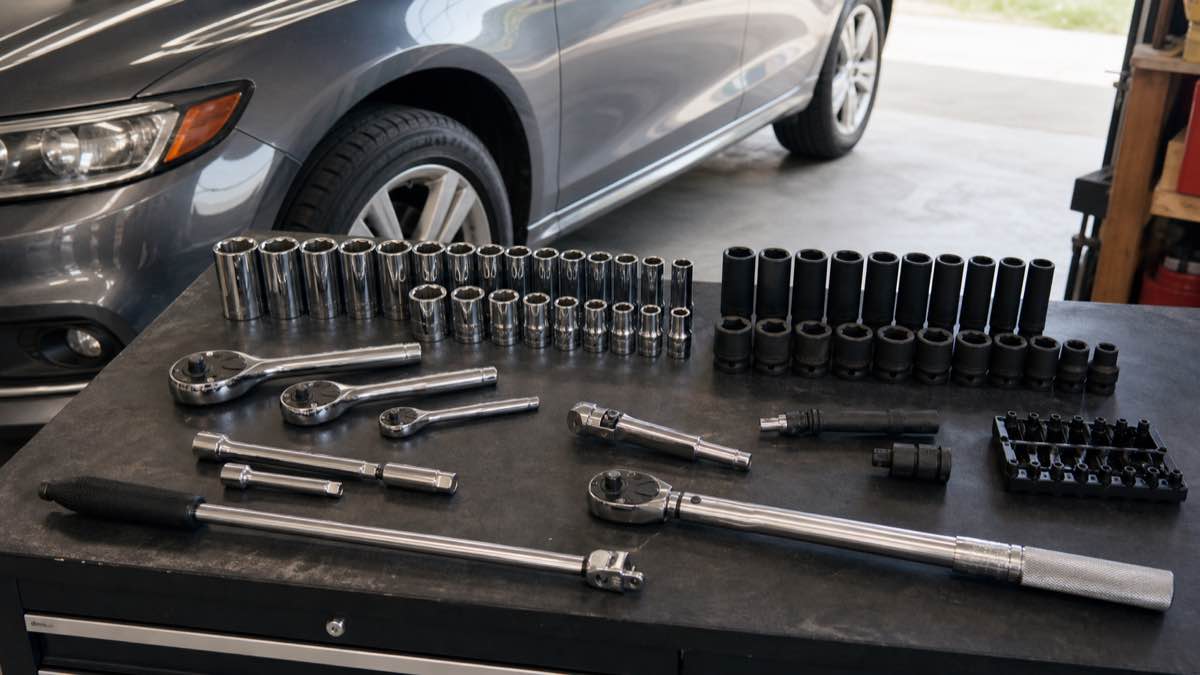
A useful socket set is not necessarily the box with the biggest piece count. For automotive work, coverage, fit, access, and safe torque handling matter far more than an impressive number on the label. A compact no-skip set can be more useful than a 200-piece kit padded with driver bits and duplicate sizes.
This socket set guide explains the choices that confuse first-time buyers: 1/4-, 3/8-, and 1/2-inch drive; metric versus SAE; shallow versus deep; 6-point versus 12-point; and chrome versus impact sockets. It also shows what a practical starter kit looks like for a US car owner without recommending a particular brand.
Quick Recommendation for a First Automotive Socket Set
For routine work on most modern passenger vehicles, start with a 3/8-inch-drive, 6-point metric set with shallow and deep sockets. Look for continuous coverage somewhere around 8 mm through 19 mm, a ratchet, two useful extensions, and a sturdy case. Exact fastener sizes vary by vehicle, so inspect your owner’s or service information before assuming any range is complete.
Add a 1/2-inch drive set when you plan to remove wheel fasteners or tackle higher-torque chassis work. Add a compact 1/4-inch drive set for small engine-bay fasteners, trim, clamps, and tight access. Many beginners eventually own all three, but a good 3/8-inch set usually provides the best first step.
| Drive size | Best use | Main limitation |
|---|---|---|
| 1/4 inch | Small fasteners, trim, clamps, tight spaces | Low torque capacity |
| 3/8 inch | General underhood and routine automotive work | Not ideal for the highest-torque fasteners |
| 1/2 inch | Wheel fasteners, larger bolts, breaker bars, impact tools | Bulkier in confined spaces |
| 3/4 inch | Heavy trucks and industrial equipment | Usually unnecessary for passenger-car DIY work |
Drive Size Is Not the Same as Socket Size
The drive size is the square connection between a ratchet, breaker bar, torque wrench, or impact wrench and the back of a socket. Socket size describes the opening that fits the fastener head. A 10 mm socket, for example, may be sold with a 1/4- or 3/8-inch square drive. The fastener is still 10 mm; only the tool connection changes.
Larger drives generally support larger tools and greater torque, but the rating depends on the specific tool and manufacturer. Do not rely on a generic internet torque limit. If the required torque approaches the rating of the ratchet, socket, adapter, or extension, move to equipment designed for that load.
Metric or SAE: Which Does Your Car Need?
Most late-model vehicles use predominantly metric fasteners, including many vehicles assembled in the United States. Older American vehicles, trailers, aftermarket accessories, household equipment, and some specialty components may use SAE fractional sizes. A mixed garage can therefore justify both systems even when the daily driver is metric.
Do not substitute a “close enough” SAE socket for a metric fastener, or vice versa. Some pairs feel similar when unloaded, but a loose fit concentrates force on the corners and can round the head. Read the stamped marking, clean dirt or rust from the fastener, and test the fit by hand before applying force.
Why No-Skip Coverage Matters
A no-skip set includes each size in its stated range instead of omitting less common sizes. Skipped sizes are one reason a large kit can fail in the middle of a simple job. For general automotive use, sizes such as 8, 10, 12, 13, 14, 15, 17, 18, and 19 mm appear often, but that list is not universal. Wheel-fastener sizes, spark-plug hex sizes, and suspension hardware vary widely.
Compare the printed size list rather than the total piece count. Treat screwdriver bits, hex keys, adapters, and duplicate sockets as accessories, not as proof of socket coverage. Replacement availability also matters: frequently used sockets can disappear, and buying one matching replacement is cheaper than replacing a set.
6-Point vs 12-Point Sockets
A 6-point socket contacts a standard hex fastener across broader areas near the flats. It is the safer default for automotive repair, especially on tight, corroded, or previously damaged fasteners. A 12-point socket offers twice as many engagement positions, which can help where the ratchet can move only a few degrees, and it is required for actual 12-point fasteners.
Do not use a 12-point socket merely because it slips onto a stubborn 6-point bolt more easily. Extra clearance can increase the chance of rounding. Start with a fully seated 6-point socket, keep the tool square to the fastener, and stop when the corners begin to deform.
Shallow vs Deep Sockets
Shallow, or standard-depth, sockets are compact and place the ratchet closer to the fastener. They fit more confined spaces and are usually the first choice when a bolt head is unobstructed. Deep sockets reach nuts on long studs and can clear protruding threads, recessed fasteners, and some spark-plug locations.
Deep sockets are not automatically better. Their extra length can prevent access, add leverage that makes the tool easier to tilt, and increase torsional movement under heavy load. A starter set benefits from both depths in common sizes, but use the shortest socket that reaches and seats fully.
Chrome Sockets vs Impact Sockets
Chrome hand sockets are intended for ratchets, breaker bars, and torque wrenches when the manufacturer approves those uses. Impact sockets are built for the repeated shock loads created by impact wrenches and impact drivers. They are commonly thicker, have a dark protective finish, and carry an impact rating or marking.
Never use a standard chrome socket on an impact tool. It can crack or fragment under impact loading. Use an impact-rated socket, extension, adapter, and universal joint throughout the power-tool connection. Wear eye protection and replace any socket that is cracked, mushroomed, heavily corroded, or visibly distorted.
Impact sockets can sometimes be used with hand tools, but their thicker walls may not fit recessed fasteners. A common garage setup uses chrome sockets for controlled hand work and a separate 1/2-inch impact set for wheel and chassis fasteners.
What Makes a Ratchet Useful?
Ratchet tooth count affects the minimum swing arc needed to engage the next tooth. A fine-tooth ratchet can work in a tighter space, but tooth count alone does not establish strength or quality. Head size, backdrag, handle comfort, selector design, sealing, serviceability, and the manufacturer’s torque rating also matter.
A quick-release button is convenient but not essential. A flex head improves access around obstacles, although it introduces another joint that must be controlled. For a first set, a conventional fixed-head ratchet from a company that sells repair kits or replacements is a sensible choice.
Accessories Worth Having
- Extensions: A short and medium extension solve more access problems than a pile of unusual sockets.
- Wobble extension or universal joint: Useful for slight angles, but not a substitute for correct alignment under high torque.
- Breaker bar: Designed to loosen tight fasteners without abusing a ratchet mechanism.
- Torque wrench: Used for final tightening to a verified specification; it is not a general-purpose breaker bar.
- Spark-plug socket: Must match the plug hex and access requirements of the specific engine.
- Socket organizer: Makes missing sizes obvious and keeps metric and SAE sockets separated.
Drive adapters are useful in light-duty situations, but an adapter does not magically give a smaller ratchet the capacity of a larger drive. Adapters and universal joints may also reduce the safe capacity of the system. Use a correctly sized drive tool for stubborn or highly torqued fasteners.
A Practical Starter Setup
Instead of buying everything at once, build around the jobs you genuinely expect to do:
- Start with a no-skip 3/8-inch-drive metric 6-point set, preferably with shallow and deep coverage.
- Add short and medium extensions plus a breaker bar rated for the work.
- Buy a torque wrench with a range that places your target specifications comfortably inside its operating range.
- Add a 1/2-inch impact-rated set only when wheel, brake, or suspension work makes it necessary.
- Add 1/4-inch-drive tools for small fasteners and tight access.
- Purchase SAE sockets after confirming that your vehicle, trailer, or other equipment actually uses them.
Before taking on a repair, decide whether the job fits your skill, workspace, and safety equipment. Owning the correct socket does not make a safety-critical procedure suitable for a beginner, and a service manual is more valuable than guessing from a fastener’s location.
Check These Details Before You Buy
- List three realistic jobs: Use those tasks to identify required sizes, depths, and drive tools instead of buying for hypothetical projects.
- Inspect your vehicle information: Confirm wheel-fastener size, spark-plug socket requirements, and any specialty fasteners in reliable service information.
- Read the actual size list: Verify that the metric or SAE range has no unexplained gaps and that deep sockets are not replacing shallow coverage.
- Check working space: A large ratchet and deep socket may not fit even when their size is technically correct.
- Separate removal from installation: Plan for a breaker bar or impact-rated removal setup and a suitable torque wrench for controlled final tightening.
- Confirm support equipment: Under-car work may also require rated stands, wheel chocks, lighting, gloves, and eye protection.
Do not buy sockets until you understand the problem you are trying to fix. If a puddle started the project, use the car leaking fluid color guide to record its appearance and location, then confirm the repair procedure before removing parts.
Socket Safety: Avoid Rounded Fasteners and Injuries
- Confirm the socket size and fully seat it before applying force.
- Use 6-point sockets on tight or corroded 6-point fasteners.
- Pull a breaker bar with controlled force when possible; avoid unstable body positions.
- Do not add a pipe to a ratchet handle unless the tool manufacturer explicitly permits it.
- Use a penetrating product and allow time to work on corroded hardware; keep it away from hot surfaces and ignition sources.
- Support a raised vehicle with appropriately rated stands at manufacturer-approved points. Never work under a vehicle supported only by a jack.
- Keep sockets square to the fastener and stop if the head begins to round.
- Use the vehicle manufacturer’s current torque specification for assembly.
A socket set does not replace diagnosis. For example, a warning light can point to a system without identifying the failed component. Read our check engine light guide before buying parts based only on a code or dashboard symbol.
Brake work deserves particular caution because tool access is only one part of the job. If braking performance changes or a warning appears, review the brake warning light guidance and arrange professional help when the system’s safety cannot be verified.
How to Judge Quality Without Chasing a Brand
Look for clearly stamped sizes, consistent machining, minimal wobble on the drive, a ratchet with low backdrag, and a case that holds every piece securely. Check whether the warranty covers individual components and whether replacements can be purchased separately. A lifetime promise is less useful when the process requires shipping an entire set or the brand cannot supply a missing 10 mm socket.
Inspect a new set before the return window closes. Test the ratchet direction selector, socket retention, extensions, and case. Remove excess packaging oil, but leave protective finishes intact. Store sockets dry, and wipe off road salt, brake dust, and moisture after use.
Frequently Asked Questions
Is a 3/8-inch socket set enough for car maintenance?
A 3/8-inch-drive metric set covers many routine underhood jobs and is the most versatile first purchase. It does not replace a 1/2-inch drive for higher-torque work or a 1/4-inch drive where access and fastener size demand smaller tools.
Do modern cars use metric or SAE sockets?
Most late-model passenger vehicles use mainly metric fasteners. Older vehicles, trailers, aftermarket parts, and other garage equipment may use SAE sizes. Verify the fastener instead of assuming based on vehicle brand or country of assembly.
Can I use impact sockets with a hand ratchet?
Often yes, provided the socket and ratchet fit correctly and their manufacturers permit the use. Impact sockets may have walls too thick for tight recesses. Never reverse the rule by using a standard chrome hand socket on an impact tool.
Should I buy deep or shallow sockets first?
Shallow sockets fit more confined spaces, while deep sockets reach nuts on long studs and recessed fasteners. For a first automotive set, shallow sockets plus deep coverage in commonly used sizes is more flexible than choosing only one depth.
Why are 6-point sockets better for automotive work?
Six-point sockets provide broad contact on standard hex fasteners and are less likely to round tight or corroded heads when correctly sized and fully seated. Use a 12-point socket when the fastener itself has 12 points or access genuinely requires it.
Can I tighten lug nuts with a regular ratchet?
A regular ratchet cannot confirm final torque. Start wheel fasteners by hand, snug them in the specified sequence, then use a suitable calibrated torque wrench and the vehicle manufacturer’s current specification. Recheck only when the manufacturer or service procedure calls for it.
Bottom Line
For most first-time automotive buyers, a no-skip 3/8-inch-drive metric 6-point set is the useful center of the toolbox. Add 1/4-inch tools for access and 1/2-inch tools for higher-torque work as real projects require them. Buy coverage and fit before piece count, keep chrome sockets off impact tools, and treat a torque wrench and safe vehicle support as essential equipment rather than optional upgrades.