
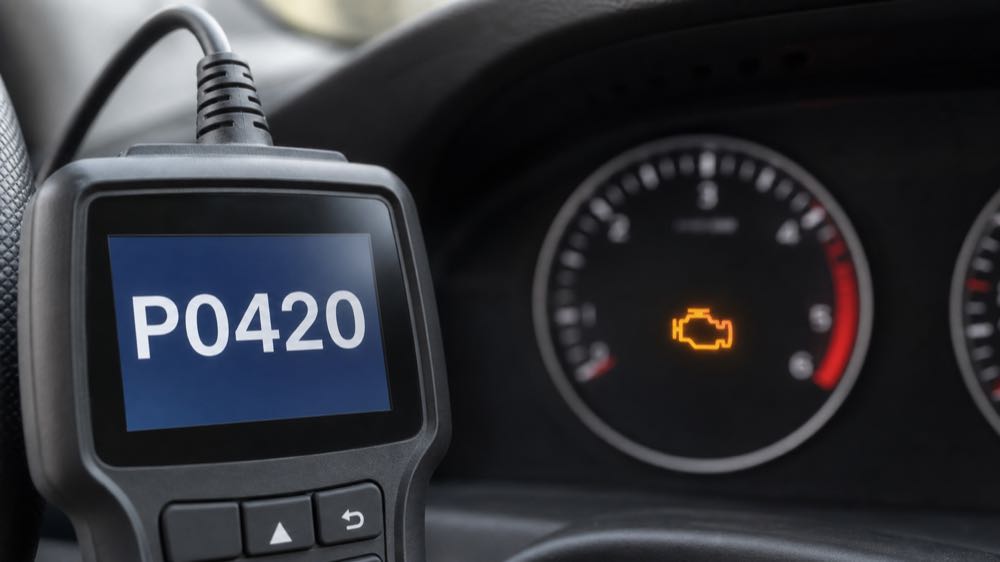
P0420 is an OBD2 diagnostic trouble code that means “catalyst system efficiency below threshold, bank 1.” In plain English, the engine computer thinks the catalytic converter on bank 1 is not cleaning exhaust gases as well as it should.
Many drivers see P0420 after the check engine light comes on. The code often points toward the catalytic converter, but that does not mean you should replace the converter first. Exhaust leaks, oxygen sensor data problems, misfires, fuel mixture issues, and engine running problems can also trigger or contribute to P0420.
This guide explains what P0420 means, how serious it is, common causes, what to check first, and when catalytic converter replacement makes sense.
P0420 Quick Facts
| Item | Details |
|---|---|
| Code | P0420 |
| Definition | Catalyst system efficiency below threshold, bank 1 |
| System | Emissions / exhaust aftertreatment |
| Common symptom | Check engine light on |
| Common mistake | Replacing the catalytic converter without diagnosis |
| Driving risk | Usually not immediate, but emissions and engine issues matter |
| Typical next step | Scan codes, check freeze frame data, inspect exhaust, review oxygen sensor data |
What P0420 Means
Your catalytic converter helps reduce harmful exhaust emissions. It works after combustion, using precious metals inside the converter to help change pollutants into less harmful gases.
The engine control module checks converter efficiency by comparing oxygen sensor signals. Most modern vehicles have an upstream oxygen sensor before the catalytic converter and a downstream oxygen sensor after it. The upstream sensor reacts quickly to changes in the air-fuel mixture. The downstream sensor should usually be steadier if the converter is storing oxygen and doing its job.
When the downstream sensor pattern looks too similar to the upstream sensor pattern, the computer may decide the converter is not working efficiently enough. If the test fails under the right conditions, it can store P0420 and turn on the check engine light.
What Does Bank 1 Mean?
Bank 1 is the side of the engine that contains cylinder number 1. On an inline four-cylinder engine, there is usually only one bank, so P0420 refers to the main catalytic converter system. On a V6 or V8, bank 1 is one side of the engine and bank 2 is the other side.
Do not guess bank location by standing in front of the car. Cylinder numbering varies by manufacturer. If you are diagnosing a V-style engine, use repair information for the exact vehicle before replacing parts.
Common Symptoms of P0420
Many P0420 cases have few noticeable symptoms. The vehicle may drive normally while the check engine light stays on.
Possible symptoms include:
- Check engine light on
- Failed emissions or smog test
- Slight loss of power
- Lower fuel economy
- Rotten egg smell from the exhaust
- Rattling noise from a damaged converter
- Other codes for misfire, fuel trim, or oxygen sensors
If the check engine light is flashing, that is a different level of urgency. A flashing light can mean a misfire that may damage the catalytic converter. In that case, read our guide on whether you can drive with the check engine light on and avoid continuing normal driving.
Can You Drive With a P0420 Code?
You can often drive short-term with a P0420 code if the vehicle runs normally and the check engine light is steady. However, you should not ignore it.
P0420 can cause an emissions test failure, and the underlying cause may get worse. If the converter is damaged by a rich condition, oil burning, coolant contamination, or repeated misfires, continuing to drive can make the repair more expensive.
Avoid long trips or heavy driving if the engine is running rough, fuel economy suddenly drops, the exhaust smells unusual, the converter rattles, or other codes are present.
Most Common Causes of P0420
Worn or Failing Catalytic Converter
A catalytic converter can lose efficiency with age, mileage, contamination, or overheating. If the converter substrate is damaged or the precious metal coating is no longer effective, P0420 may return even after other issues are fixed.
Converters often fail because something upstream hurt them. Misfires, rich running, oil consumption, coolant entering the exhaust, or poor fuel control can shorten converter life. That is why diagnosis should look beyond the converter itself.
Exhaust Leak Before or Near the Converter
An exhaust leak can let extra oxygen into the exhaust stream and confuse oxygen sensor readings. Leaks near the manifold, flex pipe, flange, gasket, or sensor bung can contribute to false efficiency readings.
Before replacing expensive parts, inspect for ticking noises, soot marks, broken studs, cracked pipes, loose flanges, and leaks ahead of the downstream oxygen sensor.
Oxygen Sensor Problem
A lazy or inaccurate oxygen sensor can affect catalyst monitor results. The downstream oxygen sensor is especially important because the computer uses it to judge converter performance.
That said, P0420 is not automatically an oxygen sensor code. A sensor can be blamed too quickly, just like the catalytic converter can. Live data, sensor response, heater codes, and related fuel trim information all matter.
Engine Misfire
Misfires send unburned fuel into the exhaust. That fuel can overheat and damage the catalytic converter. If you have misfire codes such as P0300, P0301, P0302, or rough running, address those first.
Replacing a converter while the engine is still misfiring can destroy the new converter.
Rich or Lean Fuel Mixture
Fuel mixture problems can trigger catalyst efficiency faults. A rich condition can overheat the converter. A lean condition can affect exhaust oxygen readings and engine performance.
Fuel trim data helps here. Large positive fuel trims may suggest a vacuum leak, weak fuel delivery, or unmetered air. Large negative fuel trims may suggest too much fuel, leaking injectors, or sensor issues.
Oil or Coolant Contamination
An engine that burns oil or leaks coolant into the combustion chamber can contaminate the converter. Blue smoke, coolant loss, white exhaust smoke, or repeated fouled spark plugs are warning signs.
Converter replacement will not hold up if the engine is still feeding oil or coolant into the exhaust.
Aftermarket or Low-Quality Converter
Some replacement catalytic converters do not meet the same efficiency expectations as the original equipment converter, especially on vehicles with sensitive catalyst monitors. In emissions-regulated states, converter type and compliance matter.
If P0420 appeared after converter replacement, confirm the correct part was installed and that there are no exhaust leaks.
Diagnostic Order: What to Check Before Replacing Parts
The best way to approach P0420 is to move from simple and cheap checks to expensive parts.
- Confirm the code with an OBD2 scanner.
- Check for other codes, especially misfire, oxygen sensor, fuel trim, and coolant temperature codes.
- Review freeze frame data to see when the code set.
- Inspect for exhaust leaks before and near the converter.
- Check engine running condition, fuel trims, and misfire counters.
- Review upstream and downstream oxygen sensor live data.
- Check for oil burning, coolant loss, or fuel mixture problems.
- Consider catalytic converter testing or replacement only after upstream causes are addressed.
This order helps prevent the classic mistake: installing a new converter, then watching the P0420 code return because the real cause was a misfire, leak, or fuel-control problem.
How a Mechanic May Diagnose P0420
A technician may use a scan tool to look at live data, catalyst monitor status, fuel trims, oxygen sensor switching, and freeze frame information. They may also inspect the exhaust system, check for leaks, verify engine temperature, look for misfire history, and compare upstream and downstream oxygen sensor patterns.
In some cases, a temperature check before and after the converter, scope testing, or manufacturer-specific monitor data may be used. The exact method depends on the vehicle and the equipment available.
How Much Does P0420 Cost to Fix?
P0420 repair cost depends on the actual cause.
| Possible repair | Typical cost range |
|---|---|
| Diagnostic scan and inspection | $75-$180 |
| Exhaust leak repair | $100-$600+ |
| Oxygen sensor replacement | $150-$500+ |
| Misfire repair | $100-$1,000+ depending on cause |
| Catalytic converter replacement | $800-$2,500+ |
| OEM converter on some vehicles | $1,500-$4,000+ |
These are general U.S. ranges. Luxury vehicles, trucks, California-compliant converters, and difficult labor access can cost more.
Can You Clear P0420 and See If It Comes Back?
Clearing the code may turn off the check engine light temporarily, but it does not fix anything. The catalyst monitor has to run again under specific conditions. If the problem is still present, P0420 will usually return after enough driving.
Clearing codes right before an emissions test can also backfire because readiness monitors may show “not ready.” Many emissions programs check both trouble codes and monitor readiness.
Preventing P0420 From Coming Back
The best prevention is keeping the engine healthy. Fix misfires quickly, repair fuel mixture problems, do not ignore oxygen sensor or coolant temperature codes, and address oil or coolant consumption before it damages the converter.
If you replace the converter, make sure the upstream problem is fixed first. A new converter is expensive, and it should not be used as a bandage for an engine that is running poorly.
FAQ
What does code P0420 mean?
P0420 means catalyst system efficiency below threshold on bank 1. The engine computer believes the catalytic converter is not cleaning exhaust gases as effectively as expected.
Is P0420 always a bad catalytic converter?
No. A worn catalytic converter is common, but exhaust leaks, oxygen sensor issues, misfires, fuel mixture problems, oil burning, or coolant contamination can also cause or contribute to P0420.
Can I drive with a P0420 code?
You can often drive short-term if the engine runs normally and the check engine light is steady. Do not ignore it, especially if the vehicle runs rough, smells unusual, or has other codes.
Will P0420 fail emissions?
Usually, yes. An active check engine light or catalyst efficiency code can cause an emissions or smog test failure. Readiness monitors also need to be complete.
Can a bad oxygen sensor cause P0420?
Yes, an oxygen sensor problem can contribute to P0420, but the code does not automatically mean the sensor is bad. Live data and related codes should be checked first.
Should I replace the catalytic converter first?
Usually, no. Check for exhaust leaks, misfires, fuel trim problems, oil or coolant contamination, and oxygen sensor data before replacing the converter.