
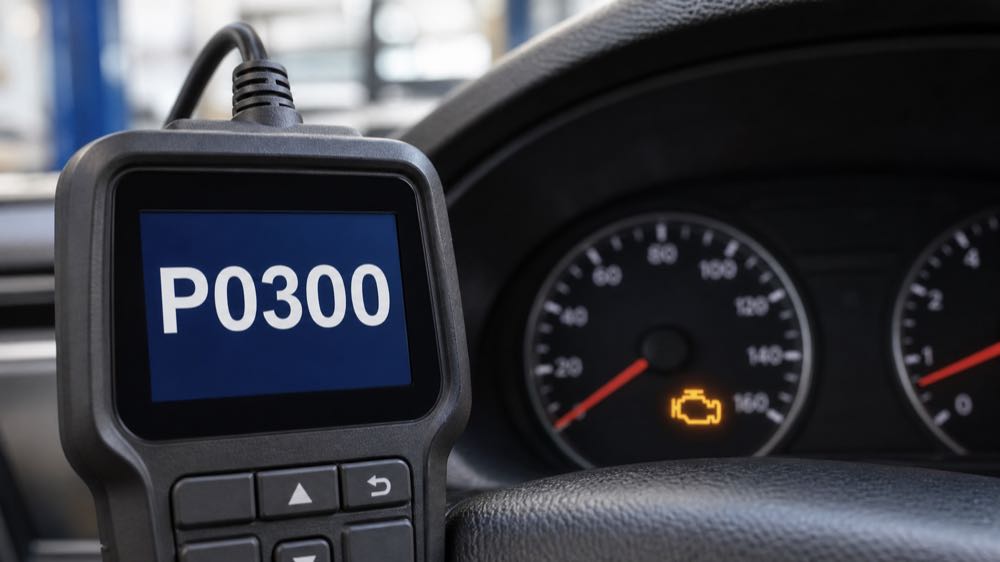
P0300 is an OBD2 diagnostic trouble code that means random or multiple cylinder misfire detected. In plain English, the engine computer has detected misfires, but it cannot point to only one cylinder with confidence. The misfire may move between cylinders, affect several cylinders at once, or happen under certain driving conditions.
You will usually see P0300 after the check engine light comes on. If the check engine light is flashing, the situation is more urgent because raw fuel can overheat and damage the catalytic converter. A steady light gives you more room to diagnose, but P0300 should still be taken seriously.
The mistake many drivers make is replacing spark plugs or ignition coils immediately. Those parts can cause P0300, but a random misfire can also come from vacuum leaks, low fuel pressure, dirty airflow readings, injector problems, timing issues, or mechanical engine problems.
P0300 Quick Facts
| Item | Details |
|---|---|
| Code | P0300 |
| Definition | Random or multiple cylinder misfire detected |
| System | Ignition, fuel, air, or mechanical engine operation |
| Common symptom | Rough idle, shaking, hesitation, check engine light |
| Severity | Medium to high depending on symptoms |
| Biggest risk | Catalytic converter damage if driven with active misfires |
| Best first step | Scan all codes and check freeze frame data |
What P0300 Means
A misfire happens when a cylinder does not burn the air-fuel mixture correctly. The engine control module watches crankshaft speed and other sensor data to detect uneven combustion. If one cylinder misfires consistently, the computer may set a code like P0301, P0302, P0303, or P0304. The last digit often identifies the cylinder.
P0300 is different. It means the misfire is random, affects multiple cylinders, or is not isolated cleanly enough for a single-cylinder code. That makes diagnosis broader.
Random misfires often point to something shared across cylinders. Examples include unmetered air from a vacuum leak, low fuel pressure, bad fuel, an airflow sensor issue, incorrect fuel trim, a weak ignition supply, or a timing/sensor problem.
Common Symptoms of P0300
P0300 symptoms can be mild or obvious depending on how often the misfire happens.
- Check engine light on
- Flashing check engine light
- Rough idle
- Engine shaking
- Hesitation during acceleration
- Poor fuel economy
- Fuel smell from the exhaust
- Hard starting
- Loss of power
- Failed emissions test
If the engine is shaking badly or the check engine light is flashing, reduce driving and diagnose it quickly. A flashing light is covered in more detail in our flashing check engine light guide.
Can You Drive With a P0300 Code?
You may be able to drive a short distance with a steady check engine light if the vehicle runs smoothly. But if the engine is shaking, power is reduced, the exhaust smells like fuel, or the light is flashing, avoid normal driving.
Driving with an active misfire can send unburned fuel into the exhaust. That can overheat the catalytic converter and lead to expensive damage. A damaged converter may later trigger codes such as P0420.
The safer rule is simple: steady light and mild symptoms means schedule diagnosis soon; flashing light or rough running means stop driving normally.
Common Causes of P0300
Worn Spark Plugs
Spark plugs ignite the air-fuel mixture. Worn plugs, incorrect gap, oil fouling, or wrong plug type can cause weak or inconsistent combustion. If plugs are overdue, they are a reasonable inspection point.
However, spark plugs are not the only answer. If multiple plugs are fouled, the root cause may be oil consumption, rich running, or another engine condition.
Ignition Coil or Ignition System Problem
Ignition coils create the high voltage needed for spark. One weak coil may set a cylinder-specific code, but several weak coils, poor ignition power, bad grounds, or moisture intrusion can contribute to random misfires.
Coil-on-plug vehicles often require testing instead of guessing. Swapping coils can help when a single cylinder is involved, but P0300 may need broader live data and misfire counter review.
Vacuum Leak
A vacuum leak lets unmetered air enter the engine. That can create a lean mixture and cause random misfires, especially at idle. Common leak points include intake boots, vacuum hoses, PCV hoses, intake manifold gaskets, and brake booster hoses.
Fuel trim data can help here. Large positive fuel trims often suggest the computer is adding fuel to compensate for extra air.
Low Fuel Pressure
If the fuel pump, filter, regulator, or fuel supply cannot deliver enough fuel, multiple cylinders can misfire. Low fuel pressure may feel worse under load, during acceleration, or at higher speeds.
Fuel pressure testing is important because a weak pump may not set a direct fuel pump code.
Dirty or Faulty Fuel Injectors
Fuel injectors can clog, leak, or spray poorly. One bad injector may cause a cylinder-specific misfire, while dirty fuel, multiple weak injectors, or fuel quality problems can create random misfire behavior.
Injector diagnosis may involve balance testing, listening tests, scan data, and fuel trim review.
Mass Airflow Sensor Problem
The mass airflow sensor measures how much air enters the engine. If it reads incorrectly because of dirt, contamination, wiring issues, or sensor failure, the computer may calculate the wrong fuel amount.
That can cause hesitation, rough idle, lean or rich fuel trims, and P0300.
Crankshaft or Camshaft Sensor Issue
The engine computer depends on crankshaft and camshaft position signals to manage timing and detect misfires. A weak or erratic signal can cause misfire codes, stalling, hard starts, or timing-related symptoms.
Sensor issues may also set separate codes, but not always at first.
Mechanical Engine Problem
Low compression, valve sealing problems, timing chain issues, head gasket problems, or worn engine components can cause misfires. Mechanical issues become more likely when ignition, fuel, and air checks do not explain the problem.
A compression test or leak-down test can help confirm whether the engine itself is healthy.
Diagnostic Order: What to Check First
The best P0300 diagnosis starts with data, not random parts.
- Confirm P0300 with an OBD2 scanner.
- Check for other codes, including fuel trim, oxygen sensor, crank sensor, cam sensor, and cylinder-specific misfire codes.
- Review freeze frame data to see engine speed, load, coolant temperature, and driving conditions when the code set.
- Check whether the check engine light is steady or flashing.
- Inspect spark plugs, ignition coils, and ignition wiring if applicable.
- Look for vacuum leaks and intake air leaks.
- Review fuel trim and live data.
- Test fuel pressure if symptoms point to fuel starvation.
- Check injector operation when ignition and air checks do not explain it.
- Consider compression or mechanical testing if the misfire remains unexplained.
This order helps avoid replacing plugs, coils, sensors, and injectors without knowing which system is actually failing.
P0300 vs P0301, P0302, P0303, and P0304
P0300 means random or multiple cylinder misfire. Codes like P0301, P0302, P0303, and P0304 point to a specific cylinder. For example, P0301 usually means cylinder 1 misfire detected.
If P0300 appears with a cylinder-specific code, start with the specific cylinder but still look for shared causes. A vacuum leak, low fuel pressure, or sensor problem can set both random and cylinder-specific misfire codes.
How Much Does P0300 Cost to Fix?
P0300 repair cost depends on the cause. Diagnosis matters because the code covers several systems.
| Possible repair | Typical U.S. cost range |
|---|---|
| Diagnostic scan and inspection | $75-$180 |
| Spark plugs | $150-$500+ |
| Ignition coil replacement | $120-$450+ per coil or set |
| Vacuum leak repair | $100-$700+ |
| Fuel injector service or replacement | $150-$1,000+ |
| Fuel pump replacement | $500-$1,200+ |
| MAF sensor replacement | $150-$450+ |
| Compression/mechanical repair | $500-$3,000+ |
These ranges vary by vehicle, engine layout, parts quality, and labor access. A V6 or V8 may cost more than a simple four-cylinder engine.
What Not to Do
Do not keep driving with a flashing check engine light. Do not replace the catalytic converter because the car smells rich without fixing the misfire. Do not replace every coil, sensor, and injector before checking codes and live data.
P0300 is a clue, not a parts list. The goal is to find why combustion is unstable.
FAQ
What does code P0300 mean?
P0300 means random or multiple cylinder misfire detected. The engine computer sees misfires but cannot isolate the problem to only one cylinder.
Is P0300 serious?
It can be serious. A steady check engine light with mild symptoms should be diagnosed soon. A flashing check engine light or rough-running engine can damage the catalytic converter and should be handled quickly.
Can I drive with a P0300 code?
You may be able to drive a short distance if the engine runs smoothly and the light is steady. Avoid normal driving if the engine shakes, loses power, smells like fuel, or the check engine light flashes.
What is the most common cause of P0300?
Common causes include worn spark plugs, ignition coil problems, vacuum leaks, low fuel pressure, injector issues, mass airflow sensor problems, and mechanical engine problems.
Can bad gas cause P0300?
Yes, contaminated or poor-quality fuel can cause random misfires. If the problem started right after refueling, fuel quality should be considered, but other causes still need diagnosis.
Can P0300 damage the catalytic converter?
Yes. Active misfires can send unburned fuel into the exhaust and overheat the catalytic converter. That can lead to expensive converter damage and codes such as P0420.