
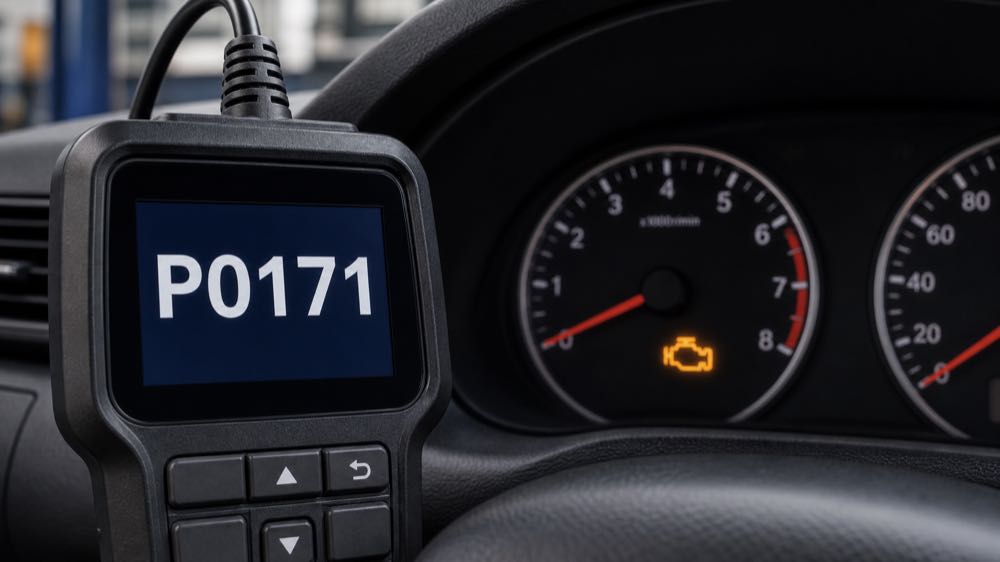
P0171 is an OBD2 diagnostic trouble code that means “system too lean, bank 1.” In simple terms, the engine computer believes there is too much air or not enough fuel in the air-fuel mixture on bank 1.
Most drivers notice P0171 after the check engine light comes on. The vehicle may still drive, but it can idle rough, hesitate, lose power, or use more fuel. A lean condition can also contribute to misfires and long-term engine or catalytic converter problems if ignored.
The important point is this: P0171 does not automatically mean the oxygen sensor is bad. The oxygen sensor often reports the lean condition; it does not always cause it. Vacuum leaks, intake leaks, dirty MAF readings, low fuel pressure, and fuel delivery problems are common places to start.
P0171 Quick Facts
| Item | Details |
|---|---|
| Code | P0171 |
| Definition | System too lean, bank 1 |
| System | Air-fuel mixture / fuel control |
| Common symptom | Check engine light, rough idle, hesitation |
| Common mistake | Replacing the oxygen sensor before checking for air leaks |
| Severity | Medium; higher if rough running or misfires are present |
| Best first step | Check fuel trims, intake leaks, MAF data, and related codes |
What P0171 Means
An engine needs the right balance of air and fuel. If there is too much air or not enough fuel, the mixture is called lean. The engine control module uses oxygen sensor feedback to adjust the mixture. These adjustments are shown as fuel trims.
Short term fuel trim changes quickly as the computer reacts in the moment. Long term fuel trim is the computer’s learned correction over time. When fuel trims stay too positive, the computer is adding fuel to compensate for a lean condition. If the correction is beyond the expected range, P0171 can set.
Bank 1 means the side of the engine that contains cylinder number 1. On most four-cylinder engines, there is only one bank. On V6 and V8 engines, bank location depends on the manufacturer.
Common Symptoms of P0171
P0171 symptoms depend on how lean the engine is and when the problem happens.
- Check engine light on
- Rough idle
- Hesitation during acceleration
- Surging idle
- Hard starting
- Stalling at stops
- Poor fuel economy
- Whistling or hissing sound from the intake area
- Misfire codes such as P0300
- Failed emissions test
Some vehicles drive almost normally with P0171, especially early in the problem. That does not mean the code should be ignored.
Can You Drive With a P0171 Code?
You may be able to drive short-term with P0171 if the check engine light is steady and the vehicle runs smoothly. But you should diagnose it soon.
Avoid normal driving if the engine is shaking, stalling, hesitating badly, overheating, or showing a flashing check engine light. A lean condition can create misfires, and active misfires can damage the catalytic converter. If poor running continues, converter-efficiency codes such as P0420 can appear later.
The safest approach is to treat P0171 as a warning that the engine’s fuel control is out of range.
Common Causes of P0171
Vacuum Leak
A vacuum leak is one of the most common causes of P0171. It allows unmetered air to enter the engine after the air has already passed the mass airflow sensor. The computer does not fully account for that extra air, so the mixture goes lean.
Common leak points include vacuum hoses, PCV hoses, intake manifold gaskets, brake booster hoses, EVAP lines, and cracked plastic fittings.
Cracked Intake Boot or Loose Clamp
The intake boot between the air filter box, MAF sensor, and throttle body can crack with age. A loose clamp or split boot can let extra air enter. This is a simple visual check that can save a lot of guesswork.
Small cracks may open only when the engine moves under load, so inspect the boot carefully.
Dirty or Faulty MAF Sensor
The mass airflow sensor measures how much air enters the engine. If it underreports airflow because it is dirty or failing, the computer may command too little fuel. That can trigger P0171.
MAF-related lean problems often show up with hesitation, poor throttle response, or fuel trims that change with engine load. Cleaning may help if the sensor is contaminated, but only use MAF-safe cleaner.
Low Fuel Pressure
If the fuel pump, fuel filter, pressure regulator, or fuel supply cannot deliver enough fuel, the engine may run lean. Low fuel pressure often becomes more noticeable during acceleration or highway driving when the engine needs more fuel.
Fuel pressure testing is important because a weak pump may not always set a separate code.
Clogged or Weak Fuel Injector
A clogged injector can make one or more cylinders run lean. If the issue affects enough cylinders on bank 1, P0171 may set. Injector problems may also create misfire codes, rough idle, or hesitation.
Diagnosis may include injector balance testing, listening tests, scan data, or fuel trim analysis.
Exhaust Leak Before the Oxygen Sensor
An exhaust leak before or near the upstream oxygen sensor can let outside air into the exhaust. That extra oxygen can make the sensor report a lean condition even if the engine mixture is not truly lean.
Look for ticking noises, soot marks, cracked manifolds, loose flanges, or damaged gaskets.
Oxygen Sensor Issue
An oxygen sensor can fail or report inaccurately, but it should not be the first part replaced just because P0171 is present. The sensor may be correctly reporting a lean condition caused by an air leak or fuel problem.
Oxygen sensor diagnosis should include live data, response behavior, heater circuit codes, and fuel trim context.
Fuel Trim Clues That Help Diagnosis
Fuel trim behavior can point you in the right direction.
| Pattern | What it may suggest |
|---|---|
| High positive trims mostly at idle | Vacuum leak or intake leak |
| High positive trims under load | Low fuel pressure, weak pump, restricted fuel flow, MAF issue |
| Both banks lean on a V engine | Shared air leak, MAF problem, low fuel pressure |
| Only bank 1 lean | Bank-specific intake leak, exhaust leak, injector issue, or sensor issue |
| Lean code plus misfire codes | Diagnose misfire and lean condition together |
These patterns are clues, not final proof. They help decide what to test next.
Diagnostic Order: What to Check First
The best P0171 diagnosis moves from common and inexpensive checks to more complex testing.
- Confirm P0171 with an OBD2 scanner.
- Check for other codes, especially misfire, MAF, oxygen sensor, EVAP, or fuel pressure-related codes.
- Review freeze frame data to see when the code set.
- Check short term and long term fuel trims at idle and under load.
- Inspect intake boots, vacuum hoses, PCV hoses, and clamps.
- Listen for hissing and inspect for obvious air leaks.
- Check MAF sensor readings and clean only if contamination is likely.
- Test fuel pressure if trims worsen under load.
- Inspect for exhaust leaks before the upstream oxygen sensor.
- Consider oxygen sensor or mechanical testing only after air and fuel checks.
This order helps avoid the classic mistake of replacing the upstream oxygen sensor while the real problem is a cracked hose or weak fuel pump.
P0171 vs P0174
P0171 means system too lean on bank 1. P0174 means system too lean on bank 2. On a four-cylinder engine, you may only see P0171 because there is usually one bank. On a V6 or V8, seeing P0171 and P0174 together often points to a shared problem such as a MAF sensor issue, large vacuum leak, or low fuel pressure.
If only P0171 is present on a V engine, look more closely at bank 1 intake leaks, bank 1 exhaust leaks, bank 1 injector problems, or bank-specific sensor data.
How Much Does P0171 Cost to Fix?
P0171 repair cost depends on what is causing the lean condition.
| Possible repair | Typical U.S. cost range |
|---|---|
| Diagnostic scan and inspection | $75-$180 |
| Vacuum hose or PCV hose repair | $50-$300+ |
| Intake boot replacement | $75-$350+ |
| MAF sensor cleaning | $20-$80 |
| MAF sensor replacement | $150-$500+ |
| Fuel pressure diagnosis or fuel filter | $100-$400+ |
| Fuel pump replacement | $500-$1,200+ |
| Oxygen sensor replacement | $150-$500+ |
| Intake manifold gasket repair | $300-$1,000+ |
These are general ranges. Vehicle layout, parts quality, and labor access can change the cost.
What Not to Do
Do not replace the oxygen sensor first without checking fuel trims and intake leaks. Do not ignore rough running because a lean engine can misfire. Do not clear the code right before an emissions test and assume the vehicle is fixed.
P0171 is a fuel-control clue. The repair depends on why the engine is lean.
FAQ
What does code P0171 mean?
P0171 means system too lean on bank 1. The engine computer is adding fuel because it believes there is too much air or not enough fuel in the mixture.
Is P0171 usually an oxygen sensor?
Not usually. The oxygen sensor often reports the lean condition. Vacuum leaks, intake leaks, MAF sensor problems, low fuel pressure, and fuel delivery issues should be checked first.
Can I drive with a P0171 code?
You may be able to drive short-term if the engine runs smoothly and the check engine light is steady. Diagnose it soon, and avoid normal driving if the engine misfires, stalls, or hesitates badly.
Can a vacuum leak cause P0171?
Yes. A vacuum leak is one of the most common causes. It lets unmetered air enter the engine, which can make the mixture too lean.
Can P0171 cause a misfire?
Yes. A lean mixture can cause rough running and misfires. If random misfire code P0300 appears with P0171, diagnose both together.
Will P0171 fail emissions?
Usually, yes. An active check engine light or lean fuel-control code can cause an emissions test failure, and readiness monitors must also be complete.