
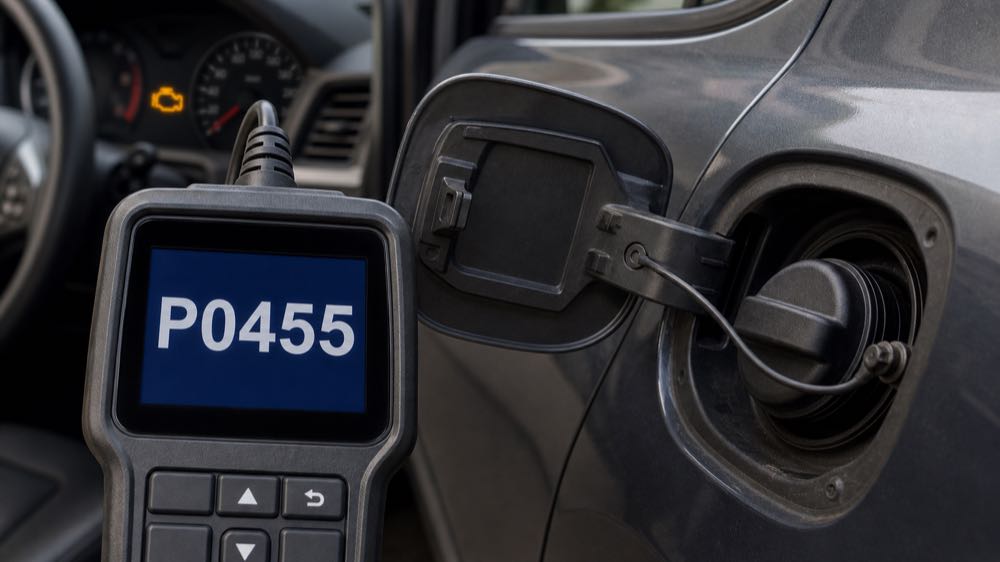
P0455 is an OBD2 diagnostic trouble code that means the evaporative emission system has detected a large leak. You may also see it described as “EVAP system leak detected, gross leak.” In plain English, the vehicle cannot seal the fuel vapor system during its self-test.
Many drivers see P0455 after the check engine light comes on, even though the car seems to drive normally. That is common because the EVAP system controls fuel vapors, not basic engine power. A loose gas cap can cause P0455, but so can a cracked hose, stuck vent valve, purge valve problem, damaged fuel filler neck, leaking canister, or fuel tank pressure sensor issue.
The right first step is not panic. Check the gas cap and fuel filler area first, then diagnose the EVAP system if the code returns.
What P0455 Means
The EVAP system keeps fuel vapors from escaping into the air. Fuel vapor from the tank is stored in a charcoal canister and later pulled into the engine to be burned. To check itself, the system seals parts of the vapor circuit and watches pressure or vacuum changes.
When the computer sees a leak large enough that the system cannot hold pressure or vacuum, it can store P0455. A large leak may be as simple as a loose gas cap, or it may be a broken hose or valve that prevents the system from sealing.
P0455 is different from small leak codes such as P0442. A large leak usually means the opening is big enough for the test to fail clearly.
P0455 Quick Triage
| What you notice | What it may mean | What to do |
|---|---|---|
| Code appeared after refueling | Gas cap loose, damaged, or not sealing | Tighten cap until it clicks and inspect seal |
| Fuel smell near rear of vehicle | Vapor leak or fuel system issue possible | Avoid open flames and inspect soon |
| Car drives normally | EVAP fault may not affect drivability | Diagnose before emissions test |
| Code returns after clearing | Leak or valve fault still present | Smoke test or scan-tool diagnosis |
| P0455 plus other EVAP codes | Valve, sensor, wiring, or canister issue possible | Diagnose codes together |
Common Symptoms of P0455
P0455 often has few obvious symptoms.
- Check engine light on
- Fuel smell around the vehicle
- Loose or missing gas cap
- Failed emissions or smog test
- Slight fuel odor after parking
- Other EVAP codes such as P0440, P0442, P0446, or P0456
The engine may idle and accelerate normally. That is why many drivers ignore it until inspection time. But if you smell fuel strongly, treat it as a safety issue.
Can You Drive With a P0455 Code?
You can usually drive with P0455 if the vehicle runs normally and there is no strong fuel smell or visible fuel leak. The code is usually emissions-related, not an immediate engine-damage warning.
Still, do not ignore it for weeks. P0455 can cause an emissions test failure, and fuel vapor leaks should be repaired. If you smell raw fuel, see wet fuel, or notice the odor getting stronger, park safely and have the vehicle inspected.
First Check: Gas Cap and Fuel Filler Area
Before paying for diagnosis, check the gas cap.
- Turn the engine off.
- Remove the gas cap.
- Inspect the rubber seal for cracks, flattening, dirt, or missing pieces.
- Inspect the fuel filler neck for rust, dents, dirt, or damage.
- Reinstall the cap until it clicks.
- Drive normally for several trips and see whether the code returns after monitors run.
If the gas cap is missing, loose, aftermarket, or visibly damaged, replacing it with the correct cap may fix the issue. But do not assume the cap is the answer if the code returns.
Common Causes of P0455
Loose, Missing, or Bad Gas Cap
A loose gas cap is the classic P0455 cause. If the cap cannot seal, the EVAP system may fail its leak test. The seal can also harden with age, crack, or collect dirt.
Some vehicles are sensitive to aftermarket caps, so the correct replacement matters.
Damaged Fuel Filler Neck
The fuel filler neck is where the gas cap seals. Rust, dents, cracked metal, damaged threads, or debris can prevent a good seal. This is especially common in areas with road salt or older vehicles.
Cracked EVAP Hose or Vapor Line
EVAP hoses carry fuel vapor between the tank, charcoal canister, purge valve, and vent valve. Rubber hoses can crack, plastic lines can break, and connections can loosen.
Because many EVAP lines are under the vehicle, a visual inspection may miss small or hidden leaks.
Stuck Open Vent Valve
The vent valve allows fresh air into the EVAP system at certain times and closes during leak testing. If it sticks open, the system cannot seal, which can trigger P0455.
Vent valve problems can be caused by dust, dirt, moisture, road debris, or internal failure.
Purge Valve Problem
The purge valve controls when fuel vapors are drawn into the engine. If it sticks open or does not seal when commanded, it can interfere with EVAP testing. A purge valve issue may also cause rough starts after refueling on some vehicles.
Purge valve diagnosis should be based on command tests, vacuum behavior, and scan-tool data rather than guessing.
Charcoal Canister Damage
The charcoal canister stores fuel vapor. It can crack, become saturated, or be damaged by overfilling the fuel tank. Topping off after the pump clicks can push liquid fuel into parts of the EVAP system that are meant for vapor.
Fuel Tank Pressure Sensor Issue
The fuel tank pressure sensor helps the computer monitor EVAP pressure or vacuum. If the sensor reads incorrectly, the system may think there is a leak or may fail to complete testing properly.
Sensor faults often need scan-tool data to diagnose.
How a Smoke Test Finds EVAP Leaks
An EVAP smoke test uses low-pressure smoke to fill the vapor system so leaks become visible. A technician may command the vent valve closed, seal the system, and watch for smoke escaping from hoses, the filler neck, the canister, valves, or connections.
Smoke testing is useful because EVAP leaks can be small, hidden, or located under the vehicle. For P0455, the leak is usually large enough that smoke testing can be very effective.
Do not use unsafe homemade methods near fuel vapors. EVAP diagnosis should use equipment designed for low pressure and fuel-vapor safety.
P0455 vs Engine Vacuum Leak
P0455 is an EVAP leak code. It does not automatically mean the engine has an intake vacuum leak.
That matters because lean-condition codes such as P0171 involve air-fuel mixture and fuel trims. P0455 involves the fuel vapor control system. A purge valve stuck open can sometimes affect engine behavior, but most EVAP leaks are not the same thing as an intake leak.
Diagnostic Order: What to Check First
Use this order to avoid random parts replacement.
- Confirm P0455 with an OBD2 scanner.
- Check for other EVAP codes and freeze frame data.
- Inspect and tighten the gas cap.
- Inspect the gas cap seal and fuel filler neck.
- Look for obvious cracked hoses or disconnected vapor lines.
- Check for fuel smell or visible fuel leaks.
- Test purge valve and vent valve operation if the cap area is good.
- Use a smoke test to locate leaks.
- Check fuel tank pressure sensor data if the system appears sealed.
This approach starts with the simple parts, then moves into proper EVAP testing.
How Much Does P0455 Cost to Fix?
P0455 repair cost depends on what is leaking or failing.
| Possible repair | Typical U.S. cost range |
|---|---|
| Tighten gas cap | Free |
| Replace gas cap | $15-$60 |
| Diagnostic scan and smoke test | $100-$250 |
| EVAP hose repair | $75-$400+ |
| Purge valve replacement | $120-$400+ |
| Vent valve replacement | $150-$500+ |
| Fuel filler neck repair | $200-$800+ |
| Charcoal canister replacement | $300-$900+ |
| Fuel tank pressure sensor | $150-$600+ |
Costs vary by vehicle and access. Some EVAP parts are easy to reach, while others are tucked near the tank or underbody.
Clearing P0455 and Emissions Readiness
Clearing the code may turn off the check engine light, but it does not fix the leak. The EVAP monitor has to run again under specific conditions, usually involving fuel level, temperature, and drive cycle requirements.
If you clear the code right before an emissions test, the vehicle may fail or be rejected because monitors are not ready. Fix the cause, then allow the readiness monitor to complete.
What Not to Do
Do not keep replacing EVAP valves without testing. Do not ignore a strong fuel smell. Do not top off the fuel tank after the pump clicks. Do not assume a new gas cap fixed the problem until the EVAP monitor runs and the code stays away.
P0455 is usually fixable without major engine repair, but guessing can turn a small emissions problem into a parts bill.
FAQ
What does code P0455 mean?
P0455 means the EVAP system has detected a large leak. The vehicle cannot seal the fuel vapor system during its self-test.
Is P0455 usually a gas cap?
A loose, missing, or damaged gas cap is a common cause, especially if the code appeared after refueling. But cracked hoses, vent valves, purge valves, filler neck problems, and canister issues can also cause P0455.
Can I drive with a P0455 code?
You can usually drive if the car runs normally and there is no strong fuel smell or visible fuel leak. Repair it before emissions testing and inspect soon if fuel odor is present.
Will P0455 fail emissions?
Usually, yes. An active check engine light or EVAP large leak code can cause an emissions test failure. Readiness monitors also need to be complete.
How long does it take for P0455 to clear after tightening the gas cap?
It may take several drive cycles for the EVAP monitor to run and the light to turn off, depending on the vehicle. If the code returns, the leak is still present or another EVAP part is failing.
Can overfilling the gas tank cause EVAP problems?
Yes. Topping off after the pump clicks can push liquid fuel into EVAP components that are designed for vapor, potentially damaging the charcoal canister or causing EVAP faults.