
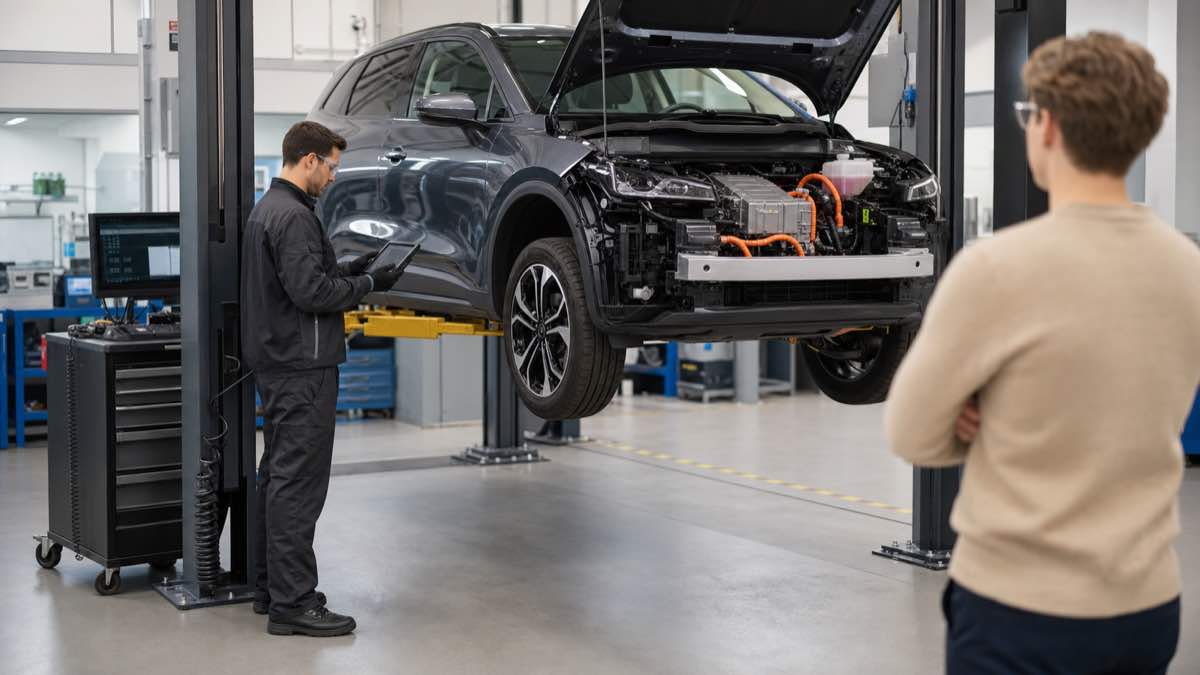
Some car repairs are poor DIY choices because one mistake can cause an electric shock, fire, unintended airbag deployment, brake failure, structural weakness, illegal refrigerant release, or a vehicle that appears fixed but is not calibrated correctly. High-voltage battery work, airbag repairs, refrigerant recovery, structural collision repair, and safety-system calibration belong with trained professionals using the correct equipment.
This is not a claim that every owner lacks mechanical ability. An experienced technician working at home may safely complete jobs a beginner should decline. The real boundary depends on training, model-specific service information, tools, workspace, replacement procedures, and the ability to verify the repair before the vehicle returns to traffic.
The Five-Question DIY Safety Test
- Do you understand the hazard? Consider voltage, pressure, heat, stored spring force, fuel, chemicals, lifting, and pyrotechnic devices.
- Do you have model-specific instructions? A generic video may not match the engine, brake system, battery chemistry, fastener, calibration, or build date.
- Do you have the correct tools? That can include rated lifting equipment, insulated tools, torque-angle measurement, scan functions, recovery equipment, or calibration targets.
- Can you verify the result? A repair is not complete because a part fits or a warning light turns off. Safety systems may require bleeding, initialization, alignment, leak testing, programming, or a controlled road test.
- Can you recover safely if something goes wrong? A disabled car on stands, stripped fastener, open fuel system, or partially disassembled timing drive needs a realistic backup plan.
If any answer is no, pause before disassembly. Paying for diagnosis or professional installation is usually cheaper than turning a defined fault into several damaged systems.
1. Hybrid and EV High-Voltage Repairs
Traction batteries, inverters, onboard chargers, electric compressors, DC-DC converters, and orange high-voltage circuits can expose a person to dangerous voltage. Switching the car off or disconnecting its 12-volt battery does not prove that every high-voltage component is discharged. Capacitors can retain energy, and isolation must be verified with the prescribed procedure and rated equipment.
NHTSA says owners should never try to service a traction battery without proper training and specialized equipment. Its electric and hybrid vehicle safety guidance also distinguishes the high-voltage pack from the ordinary 12-volt battery. Flood, collision, heat, or battery damage adds fire and corrosive-material hazards.
Leave pack opening, orange-cable work, insulation testing, inverter or electric-compressor service, and high-voltage coolant procedures to appropriately trained technicians. Owners can document warnings, keep specified cooling inlets clear, and arrange a tow under the manufacturer’s instructions without touching the high-voltage system.
2. Airbag and Seat-Belt Pretensioner Repairs
Supplemental restraint systems contain pyrotechnic inflators and pretensioners designed to deploy in a crash. Incorrect probing, static electricity, wiring repair, component handling, installation orientation, or power-up procedures can create injury or leave the system unable to protect occupants.
A scan code does not automatically identify the part to replace. The fault may involve a connector, clock spring, impact sensor, occupant-classification system, module, power supply, previous collision repair, or manufacturer campaign. Some components require initialization or calibration after installation.
Do not install resistors or bypass devices to extinguish the warning. Our airbag warning light guide explains why the light needs diagnosis. Use a qualified shop with current service information, scan capability, and safe handling procedures.
3. Air-Conditioning Refrigerant Recovery and Major AC Work
Opening an automotive AC circuit can release refrigerant and oil under pressure. Frostbite, eye injury, contamination, incorrect charging, air or moisture entry, compressor damage, and environmental release are real risks. Different refrigerants require compatible fittings, oil, equipment, identification, recovery, and recycling procedures.
EPA states that anyone servicing motor-vehicle air conditioning for payment or barter must hold Section 609 certification, and technicians are responsible for regulatory requirements. Its MVAC servicing information emphasizes that the guidance is not a substitute for approved training.
A consumer recharge product being available does not prove that low refrigerant is the complete diagnosis. A sealed system that is low has lost refrigerant somewhere. Professional service can identify the refrigerant, recover it, test for leaks, repair the cause, evacuate moisture, and charge the specified mass.
4. Structural Collision and Unibody Repair
Modern body structures manage crash energy through specific materials, welds, adhesives, reinforcements, and crumple paths. A panel that looks straight may hide rail movement, compromised high-strength steel, damaged battery protection, broken restraint mounts, or corrosion caused by an incorrect repair.
Structural measuring, sectioning location, weld method, corrosion protection, rivet or adhesive specification, and post-repair inspection require vehicle-specific procedures and equipment. Cosmetic dent work is not the same as repairing a load path. A qualified collision facility should assess damage near pillars, rails, suspension mounting points, seat-belt anchors, or an EV battery enclosure.
5. ADAS Sensor, Camera, and Radar Calibration
Automatic emergency braking, lane support, adaptive cruise control, and blind-spot systems depend on cameras, radar, steering-angle data, ride height, alignment, and precise mounting. Windshield replacement, collision repair, alignment, suspension work, bumper removal, or a moved bracket can trigger a calibration requirement.
A dashboard without warnings does not prove the system sees the road correctly. Static calibration may require targets, measured floor space, controlled lighting, level surfaces, tire setup, and scan commands. Dynamic calibration may require specified roads, speeds, weather, and traffic conditions. The shop should follow the automaker procedure and document completion.
6. Brake Hydraulic, ABS, and Electronic Parking-Brake Faults
Experienced DIYers sometimes replace pads and rotors safely, so “never DIY brakes” is too broad. The line changes when the problem involves a sinking pedal, fluid leak, damaged line, ABS hydraulic unit, brake booster, electronic parking-brake service mode, contaminated fluid, or air trapped in a system requiring scan-tool bleeding.
Incorrect flare shape, line material, routing, hose twist, torque, bleeding sequence, or fluid can reduce braking or fail later. An ABS code also needs diagnosis rather than automatic sensor replacement. See the ABS light guide for the distinction between normal braking feel and lost anti-lock function.
If the pedal is soft, braking is reduced, fluid is leaking, or a red brake warning remains on, do not road-test the vehicle. Arrange professional inspection or towing. A repair must be leak-free, correctly bled, torqued, scanned, and verified before public-road use.
7. Fuel Tank, High-Pressure Fuel, and Active Leak Repairs
Gasoline vapor can ignite from a spark, lamp, heater, motor, static discharge, or tool. Direct-injection and diesel systems may retain fuel at pressures capable of penetrating skin. Dropping a fuel tank also combines liquid weight, awkward support, wiring, vapor lines, and confined-space exposure.
Do not use improvised clamps, household hose, sealant, or open flame on a fuel system. A strong fuel smell, visible leak, or wet high-pressure component calls for shutting the vehicle off away from ignition sources and arranging professional help. Our gas smell safety guide covers the first response.
8. Internal Transmission and Major Engine Timing Work
Automatic transmission disassembly requires cleanliness, measurement, model-specific tooling, clutch and seal knowledge, valve-body procedures, and often programming or adaptation. One misplaced check ball, damaged sealing surface, contaminated passage, or incorrect fluid can erase any apparent savings.
Timing belts, chains, variable-valve components, and cylinder-head work also demand exact timing, torque sequences, surface checks, and sometimes engine support. On an interference engine, incorrect timing can bend valves. These jobs are not impossible for every skilled owner, but they are poor first projects and should not begin without the complete procedure, tools, measurements, and recovery plan.
9. Steering Rack, Springs, and Loaded Suspension Work
Coil springs store substantial energy. Incorrect compressors, poor tool placement, damaged threads, or uneven release can launch components. Steering rack and subframe work can also affect alignment, steering-angle calibration, fastener replacement, support points, and the routing of lines or wiring.
Complete strut assemblies may reduce spring-handling exposure, but the vehicle still needs stable lifting, correct torque at ride height where specified, and alignment afterward. Air suspension can retain pressure and may activate automatically unless disabled by the prescribed procedure.
10. Any Repair Under an Improperly Supported Vehicle
A jack raises a car; it is not automatically a safe support for working underneath. Soft ground, sloped pavement, incorrect lift points, undersized stands, wheels that are not chocked, or a vehicle that can roll or self-level can cause collapse.
If you do not have a level hard surface, rated equipment, correct lift points, wheel-control plan, and a stable support arrangement, do not go underneath. Never substitute blocks, unstable ramps, or a roadside scissor jack for workshop support. Mobile professional service or a shop is the safer option.
Programming and Security-Coded Components
Some modules, keys, batteries, steering components, injectors, cameras, and replacement assemblies require coding, initialization, software, secure gateway access, or an online manufacturer procedure. Installing the hardware first can leave the vehicle immobilized or create configuration faults.
Confirm programming requirements before buying a part. Ask whether the shop can perform the operation in-house, whether a mobile programmer is needed, and whether used modules are supported. “Plug and play” should be verified for the exact part number and VIN.
Diagnosis Can Be the Hardest Part of DIY Repair
Replacing a component is sometimes physically easier than proving it failed. A no-start may come from battery voltage, terminals, security authorization, starter control, fuel, ignition, timing, network communication, or an engine problem. Installing a starter because the car does not crank can waste money and introduce a second fault.
Before disassembly, record the symptom, conditions, warning messages, sounds, recent work, and whether the fault is intermittent. Scan all relevant modules when appropriate and preserve codes plus freeze-frame data before clearing anything. Then follow a test plan with known specifications instead of swapping the most commonly mentioned part.
Stop when a test requires back-probing sensitive circuits without the correct diagram, energizing a component outside its normal safeguards, opening a pressurized system, or defeating an interlock. Paying a shop for diagnosis while doing a suitable mechanical installation yourself can be a sensible middle path, provided both parties agree on responsibility and verification.
Safer DIY Jobs for Beginners
Many owners can still learn useful maintenance without entering high-risk systems. Depending on the vehicle and manual, beginner-friendly tasks may include replacing wiper blades, changing a cabin air filter, checking tire pressure, inspecting visible fluid levels when cool, replacing certain exterior bulbs, or cleaning specified battery terminals after learning the correct procedure.
Start with low-consequence work, use model-specific instructions, wear appropriate protection, keep a clean workspace, and stop when the actual vehicle differs from the guide. Never force a connector or fastener simply because a video made the step look easy.
If You Already Started and Need Help
- Stop before applying power, pressure, heat, or additional force.
- Keep removed parts, fasteners, labels, and photos organized.
- Do not conceal a mistake, bypass, spill, broken connector, or changed wiring from the technician.
- Explain the original symptom, codes, tests, parts installed, fluids opened, and every step completed.
- Ask whether the vehicle should be towed rather than reassembled or driven.
A shop may need extra diagnostic time after partial disassembly, but accurate information prevents duplicated work and protects the technician. Honest handoff is part of a safe repair, not an admission of failure.
What to Ask Before Authorizing Professional Work
- What test result identifies the fault, and can the shop explain it in plain language?
- Is the repair urgent, safety-related, or likely to cause additional damage if delayed?
- Does the estimate include diagnosis, parts, labor, fluids, programming, calibration, taxes, and shop fees?
- Are parts new OEM, new aftermarket, remanufactured, or used?
- What parts-and-labor warranty applies, and who handles a claim?
- Will alignment, bleeding, initialization, software, or post-repair scanning be documented?
- How will the shop contact you before additional work exceeds the authorized amount?
A professional recommendation should still be understandable. Ask for measurements, photos, scan results, or old parts where practical. Declining DIY does not mean approving an unexplained repair; it means moving the work to someone equipped to diagnose, perform, and verify it safely.
Frequently Asked Questions
What car repairs should a beginner never attempt?
A beginner should avoid high-voltage hybrid or EV work, airbags, refrigerant circuits, structural collision repair, ADAS calibration, active fuel leaks, internal transmissions, loaded springs, and any job under an improperly supported vehicle.
Can I replace brake pads myself?
Some trained owners can, but it is not a universal beginner task. Electronic parking brakes, damaged hardware, fluid leaks, seized components, ABS bleeding, incorrect torque, and inability to verify braking are reasons to use a professional.
Does DIY repair automatically void a car warranty?
Not automatically, but damage caused by incorrect work or parts may not be covered, and warranty terms can require records or specified procedures. Keep receipts, specifications, dates, mileage, and clear documentation.
Can I recharge my car AC myself?
A consumer product may be sold for some systems, but adding refrigerant does not diagnose the leak or confirm the correct charge. Wrong refrigerant, contamination, overcharge, and release are risks. Opening, recovering, or major servicing belongs with properly equipped technicians following EPA requirements.
Why is a warning light not enough to choose a replacement part?
A light and trouble code identify a monitored fault area, not always the failed component. Wiring, power, software, mechanical conditions, communication faults, and previous repairs can produce similar codes. Test before replacing.
How do I choose a qualified repair shop?
Ask about training for the system, current service information, equipment, diagnosis process, written estimate, parts, warranty, calibration documentation, and how unexpected work is authorized. For collision or high-voltage work, ask about vehicle-specific capability.
Bottom Line
The repairs you should not DIY are the ones where your training, tools, workspace, service information, or verification method cannot control the consequence of a mistake. High voltage, restraints, refrigerant, structure, ADAS, fuel, stored spring force, and unsupported lifting deserve a conservative decision. Good DIY judgment includes knowing when to stop, document the vehicle, and hand the job to a qualified professional.