
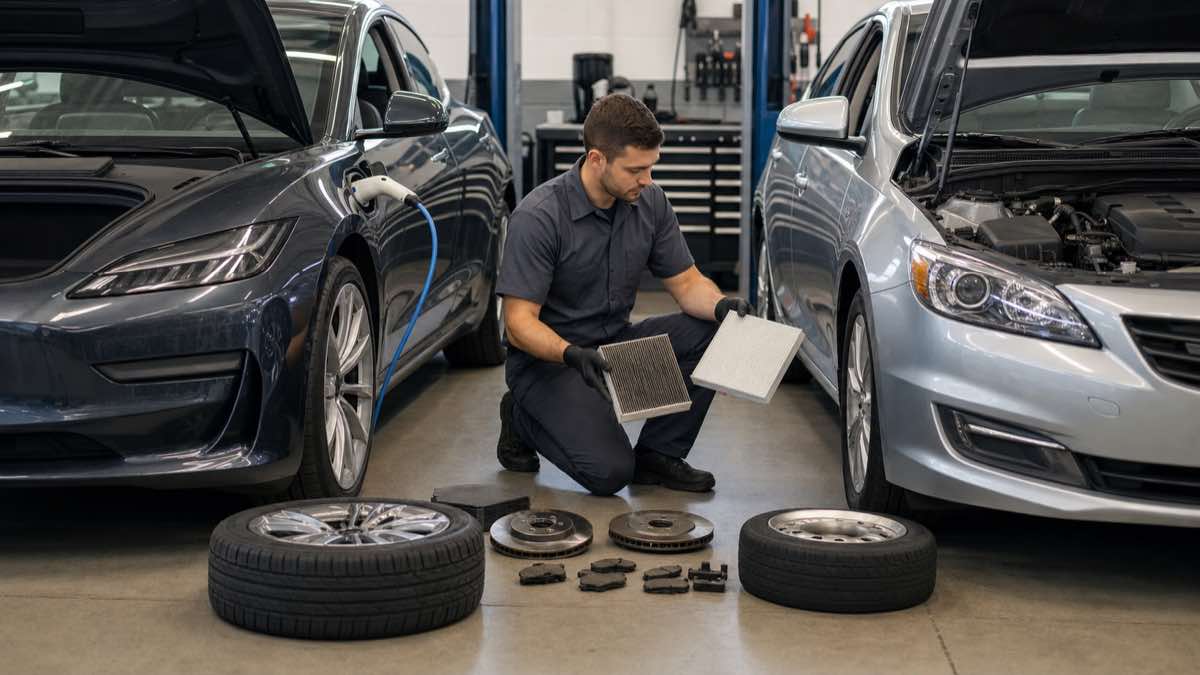
Battery-electric vehicles generally need less scheduled maintenance than gasoline cars because they have no engine oil, spark plugs, fuel system, or exhaust and use fewer moving drivetrain parts. They are not maintenance-free: tires, brakes, suspension, steering, cabin filters, wipers, climate systems, battery cooling, 12-volt electronics, software, and safety inspections still matter.
Hybrids and plug-in hybrids are a separate category. The US Department of Energy notes that HEVs and PHEVs retain an internal-combustion engine, so their general maintenance remains similar to conventional vehicles even though their electrical components usually need little scheduled service.
Maintenance Comparison
| Item | Battery EV | Gas car |
|---|---|---|
| Engine oil/filter | Not used | Required by schedule or oil-life monitor |
| Spark plugs and ignition | Not used for propulsion | Service and repairs vary by engine |
| Fuel and exhaust system | Not used | Filters, injectors, pumps, sensors, catalyst and exhaust may need work |
| Transmission | Usually reduction gear; follow model fluid schedule | Automatic, CVT, dual-clutch, or manual service varies |
| Brakes | Regeneration can reduce friction wear; corrosion and fluid still matter | More friction-brake use in normal driving |
| Tires | Rotation, pressure, alignment and replacement required | Same basic needs |
| Thermal management | Battery, motor, electronics, and cabin loops may need checks | Engine cooling and climate systems need service |
| 12V/low-voltage system | Still required for controls and accessories | Battery plus alternator/charging system |
What Current Cost Data Shows
AAA’s 2025 Your Driving Costs comparison estimated annual maintenance at 15,000 miles of $1,358 for selected electric medium sedans versus $1,786 for gas examples. For selected compact SUVs, it listed $1,449 electric versus $1,746 gas.
Those figures include selected top-selling new models and AAA’s methodology; they do not prove every EV is cheaper than every gas car. Tire size, vehicle weight, reliability, warranty, local labor, parts availability, damage, and model-specific schedules can reverse an individual comparison.
Maintenance EVs Eliminate
- Engine oil and oil-filter changes
- Spark plugs and ignition coils for a combustion engine
- Engine air filter for combustion intake
- Fuel injectors, fuel pump, and fuel filter
- Timing belt or chain associated with an engine
- Catalytic converter, oxygen sensors, muffler, and exhaust
The DOE’s EV maintenance guidance says all-electric vehicles typically require less maintenance because the battery, motor, and electronics need little regular service, fewer fluids change, regenerative braking reduces brake wear, and there are fewer moving parts.
Maintenance EVs Still Need
Follow the exact manual for tire rotation and pressure, wheel alignment, cabin filters, brake fluid and inspection, coolant where used, wipers, washer fluid, air-conditioning service, suspension, steering, drive units, charging-port inspection, and low-voltage battery checks. Some “lifetime” fluids still require inspection or special-condition service.
Regenerative braking can extend pad life, but lightly used friction brakes can corrode or bind, especially with road salt or moisture. A qualified inspection should assess pads, rotors, calipers, hoses, and fluid rather than assuming low wear means no service.
Tire Wear: Do EVs Always Wear Tires Faster?
Not always. Vehicle weight, torque, alignment, tire design, pressure, rotation, road, climate, and driving style determine wear. Some EVs use large or specialized tires that cost more, while gentle driving and proper maintenance can improve life. Compare equivalent vehicle classes and actual tire measurements.
Check pressure cold and use the doorjamb placard. If the warning appears, follow our TPMS light guide; a repeated alert may indicate a leak or wheel problem.
Battery and High-Voltage Service
The traction battery is designed for extended use but ages over time. Depending on the vehicle, liquid cooling, filters, vents, diagnostics, or software may have scheduled checks. Warranty terms vary by model, year, state, and original in-service date.
High-voltage work is not routine DIY. Do not open a pack, touch orange cables, or assume disconnecting the 12-volt battery makes the system safe. Use technicians trained for the vehicle, and document any message using our dashboard warning light guide before arranging service.
Maintenance Is Not the Same as Repair Cost
Fewer scheduled services do not guarantee every repair is cheap. Collision damage, battery packs, power electronics, charging modules, sensors, glass calibration, body structure, and specialized labor can be expensive. Gas cars have their own high-cost engine, transmission, emissions, and fuel-system risks.
Compare total ownership using purchase price, depreciation, insurance, energy or fuel, tires, maintenance, repairs, charging equipment, taxes, and expected ownership time. Do not use oil-change savings alone to choose a vehicle.
Frequently Asked Questions
Do electric cars need oil changes?
Battery EVs do not use engine oil. They may use reduction-gear lubricant, coolant, brake fluid, and refrigerant according to the manufacturer schedule.
Are EVs cheaper to maintain than gas cars?
They generally require less scheduled maintenance, and AAA’s selected 2025 examples showed lower maintenance costs. Exact models, tires, repairs, location, and warranty determine the owner’s result.
Do EV brakes need service?
Yes. Regeneration can reduce pad wear, but friction brakes, calipers, rotors, hoses, parking brakes, and fluid still need inspection and model-specific service.
Do hybrids have gas-car maintenance?
Yes. HEVs and PHEVs retain a combustion engine, so oil, filters, ignition, cooling, fuel, and emissions maintenance may apply alongside hybrid-system requirements.
Do EV tires wear out faster?
Some do, but it is not universal. Weight, torque, tire specification, alignment, pressure, rotation, road, and driving behavior all affect tread life.
Can any mechanic service an EV?
Shops can handle some conventional items, but high-voltage diagnosis and repair require vehicle-specific training, service information, protective equipment, and tools.
Bottom Line
EV maintenance is simpler than gas-car maintenance because the combustion engine, fuel system, and exhaust disappear. Tires, brakes, cooling, suspension, climate control, low-voltage electronics, and inspections remain. Compare exact vehicles and manuals, keep high-voltage work professional, and separate scheduled maintenance savings from repair and total ownership costs.