
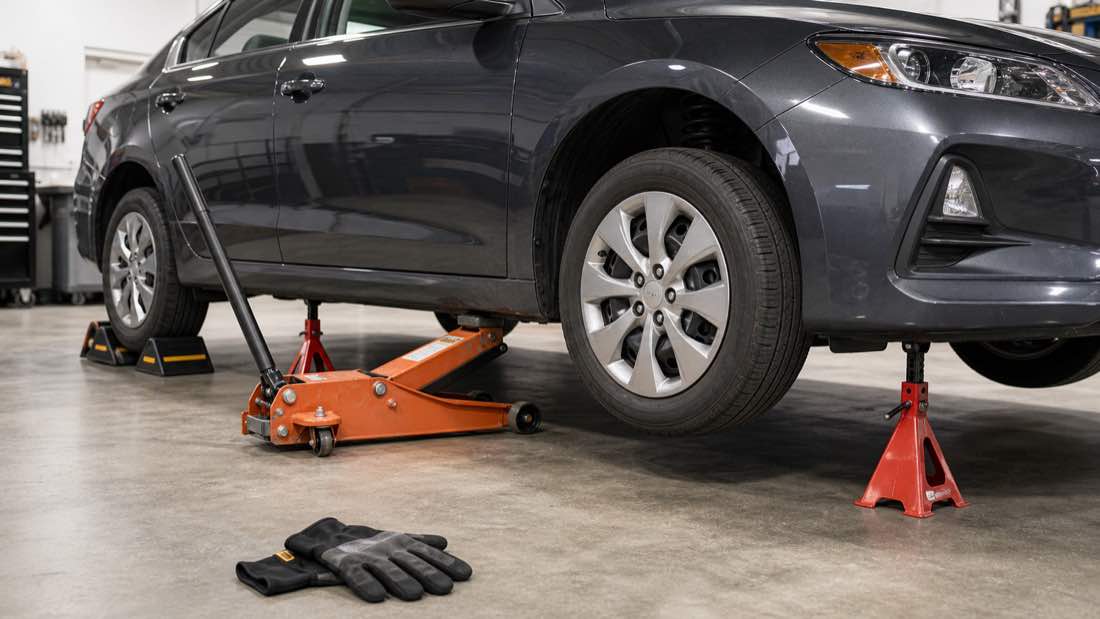
Jack and jack stand safety is not optional. A car jack is for lifting the vehicle. Jack stands are for supporting it. If you are going to remove a wheel, work near a wheel well, reach under the car, inspect suspension parts, or do anything where the vehicle could fall toward you, the car must be supported correctly.
The most important rule is simple: never get under a car supported only by a jack. Hydraulic floor jacks, scissor jacks, and bottle jacks can slip, sink, leak down, tip, or fail. Jack stands, wheel chocks, flat ground, and correct jacking points are what make the job safer.
This guide is for beginner DIY drivers. It explains what each tool does, how to set up safely, where to place stands, what mistakes to avoid, and when to stop and use a repair shop.
Quick Safety Rules
| Rule | Why it matters |
|---|---|
| Use flat, solid ground | Prevents rolling, sinking, or tipping |
| Chock the wheels | Stops the vehicle from moving |
| Use the correct jacking point | Prevents body or frame damage |
| Use jack stands | A jack alone is not support |
| Match stand rating to the vehicle | Prevents overload |
| Lower the car gently onto stands | Confirms stable support |
| Shake-test lightly before work | Finds instability before you are under the car |
| Never crawl under a jack-only car | The most important rule |
If any part of the setup feels unstable, lower the vehicle and start over.
Jack vs Jack Stand
A jack lifts. A jack stand supports. They are not the same tool.
A floor jack uses hydraulic pressure and wheels to raise part of the vehicle. It is useful because it lifts smoothly and has a wide saddle. A scissor jack is usually the emergency jack that comes with a vehicle. It is meant for roadside tire changes, not comfortable garage repair. A bottle jack can lift heavy loads, but its tall, narrow shape may be unstable on some vehicles or surfaces.
Jack stands hold the vehicle after it is lifted. A stand has a base, center column, saddle, and height adjustment. Once the car is lowered onto the stands, the jack can remain in place as backup, but the stands carry the load.
If your job requires getting under the vehicle, jack stands are required. For many beginner jobs, a floor jack plus stands is the minimum safe home setup.
Before You Lift the Car
Prepare before the vehicle leaves the ground.
- Park on level concrete or another firm, flat surface.
- Avoid gravel, dirt, grass, soft asphalt, and slopes.
- Put the transmission in Park or in gear for a manual.
- Set the parking brake unless the repair procedure says otherwise.
- Chock the wheels that will stay on the ground.
- Find the correct jacking points and stand points.
- Inspect the jack and stands for damage.
- Remove loose cargo if it may shift.
- Keep kids and pets away from the work area.
Do not lift a vehicle on a hill. Do not rely on the parking brake alone. Do not use bricks, wood stacks, cinder blocks, or random objects as stands.
Finding the Correct Jacking Points
The correct jacking point depends on the vehicle. Many cars have pinch weld jacking points along the rocker panels. Some vehicles have front and rear center jacking points. Trucks and body-on-frame SUVs may use frame points, axles, or suspension locations depending on the job.
Check the owner’s manual first. If the manual shows only emergency tire-change points, use a repair manual or trusted service information for floor jack and jack stand points.
Look for reinforced metal, not thin floor pan, plastic trim, exhaust parts, fuel tank, oil pan, control arms, or random underbody panels. Lifting from the wrong place can bend the body, crack plastic, crush lines, or make the vehicle slip.
Pinch weld adapters can help protect pinch welds when using a floor jack or stand. Use the adapter only if it fits the vehicle and tool correctly.
How to Use Jack Stands Safely
Use this basic process for many wheel-off jobs:
- Loosen lug nuts slightly while the tire is still on the ground if the wheel will be removed.
- Place wheel chocks on the wheels that remain on the ground.
- Position the floor jack under the correct jacking point.
- Raise the vehicle slowly.
- Place jack stands under the correct support points.
- Set both stands to the same height if lifting one end of the vehicle.
- Lower the vehicle gently onto the stands.
- Confirm the stand saddles are seated correctly.
- Leave the floor jack lightly touching as backup if practical.
- Give the vehicle a careful, light shake from outside before working.
The shake test is not a wrestling match. You are checking for obvious movement before you put yourself near danger.
One Wheel, One End, or the Whole Car?
Lifting one corner for a tire change is different from lifting the front of the car for an oil change or lifting all four corners for larger work.
For one wheel, use the approved jacking point and support the vehicle if you will do more than a quick roadside tire swap. For one end of the car, lift from a center jacking point if the vehicle has one, then place stands at left and right support points. For all four corners, work slowly and follow a proven procedure for that exact vehicle.
Beginners should avoid lifting all four corners until they are comfortable with the car, the floor jack, stand placement, and the surface. A vehicle on four stands can be safe when done correctly, but it leaves less margin for sloppy setup.
If you only need to inspect something, ramps may be safer and simpler than stands, as long as the job does not require removing wheels and the ramps are rated and used correctly.
Wheel Chocks Matter
Wheel chocks stop the vehicle from rolling. They should be placed firmly against the tires that stay on the ground. If you lift the front, chock the rear wheels. If you lift the rear, chock the front wheels.
Use real rubber or metal wheel chocks, not random rocks or wood scraps. Chocks are cheap compared with the risk of a vehicle moving while lifted.
The parking brake helps, but it does not replace chocks. On some jobs, the parking brake may be released as part of the repair, so chocks become even more important.
Jack Stand Ratings
Jack stands are rated by weight. The rating may be per pair or sometimes per stand, so read the label and manual carefully. Do not guess.
Use stands rated for more than the portion of vehicle weight they will support. A compact car, midsize SUV, and pickup do not need the same equipment. If your vehicle is heavy, lifted, or has unusual ground clearance, buy stands and a jack that match the job.
Do not use damaged stands, bent stands, cracked welds, missing pins, loose pawls, or stands that look abused. If the stand’s locking mechanism feels questionable, replace it.
Inspecting Jack Stands Before Use
Before each use, look at the stand body, welds, base feet, saddle, ratchet bar, locking pawl, pin, and label. The stand should sit flat without rocking. The center post should move smoothly and lock positively. If the saddle is bent, the welds are cracked, the label is missing, or the pawl does not lock cleanly, do not use the stand.
Some jack stands are built to industry standards such as ASME/PASE ratings, but a label alone is not enough if the stand is damaged or recalled. Check for recalls if you bought old stands used, inherited tools, or are unsure about the brand history. A recalled jack stand should be removed from service, not “used carefully.”
Use stands as a matched pair when lifting one end of the vehicle. Mixing different heights, ratings, or saddle shapes can make the car sit unevenly.
Floor Jack Safety
A floor jack should roll slightly as it lifts because the lifting arm moves in an arc. That is one reason smooth concrete is safer than rough ground. If the jack cannot roll, the saddle can shift.
Inspect the saddle, handle, wheels, and hydraulic action. If the jack leaks, sinks, binds, or feels unstable, do not use it. Make sure the saddle is centered under the jacking point before lifting.
Do not exceed the jack’s rated capacity. Do not use handle extensions unless the jack maker allows it. Do not lift higher than needed. The higher the vehicle goes, the more carefully you need to think about stability.
Scissor Jack Safety
The factory scissor jack is mainly for emergency tire changes on the roadside. It usually fits a specific point on the vehicle and raises one corner just enough to change a wheel.
Use it only on firm, level ground and only at the specified jacking point. Do not crawl under a vehicle on a scissor jack. If you are at home, a floor jack and stands are safer for planned work.
If the roadside location is unsafe because of traffic, slope, soft shoulder, darkness, or poor visibility, call roadside assistance instead of trying to change the tire.
If you must change a tire roadside, turn on hazard lights, move as far from traffic as practical, use a reflective triangle if you have one, and keep passengers away from the traffic side. Loosen lug nuts before lifting, raise the vehicle only as high as needed, and never place any part of your body under the car. Roadside jacking is about getting the spare on safely, not doing extra inspection or repair.
What Never to Use as a Stand
Never support a vehicle with:
- cinder blocks
- bricks
- stacked wood
- buckets
- wheels laid flat without a proper plan
- a hydraulic jack alone
- a scissor jack alone
- random metal objects
- damaged jack stands
Cinder blocks and bricks can crack suddenly. Wood can split or shift. A jack can leak down or roll. The support system needs to be made for the job.
Common Beginner Mistakes
Avoid these mistakes:
- lifting on soft ground
- forgetting wheel chocks
- choosing the wrong jacking point
- placing stands under thin sheet metal
- setting stands at uneven heights
- working under a jack-only vehicle
- trusting a rusty or damaged jack stand
- climbing into the vehicle while it is on stands
- pushing hard on stuck bolts while the setup is unstable
- using impact tools that shake the vehicle before checking stability
If a bolt is stuck, think about the vehicle’s stability before pulling harder. Sometimes lowering the car and using a better tool is the safer answer.
Safer Workflow for Wheel Work
For tire rotations, brake inspections, or wheel removal, loosen lug nuts slightly before lifting. After the vehicle is supported on stands, remove the wheel and place it flat under the rocker area as an extra backup if it does not interfere with the job.
That wheel is not a replacement for jack stands. It is only a last-resort backup space if something unexpected happens.
When reinstalling wheels, start lug nuts by hand, snug them in a star pattern, lower the vehicle enough to keep the wheel from spinning, then use a torque wrench for final tightening. Our torque wrench guide explains how to do that correctly.
For rotation planning, see how often should you rotate tires.
When to Stop and Use a Shop
Use a repair shop if:
- the ground is not flat and solid
- the jacking point is rusty or damaged
- the vehicle is too heavy for your equipment
- you cannot identify safe support points
- the vehicle shifts while lifting
- a stand will not sit flat
- the repair requires heavy pulling under the car
- you are working on suspension, steering, or brakes beyond your skill level
- you feel rushed or unsure
There is no shame in stopping. The best DIY mechanics know when a job needs better equipment, a lift, or a second experienced person.
Also stop if the car has heavy rust around support points. Rust can make a normal-looking jacking point unsafe. If the metal crunches, bends, flakes, or shifts while lifting, lower the vehicle and have the structure inspected.
Final Recommendation
For beginner DIY car work, use a quality floor jack, properly rated jack stands, wheel chocks, and the correct jacking points. Lift slowly, lower onto stands gently, check stability before work, and never go under a car supported only by a jack.
Jack and jack stand safety is boring until it is not. Build the habit every time, even for a quick job. That habit is what keeps simple maintenance from becoming dangerous.
If you are building your first setup, start with our basic car tools every driver should own guide.
FAQ
Can I work under a car with only a jack?
No. Never work under a car supported only by a jack. Use properly rated jack stands on a flat, solid surface.
Where should I place jack stands?
Place jack stands under the vehicle’s approved support points, such as reinforced pinch welds, frame points, or other locations listed in service information.
Is a scissor jack safe for repairs?
A scissor jack is mainly for emergency tire changes. It is not a good support tool for planned repairs or any job where you go under the vehicle.
Do I need wheel chocks with jack stands?
Yes. Wheel chocks help stop the vehicle from rolling while lifted. Use them on the wheels that stay on the ground.
Can I use wood or cinder blocks instead of jack stands?
No. Wood, bricks, and cinder blocks can shift, split, or crack. Use properly rated jack stands.
Should the floor jack stay under the car?
You can leave the floor jack lightly touching as a backup after the car is resting on stands, but the jack should not be the main support.
Are ramps safer than jack stands?
Ramps can be simpler for some under-car inspections or oil changes, but they are not useful when wheels must be removed. Use only rated ramps on flat ground.
What should I do if the car shifts while lifting?
Stop, lower the vehicle carefully, reposition everything, and start over. Do not continue with an unstable setup.