
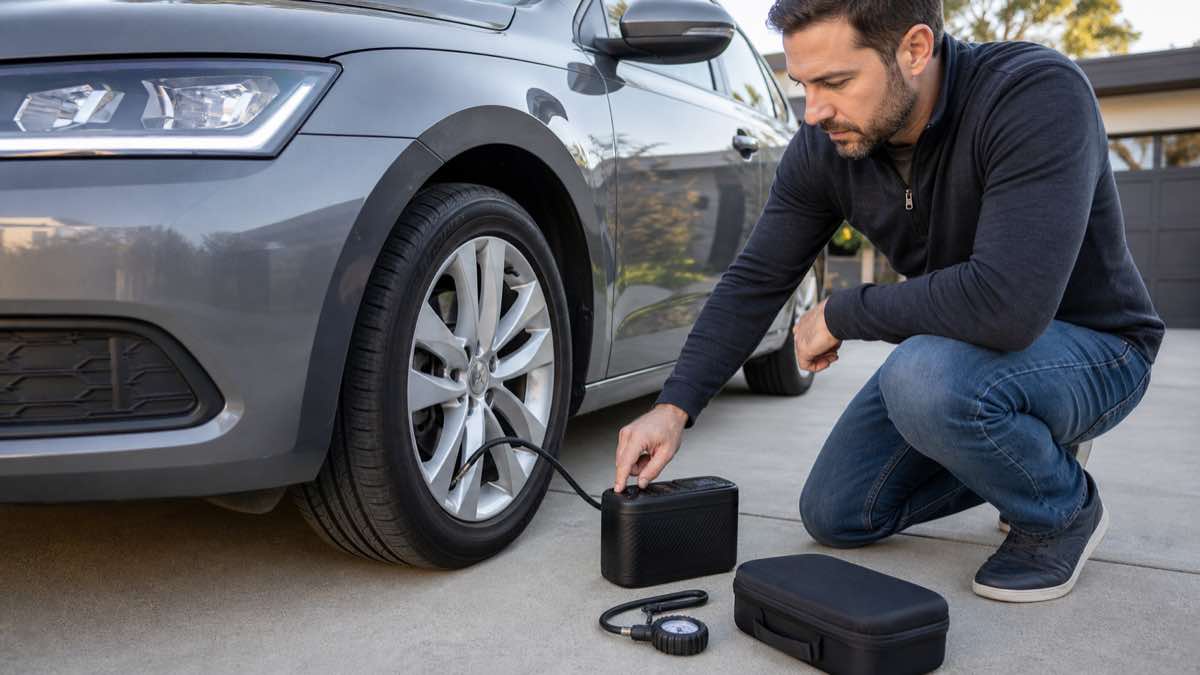
A useful portable tire inflator must fit your vehicle’s tires, reach every valve, work from a dependable power source, and run long enough without overheating. For most passenger cars, a compact 12-volt or cordless unit can handle routine pressure corrections. Large SUV, truck, trailer, and high-pressure tires need more airflow, a longer duty cycle, and heavier wiring than a glove-box pump may provide.
Do not choose by maximum PSI alone. That number says little about how quickly the pump moves air at real tire pressure. Inflation time, airflow, duty cycle, hose and cord reach, gauge behavior, thermal protection, warranty, and tested tire-size compatibility are more useful.
Which Type of Tire Inflator Should You Buy?
| Type | Best for | Main tradeoff |
|---|---|---|
| 12V plug-in | Emergency kit and passenger-car corrections | Needs a working outlet and enough cord; outlet amperage matters |
| Cordless rechargeable | Convenience, apartments, motorcycles, quick top-offs | Battery can be empty or heat-degraded when needed |
| Tool-battery inflator | Owners already using the same battery platform | Battery and charger may be sold separately |
| Dual-power | Home and roadside flexibility | Larger, heavier, and often more expensive |
| Battery-clamp compressor | Truck, off-road, and larger-volume tires | More setup, heavier cables, and careful battery connection |
The Seven Specifications That Matter
1. Tire-size rating and inflation time
Look for documented tests on a tire near your own size, starting pressure, and target pressure. A pump that quickly tops up a compact-car tire may struggle to recover a nearly flat pickup tire. Marketing that says “up to 150 PSI” does not establish useful airflow or speed.
2. Duty cycle and thermal protection
Small compressors create heat. The manual should state how long the unit may run and how long it must cool. Automatic thermal protection is valuable, but it does not replace the duty-cycle instructions. Consecutively filling four large tires can exceed a compact unit’s design even when one tire is easy.
3. Power source and electrical load
For a 12V model, compare the inflator’s current requirement with the vehicle outlet rating and follow both manuals about whether the engine should run. Never replace an outlet fuse with a higher rating. Cordless models should have a storage and recharge routine; extreme cabin heat or cold can affect battery readiness.
4. Hose, cable, and valve connector
Measure from the power point to the farthest wheel, allowing safe routing around the vehicle. A flexible hose reduces strain on the valve stem. Screw-on chucks can seal well but may release a little air during removal; clamp chucks are faster but must fit securely.
5. Gauge accuracy and auto-stop
A readable display and preset shutoff are convenient, not proof of accuracy. Compare the inflator with a dependable separate gauge when new and periodically afterward. Pressure may briefly fluctuate while air is flowing, so follow the device instructions for its final reading.
6. Controls and nighttime use
Controls should be understandable without a phone connection. A stable work light, backlit display, stored hose, and gloves can help at night. Avoid standing in traffic to reach a roadside tire; move to a safe location or call assistance when possible.
7. Storage, warranty, and replacement parts
Check whether the hose, fuse, charger, valve seals, and battery are replaceable. A case protects the cord and accessories. Warranty support and a clear manual are more valuable than extra nozzles that do not match your use.
What PSI Should You Use?
Use the vehicle manufacturer’s recommended cold pressure on the Tire and Loading Information label, commonly on the driver’s doorjamb, or in the owner’s manual. Do not use the maximum pressure molded on the tire sidewall as the normal target.
NHTSA recommends checking tires when cold—generally after the vehicle has been parked at least three hours—and checking all tires, including the spare, monthly. Its TireWise guidance notes that front and rear recommendations may differ.
If a tire is significantly low after driving, adding air to the placard cold-pressure value is safer than continuing on a severely underinflated tire, but recheck it cold later. Do not bleed a warm tire down simply to make it match the cold specification.
How to Use a Portable Tire Inflator
- Park on a stable surface away from traffic, set the parking brake, and identify the placard pressure.
- Inspect the tire for sidewall damage, exposed cords, a separated bulge, smoke, or a wheel off the rim. Do not inflate severe damage.
- Read the inflator and vehicle manuals, including power, engine-running, and duty-cycle instructions.
- Check pressure with the tire cold when possible and note how far it is below target.
- Connect the hose squarely to the valve without bending the stem.
- Power the inflator as directed, set the correct pressure if it has auto-stop, and remain nearby.
- Stop for unusual noise, smoke, odor, a hot plug or cord, repeated fuse failure, or excessive vibration.
- Remove the connector, verify pressure with a gauge, reinstall the valve cap, and inspect for continuing leakage.
If the TPMS light remains on, the system may need a short drive, relearn, sensor service, or further tire diagnosis depending on the vehicle. Pressure should still be checked manually.
When an Inflator Cannot Make the Tire Safe
An inflator adds air; it does not repair a puncture, damaged sidewall, bent wheel, failed valve, bead leak, or internal tire separation. A tire that loses pressure again needs inspection. Do not keep refilling a tire to postpone repair when the leak rate is unknown.
Do not inflate a tire with exposed cords, a sidewall cut or bulge, fire or impact damage, a bead displaced from the rim, or evidence that it was driven flat. Stay clear if the tire or wheel is distorted. Use the vehicle’s spare or call roadside assistance according to the owner’s manual.
12V Versus Cordless: Which Is More Dependable?
A 12V inflator avoids relying on a small internal battery, but it depends on a compatible working vehicle outlet and proper cable reach. A cordless model is easier to position and can work when the outlet is unavailable, but only if its battery has been charged and stored within manufacturer limits.
For an emergency kit, redundancy matters. A dual-power model or a cordless unit with a scheduled charge check can reduce surprises. Do not assume a power-bank/jump-starter combination can perform every function at full output; verify each mode, cable, and operating limit separately.
Care and Testing Schedule
- Test the inflator on your own vehicle shortly after purchase.
- Confirm the cord or hose reaches every tire and the spare.
- Compare its gauge with a separate gauge.
- Inspect cords, plugs, hose, chuck, and case every month.
- Recharge cordless batteries on the manufacturer’s schedule.
- Do not store a lithium-battery unit outside its specified temperature range.
- Run a short functional check before road trips.
- Replace damaged cables, melted plugs, cracked hoses, or unreliable valve connectors.
A repeated low tire can also trigger changes in handling and fuel use. If warning behavior is confusing, review our dashboard warning light guide and arrange tire service rather than relying only on the pump.
Common Mistakes to Avoid
- Inflating to the tire sidewall maximum instead of the vehicle placard.
- Buying by maximum PSI while ignoring airflow and duty cycle.
- Running a compact pump continuously beyond its cooling limit.
- Using an underrated extension, outlet, fuse, or adapter.
- Trusting auto-stop without periodically verifying pressure.
- Leaving a cordless unit discharged for months.
- Standing in an active traffic lane to reach a tire.
- Treating repeated air loss as normal maintenance.
Frequently Asked Questions
What size tire inflator do I need?
Choose a model explicitly tested or rated for your tire size, target pressure, and number of consecutive fills. Large truck, trailer, and off-road tires need more airflow and duty cycle than typical passenger-car tires.
Is a cordless inflator safe to keep in a car?
Only within the manufacturer’s storage-temperature and battery-care instructions. Vehicle cabins can become extremely hot or cold. Inspect the battery for swelling or damage and keep it charged on a schedule.
Can a portable inflator fill a completely flat tire?
Some can refill an intact tire that still seals to the rim, but a displaced bead, major puncture, sidewall damage, or tire driven flat requires professional inspection. Do not assume adding air makes it safe.
Should the engine run while using a 12V inflator?
Follow both the vehicle and inflator manuals. Outlet capacity and instructions differ. If running is specified, use the device only outdoors with safe exhaust clearance, never in an enclosed garage.
How accurate are built-in inflator gauges?
Accuracy varies and can change with use or damage. Compare the reading with a dependable separate gauge when new and periodically. Stop-flow and final readings may differ.
Why does my tire keep losing air?
Possible causes include a puncture, valve leak, bead leak, wheel damage, temperature change, or tire damage. Repeated loss needs inspection; an inflator does not repair the source.
Bottom Line
The best portable tire inflator is one that matches your actual tire volume, pressure, power source, and expected number of fills. Prioritize tested inflation time, duty cycle, reach, readable controls, thermal protection, and service support over maximum-PSI marketing. Use the vehicle’s cold placard pressure, verify the final reading, and remember that recurring pressure loss or visible tire damage requires repair—not more air.