
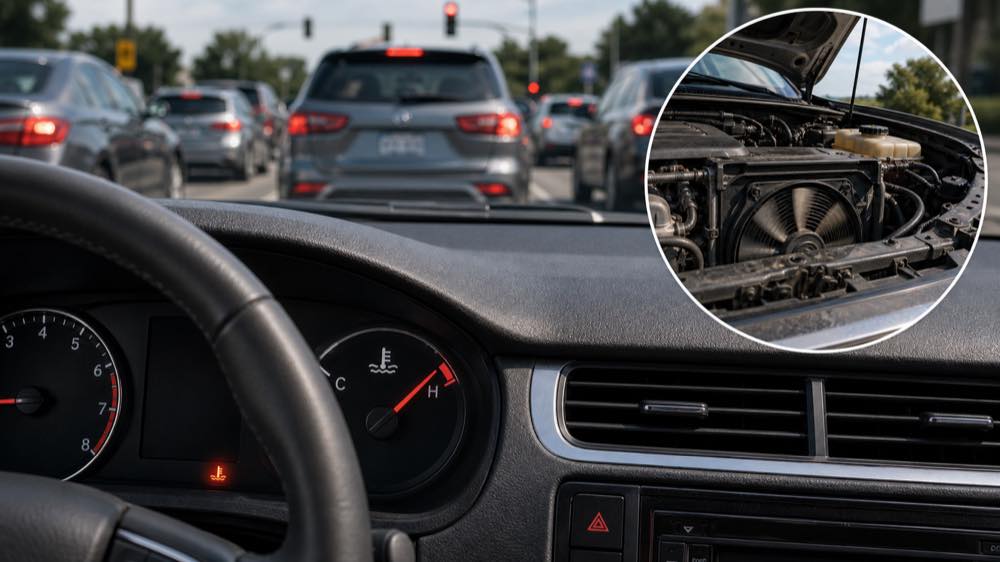
If your car overheats at idle but cools when driving, the first suspect is usually low-speed cooling: radiator fan operation, coolant level, trapped air, or airflow through the radiator. The clue is the pattern. At highway speed, moving air is forced through the radiator. At a stoplight or in slow traffic, the car depends on the cooling fan to pull air through.
That does not mean the fan is always the only problem. Low coolant, an air pocket, a weak radiator cap, a restricted radiator, a sticking thermostat, or a water pump issue can also show up more clearly at idle. But when the temperature gauge climbs while stopped and drops once you start moving, start with airflow and coolant level before replacing random parts.
Do not treat repeated idle overheating as harmless. A gauge that touches the red zone, a red temperature warning, steam, coolant smell, or coolant loss can turn into engine damage quickly. If the warning light is already on, read our coolant temperature warning light guide and pull over safely.
The Short Answer
A car that overheats at idle but cools when driving usually has a cooling system problem that shows up when natural airflow is low. The most common causes are a radiator fan that is not turning on, a bad fan relay or fuse, low coolant, trapped air in the cooling system, blocked radiator fins, a weak radiator cap, a sticking thermostat, or poor coolant circulation.
The fastest clue is this: if the temperature rises in traffic but falls at road speed, the radiator is probably getting enough airflow while moving but not enough airflow while sitting still.
Pattern Decoder
| What happens | What it points toward | First check |
|---|---|---|
| Temperature rises at stoplights, drops while driving | Radiator fan, fan relay, low coolant, airflow issue | Watch fan operation at idle |
| Overheats only with A/C on | Fan speed, condenser airflow, extra heat load | Check both radiator/condenser fans |
| Overheats at idle and highway speed | Thermostat, radiator restriction, water pump, low coolant | Full cooling-system diagnosis |
| Heater blows cold while gauge rises | Low coolant or air pocket | Let engine cool, check coolant level |
| Gauge jumps suddenly up and down | Sensor issue, wiring, air pocket | Compare scan-tool coolant temperature |
| Steam or coolant smell appears | Real overheating or leak | Stop driving and inspect when cool |
Why It Cools Down When You Drive
The radiator removes heat from hot coolant. For that to work, air must pass through the radiator fins. When the car is moving, road speed creates airflow through the grille and radiator. This is why the gauge may drop once you leave a stoplight or get back on the highway.
At idle, there is little natural airflow. The cooling fan must pull air through the radiator. On many vehicles, the electric fan turns on when coolant temperature reaches a set point. It may also turn on when the A/C is running because the condenser needs airflow too.
If that fan does not come on, spins too slowly, runs on only one speed, or cannot pull air through blocked radiator fins, heat builds while the car sits. Once the car moves, natural airflow can temporarily hide the problem.
Stop Driving If You Notice These Signs
Pull over safely and shut the engine off if:
- the temperature gauge reaches the red zone
- a red temperature warning appears
- steam comes from under the hood
- coolant is leaking or spraying
- you smell sweet coolant or see white vapor
- the heater suddenly blows cold while the gauge climbs
- the engine knocks, loses power, or runs rough
Never open the radiator cap or coolant reservoir cap while the engine is hot. The cooling system can be under pressure, and hot coolant can cause serious burns.
Common Causes
Radiator Fan Not Working
A failed radiator fan is one of the most likely causes when a car overheats at idle but cools when driving. At low speed, the fan must pull air through the radiator. If it does not run, the temperature can creep up in traffic.
The fan problem may be the fan motor itself, but it can also be a relay, fuse, wiring issue, fan control module, or coolant temperature sensor signal. On some vehicles, one fan may run for A/C while another fan is needed for engine cooling, so a quick glance is not always enough.
Bad Fan Relay, Fuse, or Wiring
If the fan motor is healthy but never receives power, the cooling fan will not turn on at the right time. A blown fuse, bad relay, corroded connector, damaged ground, or wiring fault can create the same idle overheating symptom as a failed fan motor.
This is why proper testing matters. Replacing the fan without checking power, ground, and relay control can waste money.
Low Coolant
Low coolant reduces the system’s ability to carry heat away from the engine. It can also leave the temperature sensor exposed to air pockets, which may make the gauge act strangely.
Check coolant level only after the engine is fully cool. If coolant is low, there is usually a reason: an external leak, a weak cap, a bad hose, a leaking radiator, water pump seepage, or an internal engine problem. Topping off may help temporarily, but the leak still needs to be found.
Air Pocket in the Cooling System
Air trapped in the cooling system can block coolant flow and create hot spots. This often happens after coolant service, thermostat replacement, radiator replacement, hose repairs, or a leak that allowed air into the system.
Common clues include a heater that blows cold at idle, gurgling sounds, temperature swings, or overheating after a recent cooling-system repair. Some vehicles require a specific bleeding or vacuum-fill procedure.
Blocked Radiator or Condenser Airflow
The front of the radiator and A/C condenser can collect leaves, bugs, dirt, plastic bags, and road debris. If air cannot pass through the fins, the fan has a harder time removing heat at idle.
This can be worse in hot weather or with the A/C on. A vehicle may seem fine on a cool day, then overheat in summer traffic because the cooling system has less margin.
Sticking Thermostat
The thermostat controls when coolant flows through the radiator. If it sticks closed or opens late, the engine can run hot. If it sticks open, the engine may run too cool and may set a P0128 code.
For this specific symptom, a thermostat is possible, but a fan or airflow issue is often more suspicious when the car cools as soon as road speed increases.
Weak Water Pump or Poor Coolant Circulation
The water pump circulates coolant through the engine and radiator. If the impeller is damaged, the belt is slipping, or the pump is weak, coolant circulation may be poor at low RPM. The car may cool better once engine speed and airflow increase.
Water pump issues may also come with coolant leaks, bearing noise, belt noise, or overheating under load.
Bad Radiator Cap
The radiator cap or pressure cap helps the cooling system hold pressure. If it cannot hold pressure, coolant can boil sooner, overflow into the reservoir, or fail to draw coolant back as the engine cools.
A weak cap is inexpensive compared with many cooling-system repairs, but it should still be diagnosed in context. Replacing the cap will not fix a bad fan or major leak.
Coolant Temperature Sensor or Gauge Issue
Sometimes the engine is not actually overheating, but the temperature reading is wrong. A faulty coolant temperature sensor, wiring issue, or gauge problem can make the temperature appear high.
Use scan-tool live data when possible. If the dashboard gauge says hot but the scan data and engine behavior do not match, the sensor circuit may need testing.
What to Check First
Start with checks that do not require guessing:
- Let the engine cool fully.
- Check coolant level in the reservoir and radiator if your vehicle allows safe radiator access.
- Look for leaks around hoses, radiator, water pump, thermostat housing, and the coolant reservoir.
- Start the engine and watch whether the radiator fan turns on as temperature rises.
- Turn the A/C on and see whether the fan behavior changes.
- Inspect the front of the radiator and condenser for debris.
- Scan for codes and compare live coolant temperature with the dashboard gauge.
- Note whether the problem started after coolant service or a repair.
If you are not comfortable working around hot parts or spinning fans, stop at the visual checks and have the car inspected.
Can You Drive If It Cools Down While Moving?
Maybe for a short, careful drive to a repair shop, but only if the gauge stays below the red zone, there is no steam, no coolant leak, and no warning light. Avoid stop-and-go traffic if possible because idle is exactly when the problem appears.
Do not keep driving normally just because the temperature drops when the car moves. Repeated overheating can damage the head gasket, warp cylinder heads, and lead to expensive engine repairs. If the gauge climbs again, pull over and call roadside assistance.
For a broader explanation of rising-and-falling temperature patterns, see our guide to a car overheating then going back to normal.
Repair Cost Context
| Possible fix | Typical U.S. cost range |
|---|---|
| Cooling-system diagnosis | $100-$250 |
| Coolant top-off and bleed | $50-$200+ |
| Fan fuse or relay | $50-$250+ |
| Radiator fan motor or assembly | $300-$900+ |
| Coolant temperature sensor | $100-$350+ |
| Radiator cap | $15-$60 |
| Thermostat replacement | $200-$600+ |
| Water pump replacement | $500-$1,200+ |
| Radiator replacement | $500-$1,200+ |
| Head gasket repair | $1,500-$4,000+ |
Costs vary by vehicle, labor rate, engine layout, parts quality, and how much testing is needed before repair.
FAQ
Why does my car overheat at idle but cool down when driving?
This usually happens because the radiator gets airflow when the car is moving, but at idle it depends on the cooling fan. If the fan, coolant level, airflow, or low-speed circulation is weak, the temperature can rise while stopped.
Is the radiator fan always the cause?
No. A bad fan is common, but low coolant, trapped air, a clogged radiator, weak radiator cap, thermostat problem, water pump issue, or coolant temperature sensor fault can also cause idle overheating.
Why does my car overheat in traffic but not on the highway?
Traffic creates low airflow and repeated idle time. Highway driving pushes air through the radiator, so a weak fan or airflow problem may be hidden until the car slows down again.
Can low coolant cause overheating only at idle?
Yes. Low coolant can reduce heat transfer and create air pockets. The problem may show up first at idle because airflow and coolant circulation are already weaker.
Should I turn the heater on if the car starts overheating?
Turning the heater on high can sometimes help pull heat from the engine for a short time, but it is not a fix. If the gauge keeps climbing or reaches the red zone, pull over safely.
Can I drive to a mechanic if the temperature drops when moving?
Only if the temperature stays normal, there is no red warning, no steam, and no coolant leak. Avoid traffic and stop if the gauge rises again. If it reaches the red zone, call roadside assistance.
Is this different from a car that overheats then goes back to normal?
Yes. This article is specifically about overheating at idle or in traffic and cooling while driving. A broader up-and-down gauge pattern can also involve air pockets, thermostat behavior, sensor problems, or coolant flow issues in other driving conditions.