
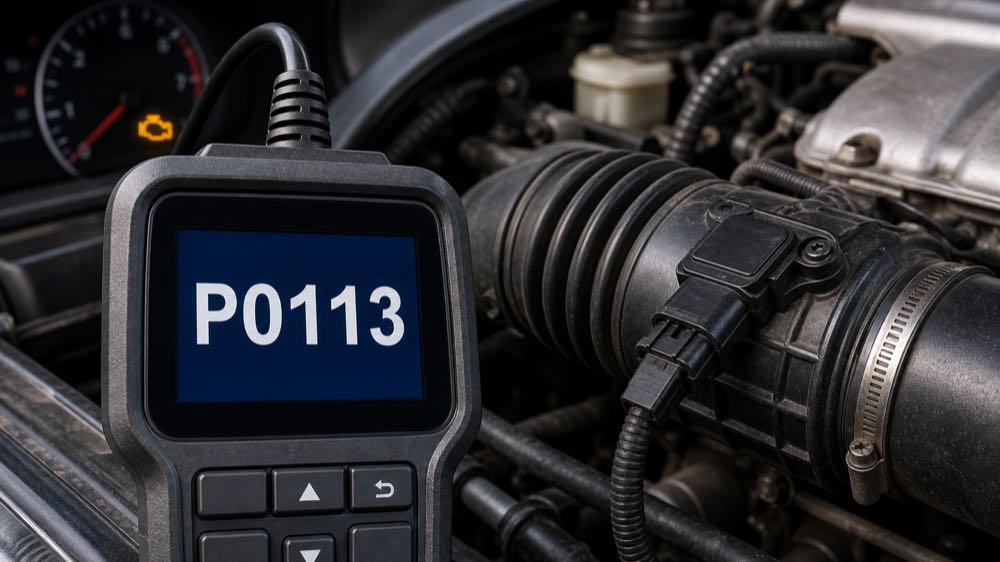
P0113 is an OBD2 diagnostic trouble code that means the intake air temperature sensor circuit has a high input. In plain English, the engine computer is seeing a signal that makes intake air temperature look unrealistically cold or outside the expected range.
Most drivers notice P0113 after the check engine light comes on. The car may still run, but it can have rough idle, hesitation, hard starting, poor fuel economy, or other air/fuel-related symptoms.
P0113 can be caused by a failed intake air temperature sensor, but a disconnected plug, broken wire, corroded connector, or open circuit is just as important to check. On many vehicles, the IAT sensor is built into the mass airflow sensor or MAP sensor, so location depends on the engine design.
P0113 Quick Facts
| Item | Details |
|---|---|
| Code | P0113 |
| Definition | Intake air temperature sensor circuit high input |
| System | Air intake temperature / engine fuel control |
| Common symptom | Check engine light on |
| Common clue | Scan data may show an extremely cold intake air temperature |
| Common mistake | Replacing the sensor before checking connector and wiring |
| Best first step | Inspect IAT/MAF/MAP connector and review live temperature data |
What P0113 Means
The engine control module uses intake air temperature data to help calculate fuel mixture, ignition timing, and air density. Cold air is denser than hot air, so the computer needs a reasonable temperature reading to make accurate adjustments.
P0113 means the IAT signal is too high electrically. Depending on the circuit design, that often translates into a scan-tool temperature reading that is extremely cold, sometimes far below real outdoor temperature. This can happen when the sensor circuit is open or disconnected.
That is why P0113 is not just a “temperature is hot” code. The wording can be confusing. High input is an electrical signal description, not a statement that the intake air is physically too hot.
Where the IAT Sensor Is Located
The intake air temperature sensor may be in different places depending on the vehicle.
- Built into the mass airflow sensor
- Built into the MAP sensor
- Mounted in the air intake tube
- Mounted in the air filter box
- Mounted in the intake manifold area
If the IAT sensor is part of the MAF sensor, P0113 may appear alongside airflow-related codes such as P0101. Do not replace parts until you know where the sensor is and whether the connector is fully seated.
Common Symptoms of P0113
P0113 symptoms can vary because the computer may substitute a default temperature value.
- Check engine light on
- Rough idle
- Hesitation during acceleration
- Hard starting
- Poor fuel economy
- Engine surging
- Reduced performance
- Failed emissions test
- Other intake, MAF, MAP, or fuel-trim codes
Some vehicles drive almost normally with P0113, especially after warm-up. That does not mean the code should be ignored.
Can You Drive With a P0113 Code?
You can usually drive short-term with P0113 if the vehicle runs normally and the check engine light is steady. It is not usually an immediate engine-damage warning.
However, you should diagnose it soon because bad intake temperature data can affect fuel mixture, emissions, and drivability. Avoid normal driving if the engine stalls, hesitates badly, runs extremely rough, or has multiple related codes.
Common Causes of P0113
Disconnected IAT, MAF, or MAP Sensor Plug
A loose or unplugged connector is one of the simplest causes. This can happen after air filter replacement, intake tube removal, engine cleaning, or other repair work.
If the code appeared right after maintenance, inspect the connector first. Make sure the plug is fully seated and the locking tab is not broken.
Open Circuit in the Wiring
P0113 often points to an open circuit. A wire may be broken, rubbed through, pulled tight, damaged by heat, or chewed by rodents. Wiring near the intake tube and engine harness can move with engine vibration, so intermittent faults are possible.
Corroded or Damaged Electrical Connector
Corrosion, loose terminals, oil contamination, or water intrusion can interrupt the IAT signal. A connector may look attached while still making poor electrical contact.
Failed IAT Sensor
The sensor itself can fail internally. If the sensor is separate and wiring checks are good, replacement may be simple. If it is built into the MAF or MAP sensor, the larger sensor assembly may need replacement depending on the vehicle.
Dirty or Damaged MAF Sensor Assembly
When the IAT sensor is integrated into the MAF sensor, contamination or damage in that assembly can affect temperature and airflow data. This is one reason P0113 and MAF-related codes may appear together.
For MAF range/performance diagnosis, see our P0101 code guide.
Intake Tube or Air Filter Service Mistake
After air filter service, the intake tube may be left loose or the sensor connector may not be reattached. A missing clip, cracked tube, or unplugged sensor can create multiple intake-related codes.
Engine Control Module Issue
Computer failure is uncommon, but it is possible after wiring, connector, power, ground, and sensor checks are complete. It should not be the first assumption.
What Scan Data Can Show
Live data is useful for P0113. Before a cold start, intake air temperature should usually be close to outside air temperature. It may differ slightly because of engine-bay heat, but it should not show a wildly unrealistic number.
If scan data shows an extremely cold intake air temperature, that supports a high-input/open-circuit style problem. If the reading jumps around when the harness is moved, suspect wiring or connector trouble.
Useful scan-tool checks include:
- Intake air temperature before startup
- Intake air temperature after warm-up
- Freeze frame data from when P0113 set
- MAF or MAP readings if the sensor is integrated
- Fuel trim data
- Related intake or lean codes
If bad temperature data contributes to a lean or rich fuel mixture, fuel-trim codes such as P0171 may also appear.
Diagnostic Order: What to Check First
Use this order to avoid replacing parts blindly.
- Confirm P0113 with an OBD2 scanner.
- Check for related MAF, MAP, fuel-trim, or intake codes.
- Review freeze frame data.
- Locate the IAT sensor for the exact vehicle.
- Inspect the connector and locking tab.
- Check for unplugged, stretched, broken, or corroded wiring.
- Compare live intake air temperature to outside temperature before startup.
- Move the harness gently while watching live data for jumps.
- Test sensor and circuit values using service information.
- Replace the sensor or assembly only after connector and wiring checks support it.
This process is especially important when the IAT sensor is built into a more expensive MAF or MAP sensor.
P0113 vs P0101
P0113 and P0101 both relate to intake data, but they are not the same code.
| Code | Main issue | Typical focus |
|---|---|---|
| P0113 | Intake air temperature circuit high input | IAT sensor, connector, open circuit, wiring |
| P0101 | MAF sensor range/performance | Airflow reading, MAF sensor, intake leaks, fuel trims |
If both codes appear together, inspect the shared connector or sensor assembly first. A disconnected MAF/IAT plug can trigger multiple intake-related codes at once.
How Much Does P0113 Cost to Fix?
P0113 repair cost depends on the sensor design and fault location.
| Possible repair | Typical U.S. cost range |
|---|---|
| Diagnostic scan and inspection | $75-$180 |
| Reconnect loose sensor plug | Free-$100 |
| Wiring or connector repair | $100-$500+ |
| Separate IAT sensor replacement | $50-$250+ |
| MAF or MAP assembly replacement | $150-$600+ |
| ECM/control diagnosis | $150-$500+ |
Costs vary by vehicle. A separate IAT sensor is usually cheaper than an integrated MAF or MAP assembly.
What Not to Do
Do not assume P0113 means the intake air is actually too hot. Do not replace the MAF sensor without checking whether the IAT connector is unplugged. Do not ignore the code if the engine is hesitating, stalling, or showing multiple intake-related codes.
P0113 is often a straightforward electrical or connector problem, but the diagnosis should match the vehicle’s sensor layout.
FAQ
What does code P0113 mean?
P0113 means the intake air temperature sensor circuit has a high input. The computer is seeing an electrical signal that often indicates an open circuit, disconnected sensor, or faulty IAT sensor.
Is P0113 always a bad IAT sensor?
No. A bad sensor is possible, but a loose connector, broken wire, corroded terminal, or disconnected MAF/MAP sensor plug can also cause P0113.
Can I drive with a P0113 code?
You can usually drive short-term if the engine runs normally and the check engine light is steady. Diagnose it soon if the engine hesitates, stalls, idles rough, or has other intake codes.
Where is the intake air temperature sensor?
It may be built into the MAF sensor, built into the MAP sensor, mounted in the air intake tube, or mounted near the air filter box or intake manifold. Location depends on the vehicle.
Can P0113 cause bad gas mileage?
Yes. Incorrect intake air temperature data can affect fuel mixture and ignition timing, which may reduce fuel economy.
Can P0113 appear after changing the air filter?
Yes. If the IAT, MAF, or MAP connector was left loose or the intake tube was not reinstalled correctly, P0113 can appear after air filter or intake service.