
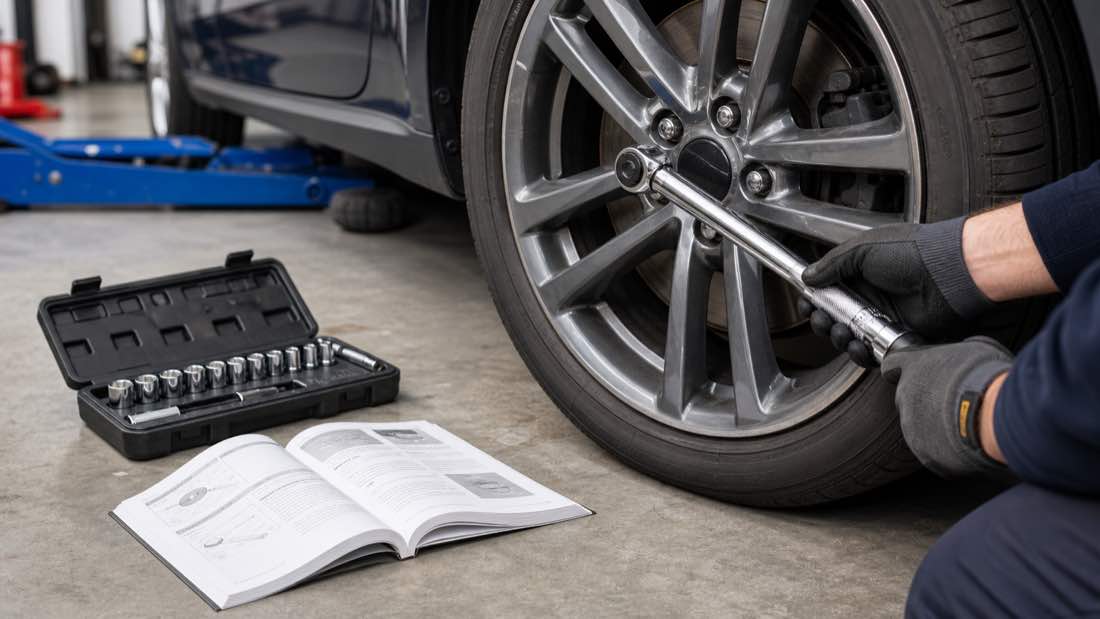
A torque wrench tightens a fastener to a specific torque value. That matters because many car parts are not supposed to be tightened by feel. Wheel lug nuts, spark plugs, drain plugs, brake parts, suspension fasteners, and engine parts can be damaged if they are too loose or too tight.
This torque wrench guide is for beginner DIY drivers who want to buy the right tool, use it safely, and avoid common mistakes. You do not need a professional toolbox to use a torque wrench, but you do need to understand range, drive size, torque specs, and storage.
The short version: most beginners should start with a 1/2-inch click torque wrench for lug nuts and heavier fasteners. If you plan to do spark plugs, drain plugs, or smaller engine work, add a 3/8-inch torque wrench later.
Quick Torque Wrench Basics
| Question | Quick answer |
|---|---|
| What does it do? | Tightens fasteners to a specified torque |
| Best first size for drivers | 1/2-inch drive for lug nuts |
| Best second size | 3/8-inch drive for medium jobs |
| Best beginner type | Click-style torque wrench |
| What not to use it for | Breaking loose stuck bolts |
| Most common mistake | Using it outside its torque range |
| Storage rule | Back a click wrench down to its lowest setting |
| Key safety rule | Always use the vehicle’s torque specification |
Torque is twisting force. In automotive work, torque is often measured in pound-feet, abbreviated lb-ft, or Newton-meters, abbreviated N-m. Some smaller fasteners use pound-inches, abbreviated lb-in.
Why Torque Matters
Fasteners clamp parts together. The goal is not simply “tight.” The goal is enough clamping force without stretching the bolt too far, damaging threads, crushing a gasket, warping a rotor, cracking a part, or letting something loosen while driving.
Wheel lug nuts are the example most drivers understand. If lug nuts are too loose, the wheel can loosen. If they are too tight, studs can stretch, threads can damage, rotors can distort, and future roadside tire changes can become difficult.
Spark plugs are another good example. Too loose can allow combustion leakage or poor heat transfer. Too tight can damage threads, especially in aluminum cylinder heads.
Oil drain plugs, brake caliper bolts, valve cover bolts, and suspension fasteners all have their own torque needs. A torque wrench helps you follow the specification instead of guessing.
Torque Wrench Types
Different torque wrenches work in different ways. Beginners do not need every type, but it helps to know what you are buying.
Click Torque Wrench
A click torque wrench is the best first choice for most automotive DIY work. You set the desired torque, tighten the fastener, and the wrench clicks when it reaches the setting.
The click is not a signal to keep pulling. It is a signal to stop. If you continue pulling after the click, you can over-tighten the fastener.
Click wrenches are affordable, familiar, and widely available. They do need proper storage and occasional calibration.
Digital Torque Wrench
A digital torque wrench uses electronics to show torque on a screen. Some beep or vibrate as you approach the target. They can be very easy to read and may switch between lb-ft, lb-in, and N-m.
The tradeoff is cost, battery dependence, and durability. Digital torque wrenches can be excellent, but beginners do not need one unless they like the display or want more precise feedback.
Beam Torque Wrench
A beam torque wrench uses a bending beam and pointer scale. It is simple and does not click. You watch the pointer while applying force.
Beam wrenches are inexpensive and simple, but they are harder to read in awkward positions. For wheels and general garage work, many beginners prefer a click wrench.
Split-Beam Torque Wrench
A split-beam wrench is similar in use to a click wrench but often easier to set and less sensitive to being stored at a specific setting. It is usually more expensive than a basic click wrench.
For frequent wheel work, a split-beam wrench can be a nice upgrade.
Drive Sizes: 1/4, 3/8, and 1/2 Inch
Drive size is the square connection where sockets attach.
| Drive size | Common automotive use |
|---|---|
| 1/4-inch | Small fasteners, interior work, light engine parts |
| 3/8-inch | Spark plugs, drain plugs, medium engine work |
| 1/2-inch | Lug nuts, suspension, larger fasteners |
A 1/2-inch torque wrench is usually the best first buy for drivers because wheel lug nuts often need higher torque than a small wrench can handle. A 3/8-inch wrench is better for mid-range work where a 1/2-inch wrench may be too large or inaccurate at low settings.
Avoid using a torque wrench at the extreme bottom or top of its range when possible. Many torque wrenches are most accurate in the middle of their range.
What Torque Range Do You Need?
A common 1/2-inch torque wrench may cover something like 20-150 lb-ft or 25-250 lb-ft. A common 3/8-inch wrench may cover around 10-80 lb-ft. A 1/4-inch wrench may be measured in lb-in for small fasteners.
For lug nuts, many passenger vehicles fall somewhere around 80-100 lb-ft, but the correct number depends on the vehicle. Trucks and some larger vehicles may require more. Always check the owner’s manual or service information.
Do not assume every car uses the same lug nut torque. Also do not use online forum numbers without confirming they apply to your exact year, make, model, wheel type, and fastener style.
How to Use a Torque Wrench
Use this basic process:
- find the correct torque specification
- choose the correct socket and drive size
- make sure threads are clean and undamaged
- start the fastener by hand
- snug fasteners evenly before final torque
- set the wrench to the required value
- pull smoothly from the handle
- stop at the first click, beep, or target reading
- follow the tightening pattern for wheels or multi-bolt parts
- reset or store the wrench correctly when done
Do not jerk the wrench. A smooth pull gives better control. Do not hold the head or extension while tightening unless the tool instructions allow it. Pull from the handle where the wrench is designed to measure force.
Using a Torque Wrench on Lug Nuts
For wheels, the car should be on the ground or lightly loaded enough that the wheel cannot spin. Tighten lug nuts in a star or crisscross pattern so the wheel seats evenly against the hub.
A typical process is:
- Start all lug nuts by hand.
- Snug them lightly in a crisscross pattern.
- Lower the vehicle until the tire touches enough to prevent spinning.
- Torque each lug nut in the correct pattern.
- Recheck each lug nut once more in the same pattern.
If you removed a wheel, it is wise to recheck lug nut torque after a short drive if the vehicle manual recommends it. Some shops and wheel manufacturers also recommend a recheck after about 25-100 miles, especially after wheel installation.
Never use a torque wrench as a breaker bar to remove lug nuts. Use a breaker bar or lug wrench to loosen, then use the torque wrench only for final tightening.
For broader wheel maintenance planning, see our how often should you rotate tires guide.
Breaker Bar vs Torque Wrench
A breaker bar is for loosening tight fasteners. A torque wrench is for tightening fasteners to a measured value. They may look similar, but their jobs are different.
Using a torque wrench to loosen stuck bolts can damage the internal mechanism and ruin accuracy. Using a breaker bar to tighten lug nuts by feel can over-tighten fasteners because a long handle gives a lot of leverage.
The clean workflow is simple: breaker bar to loosen, regular ratchet to run the fastener in or out, torque wrench for final tightening.
Extensions, Adapters, and Sockets
Use the correct socket size and a quality socket that fully seats on the fastener. For lug nuts, use the correct deep socket if needed and avoid worn sockets that slip.
Short straight extensions usually have little effect in normal use. Long extensions, wobble extensions, crowfoot adapters, and unusual angles can affect torque or control. Crowfoot adapters can change the effective lever length if positioned in line with the wrench.
If you are a beginner, keep torque setups simple: torque wrench, proper socket, and as little adapter complexity as possible.
Dry vs Lubricated Threads
Torque specs assume a certain thread condition. Many specs are for clean, dry threads unless the manual says otherwise. Lubricating threads can change clamping force at the same torque reading.
Do not oil lug studs unless the manufacturer specifically instructs it. Extra lubricant can make it easier to over-stretch studs even if the torque wrench reads correctly.
If threads are rusty, damaged, cross-threaded, or contaminated, fix the thread problem before torquing. A torque wrench cannot make damaged threads safe.
Calibration and Accuracy
Torque wrenches can drift over time, especially if dropped, overloaded, stored incorrectly, or used often. A home DIY wrench may not need yearly lab calibration, but it should still be treated as a measuring tool.
Replace or calibrate the wrench if it was dropped hard, no longer clicks consistently, feels rough, or has been overloaded beyond its range. If you use it professionally or for critical work, follow a calibration schedule.
For beginner garage work, buying a decent brand and treating it carefully is more important than chasing the cheapest wrench.
Buying Checklist for Beginners
Before buying a torque wrench, check the torque range, drive size, scale readability, ratchet direction, handle grip, warranty, and storage case. The scale should be easy to set without guessing between tiny markings. If the tool feels vague in your hand before you buy it, it will feel worse when you are leaning over a wheel.
For lug nuts, a 1/2-inch drive wrench with a range that comfortably includes your vehicle’s lug nut spec is the priority. For smaller fasteners, a lower-range 3/8-inch wrench is safer than trying to use a large wrench at the very bottom of its scale.
Do not buy only by maximum torque. A wrench that goes to 250 lb-ft may sound impressive, but it may not be ideal for common 80-100 lb-ft wheel work if the scale is hard to read or the tool is too bulky.
Torque Angle and Torque-to-Yield Bolts
Some repairs use torque angle or torque-to-yield bolts. That means the fastener is tightened to an initial torque and then turned an additional angle, such as 90 degrees. Some bolts are designed to stretch and may be single-use.
This is common in certain engine, cylinder head, and suspension procedures. It is not the same as simply tightening to one lb-ft number. If a repair procedure calls for torque angle, you may need an angle gauge or digital wrench with angle capability.
Do not reuse torque-to-yield bolts unless the service information says they can be reused. If the manual says replace the bolt, replace it. Guessing here can lead to failed clamping, leaks, broken bolts, or expensive repairs.
How to Store a Torque Wrench
For most click-style torque wrenches, dial the wrench back to its lowest marked setting before storage. Do not crank it below the scale unless the manufacturer says to. Store it in its case and keep it dry.
Do not leave it set at 100 lb-ft for months. Do not toss it loose in a trunk where it bangs into other tools. Do not use it as a hammer, pry bar, or breaker bar.
Digital torque wrenches may need battery care. Remove batteries if the tool will sit for a long time, especially if the manual recommends it.
Common Beginner Mistakes
Avoid these mistakes:
- using the torque wrench to loosen stuck bolts
- ignoring the vehicle torque specification
- tightening past the click
- using the wrong torque unit
- confusing lb-ft and lb-in
- using a wrench outside its range
- torquing dirty or damaged threads
- using impact sockets or adapters that do not fit correctly
- failing to follow a wheel crisscross pattern
- storing a click wrench at a high setting
Small mistakes can matter because torque is about clamping force, not just effort.
When Not to DIY
Use a repair shop if the fastener is safety-critical and you do not have the correct specification, if threads are damaged, if a bolt feels like it is stretching or breaking, if a wheel stud is stripped, or if the job involves brakes, steering, suspension, or engine internals beyond your comfort level.
A torque wrench helps you do simple maintenance correctly. It does not replace service information, experience, or judgment.
If you are building your tool kit, pair this with our basic car tools every driver should own guide and our tool safety for beginner DIY mechanics once that guide is live.
Final Recommendation
For most drivers, start with a 1/2-inch click torque wrench that covers common lug nut torque values. Add a 3/8-inch wrench if you plan to work on spark plugs, oil drain plugs, or smaller engine fasteners.
Use the torque wrench only for final tightening, stop at the first click, follow the correct torque spec, and store the tool properly. That is enough to make wheel and maintenance work safer, cleaner, and less dependent on guesswork.
FAQ
What size torque wrench do I need for lug nuts?
Most drivers should use a 1/2-inch drive torque wrench for lug nuts because wheel fasteners usually need higher torque than small wrenches can handle.
Can I use a torque wrench to loosen bolts?
No. Use a breaker bar or ratchet to loosen bolts. A torque wrench is a measuring tool for final tightening and can be damaged by loosening stuck fasteners.
What happens if lug nuts are over-tightened?
Over-tightened lug nuts can stretch studs, damage threads, distort brake rotors, make roadside removal difficult, or cause uneven clamping.
Should lug nuts be torqued dry or lubricated?
Follow the vehicle manufacturer’s instructions. Many lug nut torque specs assume clean, dry threads. Adding lubricant can change clamping force.
Is a click torque wrench good for beginners?
Yes. A click torque wrench is usually the best beginner choice because it is affordable, simple, and works well for common automotive tasks.
How do I store a click torque wrench?
Set it back to its lowest marked setting, keep it in its case, and store it dry. Do not leave it set at a high torque value for long periods.
Do torque wrenches need calibration?
Yes, torque wrenches can drift. Calibration matters more if the tool is dropped, used often, overloaded, or used for critical repairs.
What is the difference between lb-ft and lb-in?
Lb-ft is pound-feet and is common for wheels and larger fasteners. Lb-in is pound-inches and is used for smaller fasteners. One lb-ft equals 12 lb-in.