
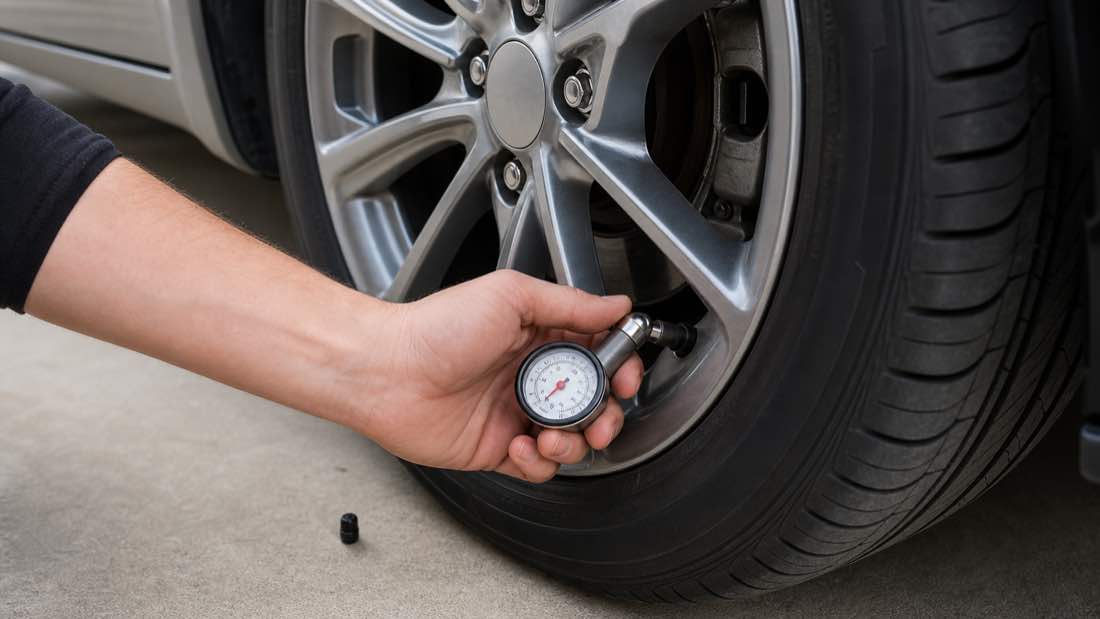
A tire pressure gauge is one of the smallest tools in a car kit, but it can prevent a surprising amount of trouble. Low tire pressure can hurt fuel economy, make the car feel sloppy, wear tires unevenly, and trigger the TPMS light. Too much pressure can also reduce ride comfort and change how the tire contacts the road.
The short version: buy a reliable tire pressure gauge, check pressure when the tires are cold, and inflate to the PSI on the driver’s door placard or owner’s manual, not the number printed on the tire sidewall.
This tire pressure gauge guide explains the main gauge types, how to use one correctly, what mistakes to avoid, and when a low-pressure reading points to a leak instead of normal pressure loss.
Quick Answer
| Question | Practical answer |
|---|---|
| Best gauge type for most drivers | A quality digital or dial gauge that reads in 1 PSI increments |
| When to check tire pressure | Monthly, before road trips, and when outdoor temperature changes sharply |
| Cold or hot tires? | Cold tires are best, before driving or after the car has been parked several hours |
| Which PSI number should you use? | The tire placard on the driver’s door jamb or the owner’s manual |
| Should you trust TPMS only? | No. TPMS warns you, but a gauge gives the actual pressure |
| What if one tire keeps dropping? | Inspect for a puncture, valve stem leak, bead leak, or wheel damage |
What Is a Tire Pressure Gauge?
A tire pressure gauge measures the air pressure inside a tire, usually in PSI for vehicles in the United States. You press the gauge onto the valve stem, the tool seals against the valve, and it shows the pressure reading.
That sounds simple, but the details matter. A crooked gauge can leak air while you check. A weak seal can give a bad reading. A cheap gauge that is several PSI off can make you overinflate or underinflate every tire on the car.
For a beginner tool kit, a tire gauge belongs near the top of the list with jumper cables, a flashlight, a basic socket set, and a portable inflator. If you are building a starter kit, see the basic car tools guide.
Types of Tire Pressure Gauges
Most drivers will see three common types: pencil gauges, dial gauges, and digital gauges. You may also see inflator gauges built into air hoses or portable compressors.
Pencil Tire Pressure Gauge
A pencil gauge is the slim metal gauge that looks like a pen. When you press it onto the valve stem, a marked stick slides out and shows the PSI reading.
Pencil gauges are cheap, compact, and easy to keep in a glovebox. The downside is readability and consistency. Some are accurate enough, but very cheap ones can be harder to read and easier to misplace.
Dial Tire Pressure Gauge
A dial gauge uses a round face with a needle. Many good dial gauges have a hose, a pressure-release button, and a larger face that is easier to read than a pencil gauge.
Dial gauges are a good choice for drivers who want something mechanical but more readable. Look for a gauge with a rubber cover, clear PSI markings, and a range that matches passenger vehicles. A 0-60 PSI range is usually easier to read for normal car tires than a huge 0-150 PSI gauge.
Digital Tire Pressure Gauge
A digital gauge displays the reading on a small screen. Many drivers like digital gauges because the number is quick to read, especially in dim light. Some also include a lighted tip.
The tradeoff is batteries. A digital tire pressure gauge is convenient, but it needs a working battery and should not be stored for years without checking it. If you keep one in the car, test it occasionally.
Inflator Gauge
An inflator gauge is attached to an air hose or portable tire inflator. It lets you add air and read pressure from the same tool. This is useful, but the built-in gauge on a gas station air pump or cheap inflator is not always the most accurate reading.
A smart habit is to use the inflator to add air, then confirm the final PSI with your own separate gauge.
Which Tire Pressure Gauge Should You Buy?
For most US drivers, the best tire pressure gauge is not the fanciest one. It is the one you can read easily, trust reasonably, and keep in the car.
| Gauge type | Best for | Main weakness |
|---|---|---|
| Pencil | Low-cost glovebox backup | Harder to read, quality varies |
| Dial | Home garage use and easy reading | Can be bulkier |
| Digital | Fast readings and low-light checks | Needs batteries |
| Inflator gauge | Adding air while checking pressure | Built-in gauge may be less accurate |
Choose a gauge that reads clearly around the pressure range your vehicle uses. Many passenger cars, crossovers, and minivans sit around the 30-35 PSI range, while trucks, vans, towing setups, and some spares may need different pressures. Always check the vehicle-specific placard.
Where to Find the Correct Tire PSI
The correct tire pressure is usually on the tire and loading information placard on the driver’s door jamb. It may also be in the owner’s manual. This placard can list separate pressures for front tires, rear tires, spare tire, different tire sizes, or loaded conditions.
Do not use the maximum PSI molded into the tire sidewall as your normal inflation target. The sidewall number is a maximum pressure rating for the tire, not the vehicle manufacturer’s recommended everyday pressure.
If your car has aftermarket wheels, a different tire size, or a heavy towing setup, the right pressure can be more specific. In those cases, use manufacturer guidance, tire-shop guidance, or load information instead of guessing.
How to Use a Tire Pressure Gauge
Checking tire pressure is quick once you have done it a few times. The goal is to get a clean seal and compare the reading with the correct cold PSI.
- Park on a safe, level surface.
- Check the tires when they are cold if possible.
- Find the recommended PSI on the driver’s door jamb placard.
- Remove the valve cap from the tire valve stem.
- Press the gauge straight onto the valve stem.
- Listen for a quick seal. A long hiss usually means the gauge is crooked.
- Read the PSI.
- Add air if the tire is low, or release air if it is too high.
- Recheck the pressure after adjusting.
- Replace the valve cap.
Repeat the process for all four tires. Check the spare tire too if your vehicle has one. Many compact spares require much higher pressure than normal tires, and they are often forgotten until the day they are needed.
Cold Tire Pressure Matters
Tire pressure rises as tires heat up during driving. That is why recommended pressures are usually based on cold tires. Cold does not mean winter-cold. It means the vehicle has not been driven much recently, often after sitting for several hours.
If you check pressure after driving, the reading may be higher than the cold target. Do not bleed air from a hot tire just because it is a few PSI above the door placard. Let the tires cool and recheck when possible.
Temperature changes also affect pressure. A cold morning can make pressure drop enough to trigger a TPMS warning, especially if the tires were already close to the limit. If the TPMS light is on, a manual gauge check is the first practical step.
TPMS vs Tire Pressure Gauge
TPMS stands for tire pressure monitoring system. It is a useful safety feature, but it does not replace a gauge. Many systems warn you only after pressure has dropped significantly. Some systems show individual tire pressure on the dashboard, while others only show a warning light.
A gauge gives you the actual pressure. That matters when you are setting pressure after adding air, checking before a road trip, or trying to figure out whether one tire is slowly leaking.
If the TPMS light flashes before staying on, the issue may be a sensor fault rather than simple low pressure. Start with a gauge check, then inspect further if the pressure is correct but the light remains.
Common Tire Pressure Gauge Mistakes
The most common mistake is using the wrong PSI number. The tire sidewall may show a maximum pressure, but your everyday target comes from the vehicle placard.
Another mistake is checking pressure only after the TPMS light turns on. By then, the tire may already be low enough to affect tread wear and handling. Monthly checks are better.
Drivers also get bad readings when they press the gauge at an angle. If you hear air hissing continuously, remove the gauge and try again with a straighter press. A quick tiny puff is normal; a long leak is not.
Finally, do not forget valve caps. They help keep dirt and moisture away from the valve. A missing cap does not usually deflate a healthy tire by itself, but replacing it is cheap and sensible.
What Low Tire Pressure Can Cause
Low tire pressure can make the tire flex more than intended. That can build heat, increase rolling resistance, wear the shoulders of the tread, reduce fuel economy, and make steering feel less precise.
On a long highway drive, a badly underinflated tire is more than an efficiency problem. Heat and flex can damage the tire structure. If one tire is extremely low, do not keep driving normally just to reach an air pump. Stop safely and inspect the tire.
Tire pressure also connects with tire rotation and wear patterns. If tires are rotated on schedule but pressure is ignored, uneven wear can still show up. For rotation timing, see how often to rotate tires.
What Overinflation Can Cause
Too much pressure can make the ride harsher and may reduce the tire’s contact patch. On some tires, chronic overinflation can contribute to center tread wear. It can also make the car feel less settled over rough pavement.
A tire that is a little above target after driving is not automatically overinflated, because warm tires read higher. The better comparison is a cold reading against the door placard.
When Low Pressure Means a Leak
All tires lose a small amount of air over time, and pressure changes with temperature. But one tire that keeps dropping faster than the others deserves inspection.
Common leak sources include nails or screws in the tread, a damaged valve stem, a loose valve core, corrosion where the tire bead seals to the wheel, or wheel damage from a pothole.
If you add air and the same tire loses pressure again within days, do not keep resetting it forever. Have the tire inspected and repaired correctly. Driving on a slow leak can eventually turn a small repair into a roadside problem.
How Accurate Does a Tire Gauge Need to Be?
You do not need a race-team gauge for normal driving, but you do want consistency. A gauge that is off by 1 PSI is not usually a crisis. A gauge that is off by 5 PSI can cause real maintenance problems over time.
If you own two gauges and they disagree, compare them on the same tire at the same time. If one always reads far higher or lower, replace the questionable gauge. Avoid dropping dial gauges, and keep digital gauges dry and powered with a good battery.
How Often Should You Check Tire Pressure?
A practical rule is to check tire pressure once a month, before long road trips, before towing or carrying heavy loads, and whenever the weather changes sharply. It only takes a few minutes, and it gives you a chance to look for sidewall damage, uneven tread wear, nails, and missing valve caps.
Keep the gauge somewhere easy to reach. A tool that lives at the bottom of a storage bin will not help much. A glovebox gauge and a small flashlight make the habit easier.
Should You Keep a Gauge With an OBD2 Scanner?
Yes, but they solve different problems. A tire pressure gauge helps with tire pressure, while an OBD2 scanner helps read engine and emissions codes. Together, they cover two common dashboard frustrations: TPMS warnings and check engine lights.
For a beginner, those two tools can reduce guessing. The gauge tells you whether tire pressure is actually low. The scanner tells you which diagnostic trouble code triggered the check engine light.
Final Advice
Buy a gauge you will actually use. Learn where your vehicle lists the correct PSI. Check tires cold. Recheck after adding air. Watch for one tire that loses pressure faster than the rest.
That simple routine protects tire life, ride quality, fuel economy, and safety. It is not complicated, but it is one of those small maintenance habits that quietly pays for itself.
FAQ
What type of tire pressure gauge is best?
Most drivers will be happy with a good digital or dial tire pressure gauge. Digital gauges are easy to read, while dial gauges do not need batteries. Pencil gauges are fine as a compact backup, but quality varies.
How do I know the correct PSI for my tires?
Use the tire placard on the driver’s door jamb or the owner’s manual. Do not use the maximum PSI printed on the tire sidewall as your everyday target.
Should I check tire pressure cold or hot?
Check tire pressure when tires are cold if possible. Pressure rises as tires heat up during driving, so a hot reading can be higher than the recommended cold pressure.
How often should I check tire pressure?
Check tire pressure about once a month, before road trips, before carrying heavy loads, and when outdoor temperature changes quickly.
Is a TPMS light enough to monitor tire pressure?
No. TPMS is useful, but it is a warning system. A tire pressure gauge gives you the actual PSI and helps you set pressure correctly after adding air.
Why does one tire keep losing air?
One tire that keeps losing air may have a puncture, valve stem leak, loose valve core, bead leak, or wheel damage. Have it inspected if it drops faster than the other tires.
Are gas station tire gauges accurate?
Some are close, but many are worn, dropped, or exposed to weather. Use the air pump to inflate if needed, then confirm the final pressure with your own gauge.
Can I overinflate a tire with a tire pressure gauge?
The gauge only measures pressure, but you can overinflate a tire if you add too much air and do not recheck. If pressure is too high, release small amounts of air and measure again.