
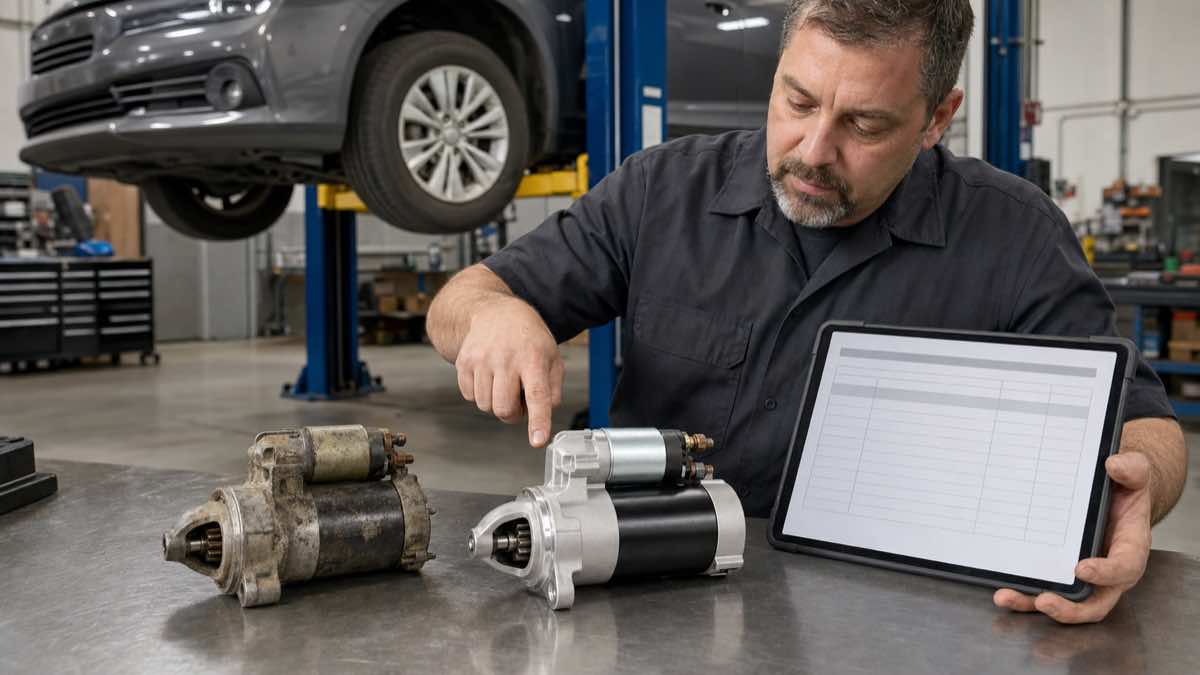
Starter replacement cost in the United States commonly lands in the mid-hundreds, but current national sources span from about $350 to $2,000 because they use different vehicles, parts, labor rates, and exclusions. RepairPal’s estimate updated June 18, 2026 places the average at $566 to $787, including $380 to $515 in parts and $186 to $272 in labor.
That range is a budgeting reference, not a quote. RepairPal excludes taxes, fees, unique location, and related repairs. A starter that is easy to reach on one engine can be buried beneath an intake manifold, exhaust component, underbody shield, or other hardware on another. Confirm the exact year, make, model, engine, drivetrain, part type, labor hours, and warranty before comparing prices.
Starter Replacement Cost at a Glance
| Source | Published estimate | What the range means |
|---|---|---|
| RepairPal | $566-$787 | Average parts and labor; updated June 18, 2026; excludes taxes, fees, location, and related work |
| AAA | $350-$1,100 | Broad complete-replacement range affected by vehicle and labor hours |
| AutoZone | $150 to over $1,100 | Very broad qualified-mechanic replacement or rebuild guidance |
| ConsumerAffairs | $400-$2,000 | 2026 sample spans standard through luxury vehicles; standard-car average reported near $650 |
The sources do not necessarily contradict one another. RepairPal reports a national average range, AAA and AutoZone publish broad consumer ranges, and ConsumerAffairs intentionally includes costly luxury applications. The useful question is not “Which average is correct?” but “Which assumptions match my vehicle and quote?”
What Is Included in a Starter Replacement Quote?
Diagnostic charge
A no-start diagnosis may be billed separately, credited toward the repair, or included in a package. Ask what testing was performed. A complete starting-system diagnosis can include battery state and health, terminal condition, cable voltage drop, starter control command, starter current behavior, charging history, and mechanical engine rotation.
Starter motor or starter assembly
The part may be new OEM, new aftermarket, or remanufactured. Some applications include the solenoid with the starter assembly; others may have separate components or special hardware. Confirm the manufacturer, part number, condition, included solenoid, and warranty rather than comparing only the line-item price.
Labor
Labor equals the shop’s rate multiplied by the quoted labor time, but shops may use different labor guides and policies. The time can include battery disconnect procedures, underbody access, removal of intake or exhaust components, starter replacement, reassembly, starting-system verification, and a post-repair scan.
Core charge
Many remanufactured starters carry a refundable core charge. The old starter is returned so it can be rebuilt. Ask whether the quote shows the core charge and credit separately and whether the shop handles the return.
Taxes, shop fees, towing, and related work
Sales tax, environmental or supply fees, towing, mobile diagnosis, damaged cables, corroded terminals, oil-leak repair, broken fasteners, intake gaskets, exhaust hardware, programming, or battery replacement may sit outside the headline estimate. A quote should separate required starter work from recommended related work.
Current Starter Cost Examples by Vehicle
The following RepairPal snapshots were displayed on June 18, 2026. They illustrate how much one national estimator can vary by model. They are not quotes and may not match your engine, location, taxes, fees, or related repairs.
| Vehicle example | RepairPal displayed range |
|---|---|
| Ford F-150 | $425-$506 |
| Toyota Camry | $445-$544 |
| Toyota Corolla | $481-$595 |
| Chevrolet Silverado 1500 | $517-$779 |
| Nissan Altima | $579-$803 |
| Honda Accord | $670-$968 |
| Honda CR-V | $904-$1,224 |
Even within one model name, different engines and generations can place the starter in different locations and use different parts. Always enter the VIN or exact configuration into an estimator and ask the shop which labor operation it quoted.
Why Starter Replacement Prices Vary So Much
Starter location and access
Access is often the largest labor variable. A visible starter reached from below may require relatively little disassembly. Another may sit beneath an intake manifold or near exhaust hardware, steering components, an axle, a subframe, or dense underbody protection. Corrosion and broken fasteners add time that a clean national estimate cannot predict.
Part design and source
A compact reduction starter, integrated solenoid, start-stop application, diesel unit, or luxury-vehicle part can cost more than a common starter used across many models. OEM, aftermarket, and remanufactured options may have different prices, availability, core requirements, and warranty labor coverage.
Local labor rate and shop type
Independent shops, dealerships, mobile mechanics, and specialists have different overhead, tooling, training, parts policies, and warranties. A higher hourly rate can still produce a lower total when the technician has the vehicle-specific tools and completes the approved labor operation efficiently.
Related damage or the wrong original diagnosis
Oil contamination, heat damage, a failing cable, poor ground, damaged ring gear, weak battery, charging fault, control-circuit problem, or engine mechanical issue can change the repair. Replacing the starter without finding the underlying cause may leave the original no-start condition or shorten the replacement’s life.
Confirm the Starter Is Actually Bad
Clicking, slow cranking, grinding, intermittent starting, or no response can involve the starter, but none is proof by itself. A discharged or weak battery, loose terminal, corroded cable, high-resistance ground, failed relay, ignition or interlock problem, immobilizer decision, or mechanically locked engine can imitate starter failure.
Ask the shop to document the battery test, loaded voltage, positive and ground voltage drop, starter control signal, and starter current behavior. If the battery warning appeared while driving before the no-start, our battery light guide explains why the charging system also needs testing.
Low voltage can trigger multiple dashboard messages that disappear after power is restored. Record the original lights before disconnecting the battery and use our dashboard warning lights guide to identify them. Do not authorize unrelated modules solely because low-voltage warnings appeared during a failed start.
New, OEM, Aftermarket, or Remanufactured Starter?
| Option | Questions to ask | Quote detail to verify |
|---|---|---|
| New OEM | Is it the automaker-branded exact application? | Part and labor warranty, availability, superseded number |
| New aftermarket | Who manufactures it and does it match the original output and fit? | Brand, country or line where disclosed, warranty, labor coverage |
| Remanufactured | Who remanufactured and tested it, and which wear items were renewed? | Core charge, warranty, labor reimbursement, return procedure |
| Rebuild your original | Is a reputable local rebuilder available and is downtime acceptable? | Scope, test report, removed parts, turnaround, warranty |
Do not assume every OEM unit is always necessary or every remanufactured unit is poor. The value depends on the application, supplier, testing process, warranty, access labor, and how costly a repeat failure would be. When labor is expensive, paying more for a well-supported part may reduce repeat-risk exposure even if the first invoice is higher.
How to Compare Starter Replacement Quotes
- Match the diagnosis. Each shop should be solving the same confirmed fault, not merely the same symptom.
- Match the part. Compare brand, part number, new or remanufactured condition, solenoid inclusion, and core charge.
- Match labor scope. Ask for labor hours, rate, required disassembly, gaskets or hardware, programming, and post-repair tests.
- Match warranties. Compare part duration, labor coverage, nationwide or local handling, exclusions, and who pays towing or repeat removal.
- Match the final total. Include diagnosis, towing, taxes, fees, and related work rather than comparing one parts line.
- Separate urgent from optional. Ask which additional items are required to complete the starter repair and which are preventive recommendations.
What a Complete Starter Repair Should Include
Before removal, the shop should preserve relevant diagnostic information and follow the vehicle’s battery disconnect or power-down procedure. Some vehicles require memory support, window or steering relearns, security preparation, or a waiting period before electrical connectors are disturbed. Those steps depend on the model and should not be assumed from a generic starter video.
During replacement, the technician should inspect the main power cable, control wire, terminals, engine and body grounds, mounting surface, ring gear where visible, heat shields, and nearby leaks. Reusing a burned terminal or leaving an oil leak above the replacement can undermine an otherwise correct repair. Removed intake, exhaust, underbody, or structural hardware should receive the required new gaskets, seals, fasteners, and tightening procedures.
After installation, the engine should crank normally through repeated starts under safe conditions. The shop should verify charging performance, check for warning messages, confirm that removed systems work, inspect for fluid or exhaust leaks, and clear or document codes only after saving useful evidence. Ask for the old part when local rules and core-return terms allow; a remanufactured exchange normally requires that core to be returned.
Starter Quote Red Flags
- The starter is condemned only because the car clicks or will not start, with no battery or cable test results.
- The estimate says only “starter” without brand, part number, new or remanufactured condition, or warranty.
- Labor hours are high, but the shop cannot name the access operation or labor-guide basis.
- A core charge appears in the total without explaining when and how the credit is applied.
- Required intake gaskets, exhaust hardware, cables, or leak repairs are added verbally but not itemized.
- The written warranty covers the part but not repeat removal labor, and that limitation was not disclosed.
- The shop discourages a second quote while the vehicle can remain safely stored and no immediate hazard exists.
A high quote is not automatically unfair. Difficult access, corrosion, a high local labor rate, OEM-only availability, or a warranty with nationwide support can justify it. The concern is an unexplained quote. A good estimate makes the diagnosis, part choice, labor operation, additions, exclusions, and final total understandable before authorization.
Starter Quote Worksheet
| Line item | Quote A | Quote B |
|---|---|---|
| Diagnostic charge and test results | _____ | _____ |
| Starter brand, number, and condition | _____ | _____ |
| Part price | _____ | _____ |
| Core charge and credit | _____ | _____ |
| Labor hours x hourly rate | _____ | _____ |
| Gaskets, hardware, cables, or related work | _____ | _____ |
| Taxes, fees, and towing | _____ | _____ |
| Part and labor warranty | _____ | _____ |
| Out-the-door total | _____ | _____ |
Can You Replace a Starter Yourself?
On some older vehicles, access is straightforward for an experienced DIYer. On others, replacement requires safe lifting, battery power-down procedures, intake or exhaust removal, tight access to an always-hot high-current cable, shims, torque specifications, scan procedures, or model-specific initialization.
DIY savings are not simply the labor line. Include diagnosis, towing or transport, safe support equipment, tools, replacement gaskets and fasteners, core return, downtime, and the consequence of a wrong diagnosis. Never work beneath a vehicle supported only by a jack, and disconnect or isolate power exactly as the vehicle service procedure specifies.
Repair, Rebuild, or Replace?
A shop may replace the complete assembly because it reduces downtime and provides a packaged warranty. A specialist may rebuild the original when parts are available and the housing or application is worth retaining. Repairing only a solenoid, terminal, or cable may be appropriate when testing proves the starter motor itself is sound.
Ask whether “rebuild” means your original unit is disassembled and repaired or a previously remanufactured exchange unit is installed. Those are different services with different core, turnaround, and warranty terms.
Frequently Asked Questions
How much does a starter replacement cost in 2026?
RepairPal’s June 18, 2026 national estimate is $566 to $787 for parts and labor, excluding taxes, fees, location, and related repairs. Other current sources span roughly $350 to $2,000 because vehicle samples and assumptions differ.
How much is labor to replace a starter?
RepairPal currently estimates average labor at $186 to $272, but your total depends on local hourly rate and labor-guide time. A buried starter requiring intake, exhaust, or underbody disassembly can cost much more in labor.
How long does starter replacement take?
An accessible starter may take around one or two labor hours, while complex placement can require several hours. Ask the shop for the quoted labor-guide operation and every component that must be removed.
Does clicking mean I need a new starter?
No. Clicking can result from a weak battery, poor terminal, cable resistance, relay or control fault, starter problem, or mechanical resistance. Require starting-system tests before approving replacement.
Is a remanufactured starter worth it?
It can be when supplied by a reputable remanufacturer with clear testing and warranty support. Compare supplier, core charge, part warranty, labor coverage, and the cost of repeating difficult installation work.
Will a warranty cover starter replacement?
Coverage depends on the vehicle warranty or service-contract terms, age, mileage, exclusions, diagnosis, and required authorization. Read the contract and obtain approval before repair; do not rely on the product name or a verbal promise.
Bottom Line
Use $566 to $787 as one current national starter replacement cost reference, not a guaranteed price. Verify the diagnosis, exact part, labor hours, access work, core credit, taxes, fees, towing, related repairs, and warranty. Two quotes are comparable only when they solve the same proven fault with equivalent parts and scope.