
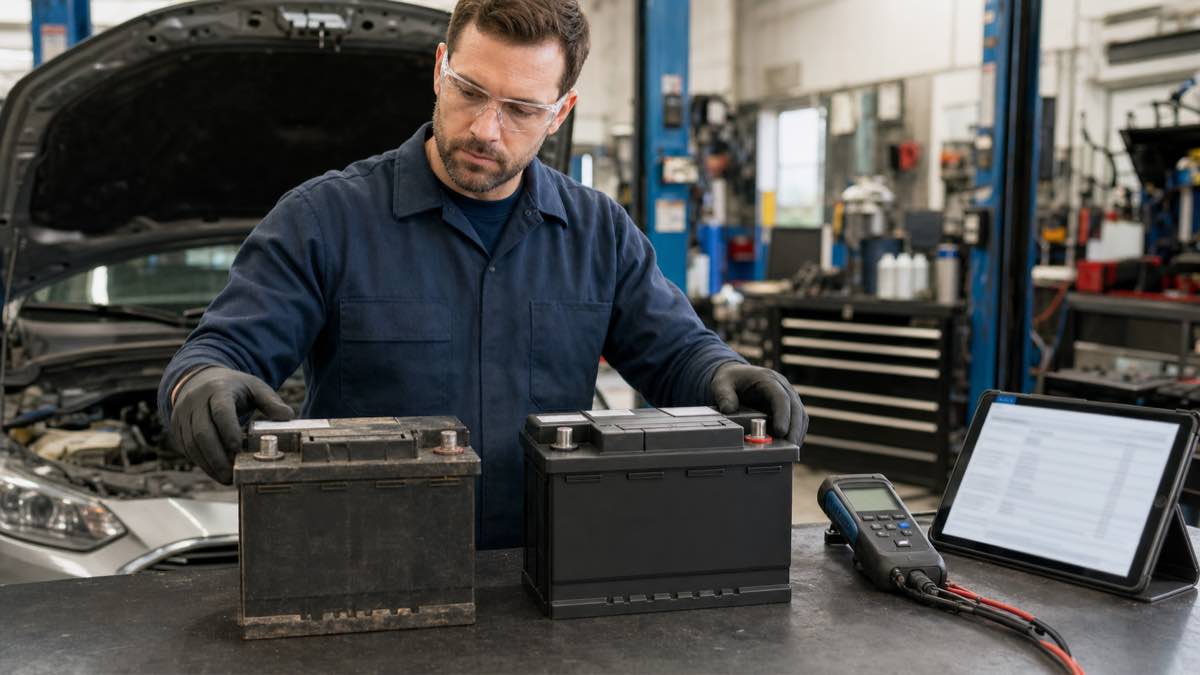
Car battery replacement cost can be less than $200 for a common battery with simple access, but some current national estimates are much higher. RepairPal’s estimate updated June 18, 2026 puts the average installed price at $423 to $460, including $364 to $374 for parts and $59 to $86 for labor. Consumer Reports, meanwhile, reported an average retail price of $187 among the batteries in its ratings, with one tested model costing more than $362.
Those figures describe different purchases. A retail battery price is not the same as a model-specific repair-shop invoice. Battery technology, group size, cold-cranking capacity, access, battery-management registration, diagnosis, shop type, location, taxes, and fees can all change the total. This guide covers the conventional 12-volt starting battery or low-voltage auxiliary battery—not a hybrid or electric vehicle’s high-voltage traction pack.
Car Battery Replacement Cost at a Glance
| Cost reference | Published figure | What it represents |
|---|---|---|
| RepairPal | $423-$460 | Average installed estimate updated June 18, 2026; excludes taxes, fees, location, and related repairs |
| Consumer Reports | $187 average | Average retail price in its battery ratings as reported October 27, 2025; one model exceeded $362 |
| Lemonade | $50-$300+ | Broad consumer range updated March 5, 2026; battery type and vehicle needs drive the spread |
| AutoZone services | Free testing, charging, and recycling | Installation may also be available after purchase, subject to vehicle and store restrictions |
A practical budget starts with an exact fitment lookup, not a universal average. Enter the year, make, model, engine, and—when requested—VIN. Then determine whether the vehicle requires a conventional flooded, enhanced flooded (EFB), or absorbed glass mat (AGM) battery. Finally, ask whether installation and electronic registration are included. A low advertised battery price can become a poor comparison when it is the wrong technology, excludes a core charge, or omits required setup.
Why Current Battery Cost Estimates Disagree
RepairPal’s number combines a relatively high parts estimate with professional labor. Consumer Reports’ figure reflects products in a retail testing set. Lemonade publishes a broad consumer shopping range. Auto-parts retailers may install an eligible battery at no additional charge, while a repair shop may bill diagnosis and labor. None of these scopes is inherently wrong; they answer different questions.
When comparing an online estimate with a local quote, match all of the following: battery part number and technology, warranty, installation, old-battery core credit, diagnostic work, terminal service, battery registration or reset, mobile service or towing, taxes, and shop fees. If even one major line differs, the totals are not equivalent.
What Determines the Price of a New Car Battery?
Battery type: flooded, EFB, or AGM
A conventional flooded battery is usually the least expensive option when the vehicle is designed for it. EFB batteries are built for greater cycling demands and appear in some start-stop applications. AGM batteries tolerate repeated charge-discharge cycles and support higher electrical loads. Consumer Reports says AGM batteries can cost 40% to 100% more than highly rated conventional batteries.
Do not downgrade solely to lower the invoice. Interstate Batteries states that its EFB line is suitable as an original-equipment replacement for vehicles that came with EFB, while its AGM guidance notes that start-stop vehicles often need the additional cycling capability. Check the owner’s manual, fitment catalog, and vehicle-specific service information before changing technologies.
Group size, terminals, CCA, and reserve capacity
The case must fit the tray and hold-down, and the terminals must be in the correct positions. Cold cranking amps (CCA) and reserve capacity must meet the vehicle’s requirements. A physically similar battery with reversed terminals or insufficient capacity is not an acceptable bargain. Less-common sizes and higher-capacity batteries frequently cost more because fewer products fit the application.
Battery location and installation access
An under-hood battery with open access may take only a short service visit. Another may sit beneath a seat, under the trunk floor, behind trim, below a cowl, or inside a compartment that needs vent routing and careful reassembly. Dual-battery systems add another layer: a vehicle may have a starting battery and a separate auxiliary battery, and the quote should identify which one failed.
Battery registration and electronic resets
Some modern vehicles monitor battery age, condition, and charge strategy. Replacement may require a scan-tool registration, battery-type entry, or energy-management reset. Other vehicles may need clock, window, steering, idle, or radio procedures after power is disconnected. Ask whether the quoted shop has included every required model-specific step instead of assuming that all batteries are “disconnect and swap.”
Warranty and seller
A longer free-replacement period, nationwide support, roadside installation, or included labor can justify a higher upfront price. Read the written terms. A prorated warranty is not the same as full replacement, and some warranties exclude improper installation, neglect, commercial use, or the labor needed to remove the failed battery.
What Should Be Included in the Quote?
- Diagnosis: battery state of charge and health, terminal condition, starting performance, and charging-system check when relevant.
- Exact battery: brand or product line, part number, group size, technology, CCA, and warranty.
- Core charge and credit: the deposit for the old battery and how it is refunded or applied.
- Installation: removal, tray and hold-down inspection, terminal cleaning when appropriate, secure installation, and vent-tube connection if equipped.
- Vehicle setup: required registration, scan, relearn, memory support, or post-install checks.
- Final charges: mobile-service fee, towing, taxes, shop supplies, environmental fees, and any related repair.
Ask for an out-the-door total before authorizing work. A core charge should not remain a mystery: if the seller keeps the old battery, the estimate or receipt should show how the credit was handled. If you take the old battery with you, confirm the return deadline and receipt requirements.
Confirm the Battery Is Actually Bad
A jump-start does not prove the battery needs replacement. The battery may simply be discharged because lights were left on, the vehicle sat unused, a parasitic draw is present, or the charging system failed. Conversely, a battery can accept a surface charge and still lack the capacity to start the engine reliably. Testing should follow an appropriate charge when needed and account for battery type, temperature, and state of charge.
Slow cranking, clicking, dim lights, and a no-start can also come from loose or corroded terminals, damaged cables, a bad ground, a starter fault, an engine problem, or a control issue. If the warning appeared while the engine was running, read our battery light guide: that light commonly points to a charging-system problem, not a simple instruction to buy a battery.
Battery age helps with planning but does not replace a test. Our guide to how long a car battery lasts covers climate, driving pattern, storage, and early failure. This page owns the replacement-price and quote-comparison question; the lifespan guide owns maintenance timing and longevity.
Standard, EFB, or AGM: How the Choice Changes Cost
| Battery type | Common use | Cost implication | What to verify |
|---|---|---|---|
| Conventional flooded | Many vehicles without heavy cycling demands | Usually the lowest initial parts price | Correct group size, terminals, CCA, and vehicle approval |
| EFB | Some start-stop and higher-cycle applications | Typically above a basic flooded battery | Whether EFB is original equipment and whether the system accepts another type |
| AGM | Many start-stop, high-accessory-load, or trunk/interior applications | Consumer Reports says 40%-100% more than highly rated conventional batteries | AGM requirement, venting, charge strategy, and registration |
| 12V auxiliary | Some hybrids, EVs, and dual-battery vehicles | Fitment, access, and electronic setup can raise total cost | That the quote is for the low-voltage battery, not the traction pack |
“Premium” is not a complete specification. A more expensive battery may provide the necessary technology, capacity, warranty, or fit, but branding alone does not prove suitability. Compare the vehicle requirement and written warranty first, then price equivalent products.
How to Compare Car Battery Replacement Quotes
- Use the exact vehicle configuration. Match year, make, model, engine, options, and battery position.
- Compare the same technology. A flooded battery quote is not equivalent to an AGM quote.
- Match performance specifications. Confirm group size, terminal layout, CCA, reserve capacity, and any automaker specification.
- Separate price from deposit. Identify the battery price, refundable core charge, and old-battery credit.
- Ask about installation limits. Free retail installation may exclude difficult locations or vehicles requiring special procedures.
- Include electronic setup. Registration or reset should appear in the scope when the vehicle requires it.
- Read the warranty. Compare full-replacement duration, prorated terms, labor, exclusions, and claim locations.
- Compare final totals. Add diagnosis, mobile service, towing, taxes, fees, and related terminal or cable work.
Ways to Lower the Cost Without Buying the Wrong Battery
Get the battery tested before buying. AutoZone advertises free battery testing and charging, and many repair facilities offer testing as part of diagnosis. A discharged but serviceable battery may need charging and an explanation for the discharge, while a failed battery needs replacement. If the battery failed early, test the charging system and check for parasitic drain rather than treating repeated replacements as normal.
Compare like-for-like fitments from a repair shop, dealer, parts retailer, warehouse club, and mobile battery service. Ask whether installation is available for your exact vehicle and whether registration is included. Return the old battery promptly for the core credit. Keep the receipt and note the installation date so a future warranty claim is easier.
Do not save money by choosing insufficient CCA, the wrong case or terminal layout, a basic flooded battery for a system that requires AGM or EFB, or an installation that leaves the hold-down loose. The cheapest safe option is the lowest total price among batteries that actually meet the vehicle’s requirements.
Can You Replace a Car Battery Yourself?
Some under-hood batteries are reasonable DIY jobs for an owner who has the correct procedure, tools, and protective equipment. Others are heavy, difficult to reach, vented into the body, paired with another battery, or tied to an energy-management system that needs a scan tool. A parts store’s free installation may also be a better value than buying tools, but availability depends on access and policy.
Before disconnecting anything, follow model-specific service information. Keep sparks, flames, and metal tools away from the terminals; wear eye protection; do not tip or drop the battery; and never bridge the terminals. Preserve power only with an approved procedure, because a memory device can create live circuits while you work. Secure the replacement with the correct hold-down, reconnect any vent tube, and verify that the cables cannot move or contact the wrong terminal.
Battery Quote Red Flags
- The seller recommends replacement without identifying a failed test result or explaining why testing was not possible.
- The estimate lists only “battery” with no part number, type, group size, CCA, or warranty.
- A conventional battery is substituted for an AGM or EFB solely because it is cheaper.
- The quote includes a core charge but does not show the credit for surrendering the old battery.
- Registration is added as an unexplained fee, or omitted even though the model-specific procedure requires it.
- Terminal, cable, or alternator work is bundled into the total without separate findings and prices.
- The seller implies that a battery light always means the battery itself has failed.
A high quote is not automatically unfair. A costly AGM battery, difficult interior access, dual-battery diagnosis, mobile service, scan-tool setup, or strong nationwide warranty can justify a higher total. The red flag is a price that cannot be connected to a clear test result, exact product, complete labor scope, and written warranty.
Car Battery Quote Worksheet
| Line item | Quote A | Quote B |
|---|---|---|
| Battery test result and diagnosis | _____ | _____ |
| Brand, part number, and technology | _____ | _____ |
| Group size, CCA, and reserve capacity | _____ | _____ |
| Battery price | _____ | _____ |
| Core charge and credit | _____ | _____ |
| Installation and access labor | _____ | _____ |
| Registration, reset, or post-install test | _____ | _____ |
| Taxes, fees, mobile service, or towing | _____ | _____ |
| Full and prorated warranty terms | _____ | _____ |
| Out-the-door total | _____ | _____ |
Frequently Asked Questions
How much does car battery replacement cost in 2026?
RepairPal’s national estimate updated June 18, 2026 is $423 to $460 installed, with $364 to $374 in parts and $59 to $86 in labor. Retail purchases can be lower: Consumer Reports reported a $187 average among batteries in its ratings. Your total depends on battery type, fitment, access, registration, seller, location, taxes, and fees.
Why is my car battery quote over $400?
The vehicle may require an expensive AGM or uncommon battery, difficult access, professional diagnosis, electronic registration, or mobile service. Ask for the exact part number, battery technology, labor scope, core credit, warranty, fees, and out-the-door total before deciding whether the quote is reasonable.
Is car battery installation free?
Some auto-parts retailers install eligible batteries bought from them at no additional charge, but restrictions can apply. Difficult battery locations, dual-battery systems, and vehicles requiring special power-down or registration procedures may need professional shop labor.
Does a battery light mean I need a new battery?
No. A battery-shaped warning while the engine is running usually indicates a charging-system problem. The battery, alternator, belt drive, wiring, terminals, or control system may be involved. Test the system before replacing parts.
Do I need an AGM battery if my car came with one?
Often, yes. The vehicle’s charge strategy, start-stop operation, electrical load, or battery location may be designed around AGM performance. Do not downgrade without checking the owner’s manual, exact fitment information, and qualified vehicle-specific guidance.
Is a hybrid or EV battery included in these prices?
This guide covers a conventional 12-volt starting battery or low-voltage auxiliary battery. A hybrid or EV high-voltage traction battery is a different system with different safety requirements, warranties, diagnosis, and replacement costs.
Bottom Line
The most useful car battery replacement cost is the out-the-door price for the correct battery and complete procedure on your exact vehicle. Use current national figures as budgeting references, then compare equivalent technology, specifications, installation, registration, core credit, warranty, and fees. Test before replacing, especially when a charging fault or cable problem could be the real cause.