
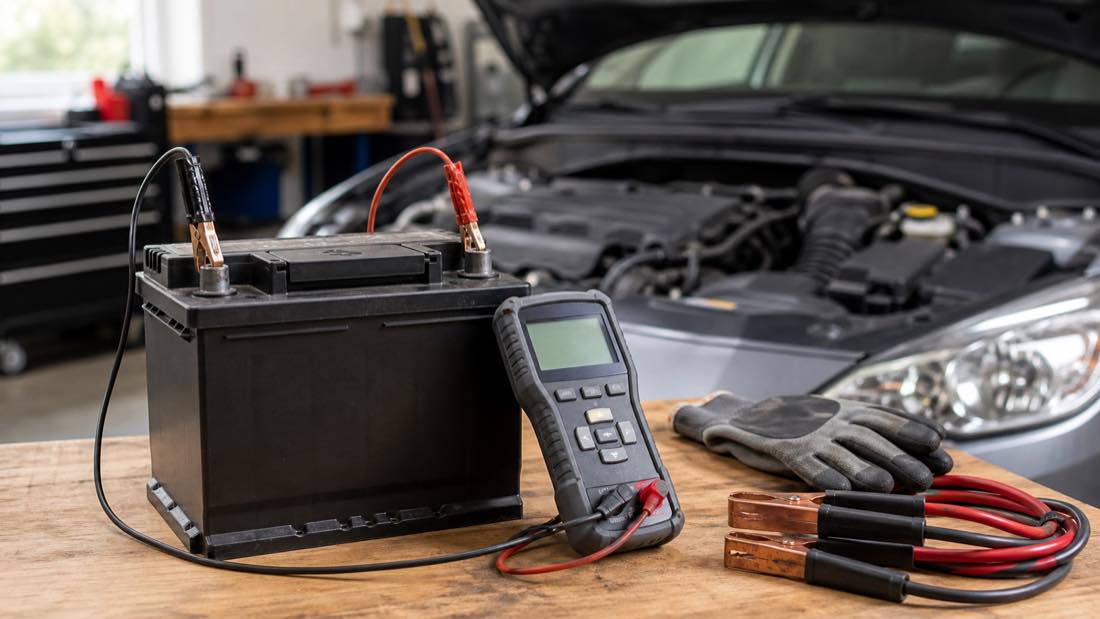
Most car batteries last about 3 to 5 years, but climate, driving habits, battery type, and the charging system can shorten or extend that range. In hot states, a battery may start getting weak closer to 3 years. In cooler climates, a healthy battery may last 5 years or a little longer.
The tricky part is that a car battery can feel fine until one morning it does not start the engine. That is why testing matters. Once a battery is 3 years old, have it tested at least once a year. If you live in a hot climate, take many short trips, or park the car for long periods, test it sooner.
For the broader service plan, see our complete car maintenance schedule by mileage. If your dashboard battery light comes on while driving, use our battery light on while driving guide because that can point to a charging system problem, not just an old battery.
Quick Answer
| Situation | Typical battery life |
|---|---|
| Average gas vehicle | About 3-5 years |
| Hot climate, frequent heat exposure | Often closer to 3 years |
| Cooler climate, healthy charging system | Often 4-5+ years |
| Mostly short trips | Often shorter than average |
| Car parked for weeks at a time | Battery may drain early |
| AGM battery in start-stop vehicle | Can last well, but must be replaced with the right type |
| Weak battery test result | Replace before it strands you |
These are general ranges. Battery testing gives a better answer than age alone.
Why Car Batteries Wear Out
A 12 volt battery has a hard job. It has to deliver a large burst of current to the starter motor, keep vehicle memory alive when the car is off, and recover charge from the alternator after each start.
Over time, lead acid battery chemistry degrades. Heat speeds up internal wear. Vibration can damage internal plates. Repeated deep discharge can shorten battery life. Short trips can prevent the alternator from fully recharging the battery after starting.
That is why two identical batteries can age differently. A battery in Arizona traffic may have a very different life than one in a mild northern climate with regular highway driving.
Heat, Cold, and Where You Live
Cold weather exposes a weak battery because engines are harder to crank and batteries produce less available power in low temperatures. But heat is often what damages the battery in the first place.
Hot climates speed up chemical breakdown and water loss inside many batteries. Under-hood temperatures can be brutal, especially in slow traffic. If you live in Texas, Florida, Arizona, Nevada, or another hot area, do not be surprised if a battery becomes questionable around year three.
Cold states bring a different problem. A battery that was barely strong enough in fall may fail during the first serious cold snap. That is why late summer or early fall is a smart time for a battery test before winter.
Driving Habits That Shorten Battery Life
Short trips are tough on batteries. Starting the engine uses a lot of power, and a five-minute drive may not give the alternator enough time to replace it.
Battery life can also be shortened by:
- repeated short errands
- long periods parked
- frequent jump starts
- loose battery hold down hardware
- dirty or corroded battery terminals
- heavy accessory use with the engine off
- aftermarket electronics
- parasitic draw or key-off drain
- weak alternator output
- extreme heat
If your vehicle sits for weeks, a battery maintainer or trickle charger can help keep the state of charge healthier. This is especially useful for seasonal cars, second vehicles, and cars driven mostly on weekends.
How Long Can a Car Sit Without Driving?
There is no perfect number because every vehicle has a different key-off drain. A simple older car with a healthy battery may sit longer than a modern vehicle with keyless entry, alarm modules, telematics, dash cameras, or aftermarket electronics.
As a practical rule, a parked car should be driven long enough to recharge the battery every week or two when possible. If the car will sit for several weeks, use a battery maintainer rather than relying on occasional idling. Idling for a few minutes may not replace the energy used to start the engine.
If the battery goes dead after sitting only a few days, suspect a weak battery, corroded battery cable, parasitic draw, or a charging system issue. Replacing the battery may not solve the problem if something on the vehicle is draining it while parked.
Signs of a Weak Car Battery
You may have a weak battery if you notice:
- slow crank when starting
- rapid clicking sound when turning the key
- dim lights before starting
- electrical features acting strange
- battery warning light or charging light
- corrosion around battery terminals
- swollen or leaking battery case
- the car starts after a jump but struggles again later
- battery is 3-5 years old and tests weak
If your car clicks but will not start, read our car clicks but won’t start guide because the cause may be the battery, starter, cables, or connection quality.
Battery, Alternator, or Starter?
Not every no-start problem is a bad battery.
| Symptom | Possible cause | What to check |
|---|---|---|
| Slow crank | Weak battery, poor connection, starter load | Battery test and terminal inspection |
| One click | Starter, solenoid, cable, weak battery | Voltage and starter circuit |
| Repeated clicking | Weak battery or bad connection | Battery state of charge |
| Battery light while driving | Alternator or charging system | Charging voltage and belt |
| New battery dies quickly | Parasitic draw or charging issue | Key-off drain and alternator test |
| No lights at all | Dead battery or bad main connection | Terminals, cables, battery voltage |
A battery test, charging system test, and starter draw test can separate these problems. Guessing can get expensive.
When Should You Replace the Battery?
Replace the battery when it fails a load test, tests weak near the end of its expected life, leaks, swells, repeatedly needs a jump start, or cannot hold charge. You do not always need to wait for a total failure.
Preventive replacement makes sense if:
- the battery is 4-5 years old
- you live in a hot climate
- the vehicle is used for commuting or family trips
- you are planning a road trip
- the battery tested marginal
- the car has already needed a jump start
- winter is coming and the battery is weak
If a battery is old and already showing symptoms, replacing it on your schedule is better than replacing it in a parking lot.
How to Test a Car Battery
A repair shop, parts store, or roadside service can test the battery with a proper battery tester. Many tests check voltage, cold cranking amps, internal resistance, and overall state of health.
A simple multimeter can give a rough voltage check:
| Reading with engine off | General meaning |
|---|---|
| About 12.6 volts | Fully charged or close |
| Around 12.4 volts | Partially charged |
| Around 12.2 volts | Low state of charge |
| Near 12.0 volts or less | Very low or discharged |
Voltage alone does not prove a battery is healthy. A weak battery can show decent voltage and still fail under load. That is why a load test is more useful before replacement decisions.
Choosing the Right Replacement Battery
Use the battery group size, terminal layout, hold down style, and cold cranking amps listed for your vehicle. The owner’s manual, existing battery label, or a parts catalog can help confirm fitment.
Important specs include:
- group size
- CCA rating
- reserve capacity
- AGM, EFB, or flooded lead acid type
- terminal position
- warranty coverage
- fresh manufacturing date
Many start-stop vehicles require AGM or EFB batteries. Replacing one with the wrong battery type can cause charging problems, warning lights, or short battery life. Some vehicles also need battery registration or reset after replacement.
The amp hour rating matters on some imported vehicles and many modern cars because it describes stored capacity, not just starting power. Cold cranking amps matter for starting, reserve capacity matters for how long the battery can support loads, and group size matters for physical fit. If the original battery is AGM or EFB, match that design unless the manufacturer says otherwise.
Also inspect the battery cables before blaming the battery. A loose, corroded, or damaged cable can mimic a dead battery by blocking current flow to the starter motor. Clean terminals and tight connections are basic, but they matter.
Roadside Help vs DIY Replacement
Replacing a simple under-hood battery can be beginner-friendly, but some vehicles make the job harder. Batteries may be under the rear seat, in the trunk, behind trim panels, or tied into electronic battery monitoring systems.
Use a repair shop or roadside assistance if:
- the battery is hard to access
- the vehicle needs battery registration
- the terminals are badly corroded
- the battery case is swollen or leaking
- the car still will not start after a jump
- the battery light stays on after replacement
- you are not sure which battery type fits
DIY replacement is safer when the battery is easy to reach, the correct group size is confirmed, the cables are clean, and you know the proper disconnect/reconnect procedure.
Car Battery Replacement Cost
Battery cost depends on size, type, brand, warranty, and labor.
| Battery/service | Typical US cost range |
|---|---|
| Standard flooded battery | $120-$250+ |
| AGM battery | $180-$350+ |
| Premium or large truck battery | $200-$400+ |
| Installation labor | Often free to $100+ |
| Testing | Often free to $50 |
Dealer replacement may cost more, especially if the battery is difficult to access or needs registration. A repair shop can also check cables, alternator output, and parasitic draw if the battery failed early.
How to Make a Car Battery Last Longer
You cannot make a battery last forever, but you can avoid shortening its life.
Helpful habits:
- drive long enough to recharge after starting
- keep terminals clean and tight
- make sure the battery hold down is secure
- test the battery yearly after year three
- avoid leaving lights or accessories on
- use a maintainer for parked vehicles
- fix charging system problems quickly
- replace the battery with the correct type
- keep heat shields and covers in place
During an oil change or tire rotation, ask for a quick battery inspection if the battery is older or you have noticed slow starting.
Common Mistakes
Do not make these battery maintenance mistakes:
- waiting until the car will not start
- replacing a battery without checking the alternator
- ignoring corrosion on terminals
- buying the wrong group size
- using lower CCA than recommended
- installing a standard battery where AGM is required
- jump-starting repeatedly without diagnosis
- letting a parked car sit for months without charging
- assuming the battery light always means the battery is bad
- ignoring a loose battery hold down
A dead battery is inconvenient. A wrong diagnosis can be more expensive.
FAQ
How long does a car battery last?
Most car batteries last about 3 to 5 years. Heat, short trips, long parking periods, vibration, battery type, and charging system health can change that range.
Can a car battery last 7 years?
Yes, some batteries last 7 years, especially in mild climates with good charging habits. But after year three, testing is smarter than guessing.
How do I know if my car battery is dying?
Common signs include slow cranking, clicking, dim lights, corrosion, needing jump starts, and a weak battery test result.
Does hot weather shorten car battery life?
Yes. Heat speeds up internal battery wear, so batteries in hot climates often fail sooner than batteries in cooler areas.
How long can a car sit before the battery dies?
Some cars can drain a battery in a few weeks, especially if the battery is old or the vehicle has keyless entry, alarms, or other key-off loads.
Should I replace my battery before it dies?
If the battery is old, tests weak, or you rely on the car daily, preventive replacement can be better than waiting for a no-start.
Is the battery light the same as a bad battery?
No. A battery light while driving often means the alternator or charging system is not keeping the battery charged.
Do AGM batteries last longer?
AGM batteries can handle deeper cycling and start-stop systems better, but they still need the correct charging strategy and replacement type.