
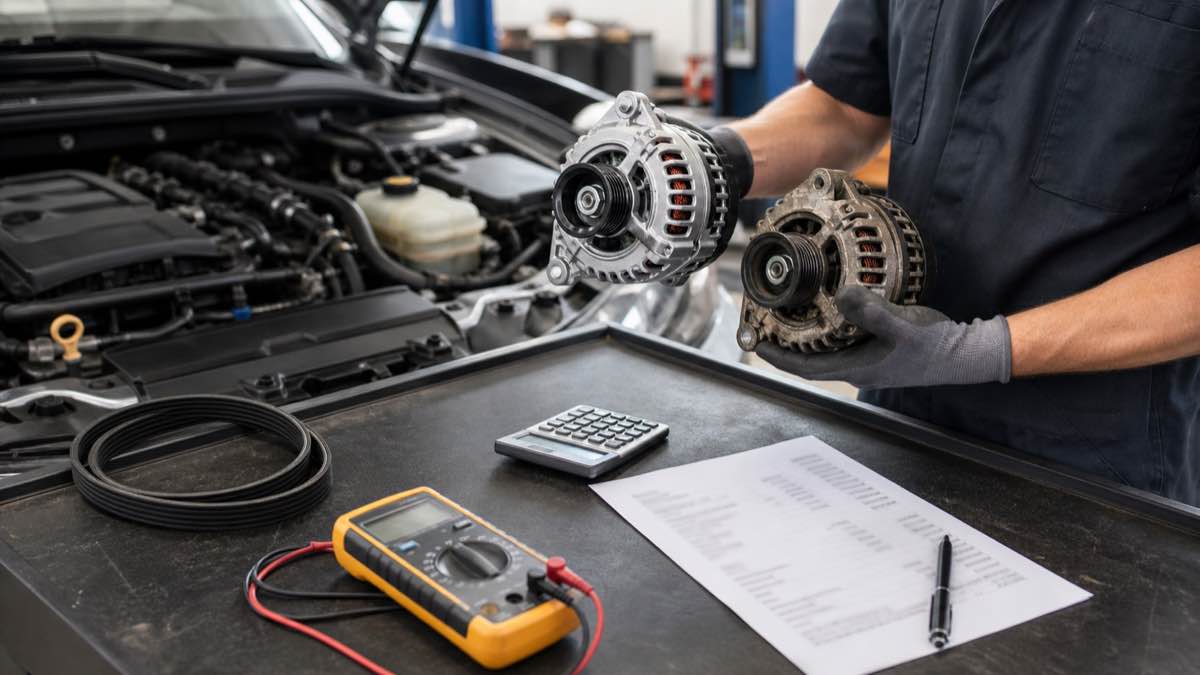
An alternator replacement commonly becomes urgent: the battery warning light appears, electrical systems weaken, and the vehicle may eventually stall. That urgency makes it tempting to approve the first quote. A better approach is to confirm the charging-system diagnosis, understand what part the shop is installing, and compare the total warranty-backed price for your exact vehicle.
As of June 30, 2026, RepairPal lists a national alternator replacement estimate of $802 to $1,073, including estimated labor of $191 to $281 and parts of $611 to $793. The estimator states that taxes, fees, location, and related repairs are not included. Your actual alternator replacement cost can fall outside that range because access, engine configuration, alternator output, part type, and local labor rates vary.
Source note: Cost figures in this article are planning benchmarks, not quotes. Check the current RepairPal alternator estimator with your vehicle and ZIP code, then compare it with written local estimates.
Alternator Replacement Cost at a Glance
| Cost item | Current national estimate | What can change it |
|---|---|---|
| Total replacement | $802-$1,073 | Vehicle, location, part choice, access, related repairs |
| Labor | $191-$281 | Book time, shop rate, engine-bay access |
| Parts | $611-$793 | OEM, new aftermarket, remanufactured, output rating |
These figures come from RepairPal’s national estimator at the review date above. They should not be combined with unrelated online ranges as though every source measures the same thing. Some articles quote inexpensive remanufactured parts or independent-shop scenarios; others use new OEM parts, dealer pricing, or difficult vehicle layouts. Ask what is included before deciding that either number is fair or inflated.
Why the Same Repair Can Cost $500 or More Than $1,400
Alternators do the same basic job, but they are not interchangeable commodities. The following variables create most of the price spread.
Vehicle and Engine Configuration
An alternator mounted high with clear access may take much less labor than one tucked behind other components. Some jobs require removing shields, cooling fans, brackets, an axle, or other parts before the alternator can come out. The same model name can also use different engines and charging components, so a quote should identify the year, trim, engine, and preferably VIN.
Alternator Output and Electronics
Vehicles with heated accessories, electric power steering, start-stop systems, large infotainment loads, towing equipment, or aftermarket electronics may use higher-output or electronically controlled charging systems. Correct amperage, pulley design, mounting, and electrical connector matter. A cheaper unit is not a bargain if it does not match the original specification.
New OEM, New Aftermarket, or Remanufactured
A new OEM alternator is supplied through the vehicle manufacturer’s parts channel. A new aftermarket unit is newly manufactured by another supplier. A remanufactured alternator is a used core that has been disassembled, inspected, and rebuilt with selected replacement components. Quality and testing standards vary within each category, so the label alone does not establish reliability.
Compare brand, part number, output rating, warranty length, labor coverage, and who pays removal and reinstallation if the part fails. A less expensive part-only warranty may still leave you responsible for a second labor bill.
Local Labor Rate and Shop Type
Labor usually equals the published labor time multiplied by the shop’s rate, although pricing policies differ. Dealers may use OEM parts and factory-specific procedures. Independent shops may offer more part choices. Mobile mechanics can reduce facility overhead for accessible jobs but may not be suitable when lifting, programming, or extensive disassembly is required.
Real Vehicle Examples Show Why One Average Is Not Enough
RepairPal’s vehicle-specific pages illustrate the spread. At the time reviewed, its estimates included:
- Toyota Corolla: $534-$722.
- Toyota Camry: $564-$832.
- Ford F-150: $694-$845.
- Nissan Altima: $703-$915.
- Honda CR-V: $1,007-$1,476.
Those are model-level estimates, not promises for every year or engine. For example, RepairPal’s year-specific listings can differ substantially within one model line. Use them to understand scale, then enter the exact vehicle and location into an estimator or request local written quotes.
What the Replacement Job Usually Includes
A professional alternator replacement should begin with diagnosis, not part removal. After confirming the charging fault, the technician records settings or follows any model-specific power-disconnection procedure, isolates the 12-volt battery, and gains access to the alternator. The drive belt is released, electrical connections are protected from short circuits, and mounting hardware is removed.
The replacement unit should be compared with the original for mounting points, connector shape, pulley design, and output specification. The technician installs it with the correct hardware and torque, restores the belt with the specified routing and tension, reconnects power, and checks the belt’s tracking. A complete job ends with a charging-system test under appropriate load, battery evaluation, and any required scan-tool reset or system relearn.
A quote may rise when access requires removing additional components or when seized hardware, damaged wiring, a worn pulley, or a contaminated belt is discovered. Ask the shop to contact you before exceeding the authorized amount rather than treating an open-ended estimate as approval.
Confirm the Alternator Is Actually the Problem
A battery warning light does not literally mean “replace the alternator.” It indicates a charging-system problem. A weak battery, loose or corroded connection, damaged cable, slipping drive belt, failed fuse or fusible link, wiring fault, control-module issue, or alternator can produce overlapping symptoms.
A proper diagnosis should evaluate the battery, cables, belt and tensioner, charging output under appropriate conditions, voltage drop, and system fault codes where applicable. Some smart-charging vehicles intentionally vary voltage, so a single generic meter reading is not enough to condemn the alternator.
If the warning came on while driving, use our battery light while driving guide for immediate safety steps. If several warning lamps appeared as system voltage fell, the broader dashboard warning lights guide can help you record what happened without guessing at a part.
Color alone does not diagnose a charging fault, but it helps communicate urgency. Our guide to red vs yellow dashboard warning lights explains why a red charging-system warning deserves prompt attention.
What a Complete Written Quote Should Include
- Confirmed diagnosis: Ask what test results show the alternator failed and whether the battery, cables, belt, and tensioner passed inspection.
- Exact replacement part: The quote should identify brand or supplier, part number when available, output rating, and whether it is OEM, new aftermarket, or remanufactured.
- Labor charge: Request the labor amount or hours and shop rate, plus any diagnostic charge.
- Warranty: Separate parts coverage from labor coverage and ask where warranty service must be performed.
- Core charge: Many alternators require the old unit to be returned. Confirm whether the quoted total already accounts for the refundable core.
- Taxes and shop fees: Ask whether supplies, disposal, environmental, programming, or mobile-service fees are included.
- Related work: Belt, tensioner, pulley, battery, cable, or connector replacement should be itemized rather than hidden inside one total.
When comparing two quotes, compare the same part class and warranty. A $650 remanufactured unit with a short part-only warranty is not equivalent to an $850 new unit with multi-year parts-and-labor coverage.
| Part option | Potential advantage | Question to ask |
|---|---|---|
| New OEM | Factory-channel fitment and specification | Who made the unit and how long are parts and labor covered? |
| New aftermarket | More price and supplier choices | Does the output, pulley, connector, and warranty match the application? |
| Remanufactured | Can reduce part cost and reuse the core | What was replaced and tested, and is repeat labor covered? |
Extra Costs That May Be Legitimate
An alternator job can uncover related problems, but each addition should have a reason:
- Diagnostic testing: Reasonable when failure was not already confirmed.
- Serpentine belt: Sensible if cracked, contaminated, stretched, or due by condition or service guidance.
- Belt tensioner or idler: Appropriate when noisy, loose, seized, or unable to maintain correct tension.
- Battery replacement: Justified when the battery fails an appropriate test, not simply because the alternator failed.
- Battery cables or terminals: Needed when damaged, loose, or severely corroded.
- Programming or battery-system reset: Some vehicles require scan-tool procedures after electrical service.
- Towing: Often safer than attempting to drive a vehicle that is losing electrical power.
Request photos, measurements, or a clear explanation for recommended related work. Declining an unnecessary add-on is sensible; declining a failed belt tensioner or damaged cable can cause a repeat problem.
Can You Drive With a Failing Alternator?
There is no reliable “minutes remaining” rule. Once charging stops, the vehicle runs on whatever energy remains in the battery, and that time changes with battery condition, lighting, climate controls, steering systems, fuel and ignition demands, and other electrical loads. The engine may stall without much warning, and power-assisted systems can change behavior.
If the battery warning light stays on, headlights dim, gauges reset, steering becomes heavy, the engine runs poorly, or burning odor or belt noise appears, pull over somewhere safe and arrange assistance. Do not keep driving merely to avoid a tow bill; a roadside stall can be more expensive and dangerous.
Is DIY Alternator Replacement Worth It?
DIY difficulty ranges from approachable to impractical. An accessible alternator may require battery isolation, belt removal, connector handling, mounting-bolt removal, correct belt routing, proper torque, and a post-repair charging test. A buried unit can require substantial disassembly or work near cooling, suspension, or axle components.
DIY is a poor choice when diagnosis is uncertain, the vehicle cannot be supported safely, high-current connections are damaged, the belt system is unfamiliar, or programming is required. Disconnecting a battery can also affect security codes, windows, steering-angle calibration, idle learning, and stored settings on some vehicles. Follow model-specific service information rather than a generic video.
Most battery-electric vehicles and many hybrids do not use a conventional belt-driven alternator; they may charge the 12-volt system through a DC-DC converter. High-voltage systems require specialized procedures and protective equipment. Confirm the vehicle architecture before applying conventional alternator advice.
How to Lower the Cost Without Buying the Wrong Repair
- Get the charging system tested before authorizing replacement.
- Request two comparable written quotes using the same part type and warranty.
- Ask whether a quality remanufactured option is available and who covers repeat labor.
- Check the shop’s policy before supplying your own part; many shops will not warranty customer-supplied parts or labor.
- Bundle a worn belt only when inspection supports replacement.
- Return the old alternator promptly if a refundable core charge applies.
- Use roadside-assistance towing benefits when continued driving is unsafe.
A low quote is not automatically the best value. Correct fitment, documented diagnosis, installation quality, and labor-backed warranty can cost less over the life of the repair than repeating the job.
Is Alternator Replacement Worth It on an Older Car?
Do not compare the repair bill only with the car’s resale value. Also compare it with the cost of obtaining reliable transportation, the vehicle’s overall condition, and other repairs likely within the next year. A well-maintained older car that needs one charging-system repair may still be economical. A vehicle with severe rust, transmission trouble, overheating, unsafe tires, and multiple warning lights requires a broader decision.
Ask for the alternator quote separately from optional work, then list urgent safety repairs, near-term maintenance, registration or inspection needs, and the car’s realistic value. A pre-repair inspection can reveal whether the alternator is an isolated expense. Avoid authorizing unrelated work simply because the vehicle is already at the shop, but do not ignore a belt, cable, or battery fault that could compromise the new alternator.
If you plan to sell soon, disclose known problems honestly and follow applicable state law. Installing the cheapest unknown unit solely to make the warning light disappear can create a comeback for the shop or a costly failure for the next owner.
Frequently Asked Questions
What is the average alternator replacement cost in 2026?
RepairPal listed a national estimate of $802 to $1,073 when reviewed on June 30, 2026. That included estimated labor of $191 to $281 and parts of $611 to $793, before taxes, fees, location adjustments, and related repairs.
Why is my alternator quote over $1,000?
A quote above $1,000 can be plausible for an expensive OEM or high-output unit, difficult access, a premium vehicle, a high local labor rate, or related belt, battery, cable, or programming work. Ask for an itemized quote and compare it with an estimate for the exact vehicle and ZIP code.
Does alternator replacement include a new battery?
Usually not. The battery should be tested separately. Replace it when test results, condition, age, or damage justify replacement, not automatically with every alternator.
Is a remanufactured alternator a bad choice?
Not necessarily. Remanufacturing quality, testing, supplier support, and warranty vary. Compare the exact unit and whether the warranty covers both the replacement part and repeat labor.
How long does alternator replacement take?
Labor time depends on access and required disassembly. Some units are straightforward; others require removing several surrounding components. Ask the shop for the labor time used in your quote instead of relying on a universal estimate.
Can a bad battery be mistaken for a bad alternator?
Yes. Battery, alternator, belt, cable, wiring, and control faults can create overlapping symptoms. A charging-system diagnosis should test the system rather than identify the failed part from one warning light or voltage reading.
Bottom Line
The national alternator replacement estimate is useful for planning, but the fair price for your car depends on the exact alternator, access, local labor, and warranty. Confirm the diagnosis, compare itemized quotes, and understand related work before approving the repair. If the charging warning appears while driving and electrical systems begin to fail, prioritize a safe stop and tow over trying to stretch the remaining battery charge.