
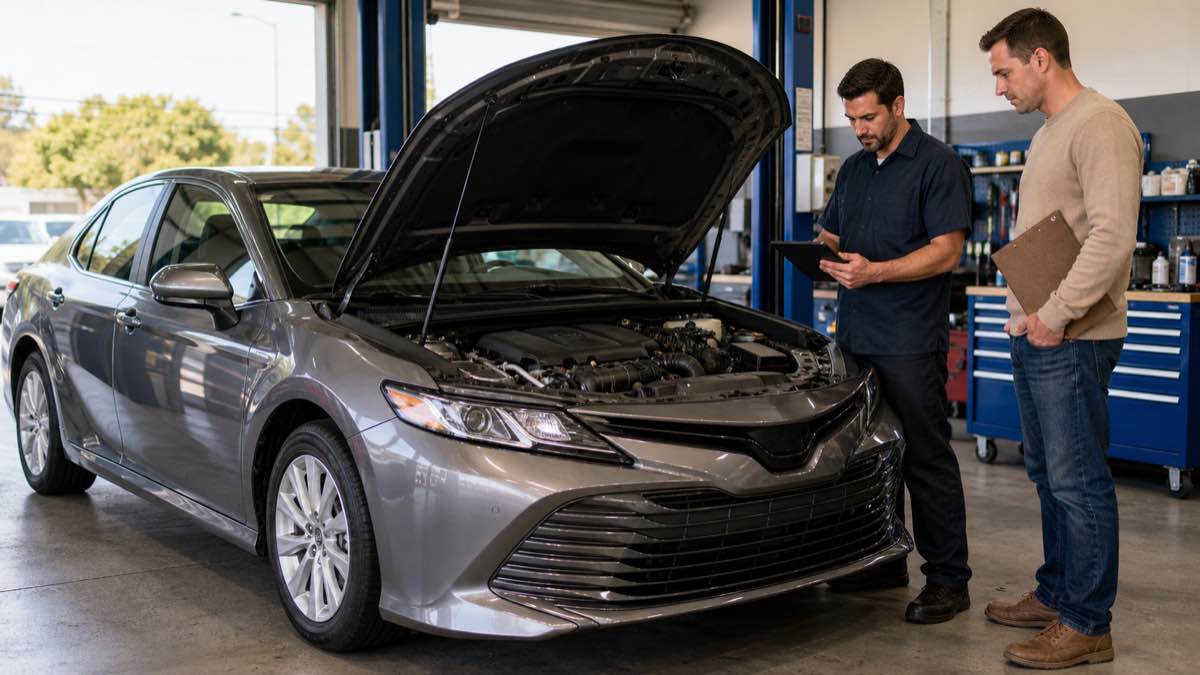
The Toyota Camry has been sold in the United States for decades, so a single list of “common problems” can be misleading. A 2008 four-cylinder Camry, a 2016 V6, a 2021 Hybrid, and a 2025 hybrid-only model do not share the same engine, transmission, electronics, or age-related risks.
This guide organizes Toyota Camry common problems by generation and symptom. It uses owner-complaint trends as inspection clues, not as proof that every vehicle will fail. Before buying or repairing a Camry, verify the year, engine, powertrain, service history, diagnostic results, and open recalls for that exact VIN.
Camry Generations at a Glance
| US model years | Generation context | Inspection priorities |
|---|---|---|
| 2007-2011 | Sixth-generation redesign | Oil use, dashboard condition, age-related cooling and suspension wear, recall history |
| 2012-2017 | Seventh generation | Low-speed shudder on applicable automatics, water-pump/cooling leaks, steering and suspension wear |
| 2018-2024 | Eighth generation | Shift quality on gas models, software updates, fuel-pump recall status where applicable, electronics |
| 2025 and newer | Ninth generation, US hybrid-only lineup | VIN recalls, software campaigns, 12-volt battery condition, collision and warranty history |
These are starting points, not verdicts. Condition and maintenance can matter more than the badge on the model-year label. A documented higher-mileage Camry may be a better purchase than a lower-mileage example with neglected oil changes, unresolved recalls, poor collision repairs, or warning lights recently cleared.
How to Read Complaint and Recall Data Correctly
Sites such as CarComplaints organize owner submissions by year and category. Those reports can reveal symptoms worth inspecting, but raw totals are not failure rates. Older cars have had more time to accumulate problems, popular model years put more vehicles on the road, and one owner may report the same event to multiple databases.
A recall is different from a complaint or technical service bulletin. A safety recall identifies a covered defect and provides a remedy for affected VINs. A service bulletin gives technicians diagnostic or repair information; it does not automatically mean every vehicle is defective or that the repair is free. Customer-support or warranty-enhancement programs have their own time, mileage, and eligibility rules.
Check the 17-character VIN at both the NHTSA recall lookup and Toyota recall and service-campaign lookup. NHTSA notes that a VIN search shows unrepaired safety recalls in its system but may not show completed recalls, very old campaigns, or non-safety customer programs.
1. Excessive Oil Consumption on Some Older Four-Cylinder Camrys
Oil-consumption complaints are associated most strongly with certain older Camrys, particularly some 2007-2009 four-cylinder vehicles using the 2.4-liter engine. The issue should not be applied to every Camry or every four-cylinder engine.
What owners may notice: The dipstick level drops between oil changes, the low-oil warning appears, oil is needed frequently, blue exhaust smoke appears under some conditions, or engine noise increases when the level becomes dangerously low.
What to verify: Check the oil on level ground using the owner’s-manual procedure, inspect for external leaks, record mileage and the amount added, and ask for service records. A controlled oil-consumption test is more useful than guessing from one low reading. Worn seals, leaks, incorrect fill, neglected service, and internal engine wear can produce similar symptoms.
Do not continue driving with an oil-pressure warning or mechanical knocking. Our oil pressure warning light guide explains why pressure and oil level are related but not interchangeable.
2. Sticky, Cracked, or Shiny Dashboard Surfaces
Owners of some 2007-2011-era Camrys have reported dashboard material that becomes sticky, glossy, soft, or cracked after prolonged heat and sun exposure. Glare from a shiny surface can be more than cosmetic when it reflects into the windshield.
Inspect the entire upper dash in daylight. Look for tackiness, ripples, cracks around the passenger airbag area, cover-up mats, or signs that coatings were applied. Do not cut, glue, drill, or install rigid hardware near an airbag deployment path. Ask Toyota whether any historical customer-support coverage applies to the VIN, but do not assume an older program is still open.
3. Low-Speed Shudder on Some 2012-2014 Automatics
Some four-cylinder Camrys from the early seventh generation have owner reports and Toyota service information related to a torque-converter shudder. Drivers often describe a brief vibration during light acceleration or lockup at lower road speeds. Tire imbalance, engine misfire, mounts, axle problems, and road surface can feel similar, so the sensation alone does not confirm a transmission failure.
During a test drive, note speed, engine load, gear behavior, temperature, and whether the vibration changes when the throttle is adjusted. Ask whether software updates or prior torque-converter work were completed, and have a technician reproduce the symptom and check the applicable Toyota service information for the exact VIN and transmission.
A hybrid Camry uses a different transaxle design from the conventional stepped automatic discussed here. Do not transfer gas-model transmission claims to the hybrid simply because the model year is the same.
4. Shift Quality Complaints on Some 2018-2024 Gas Models
The 2018 model year introduced a redesigned Camry and an eight-speed automatic for non-hybrid versions. Some owners report hesitation, busy shifting, delayed response, or harshness under particular low-speed conditions. Software calibration, adaptive values, driving mode, engine performance, and mechanical faults can all affect shift behavior.
Do not accept “they all do that” or “it needs a transmission” without evidence. Compare cold and fully warm operation, gentle and moderate acceleration, Reverse-to-Drive engagement, and warning lights. Ask the shop to scan all relevant modules and check current Toyota calibration or service information before recommending internal transmission work.
The 2018-2024 Camry Hybrid uses an electronically controlled hybrid transaxle rather than the same eight-speed automatic. Diagnose hybrid hesitation, warning messages, or reduced power as a separate system.
5. Water Pump and Cooling-System Leaks
Water pumps, hoses, radiators, caps, and seals can leak as Camrys age. A pump leak may leave pink or whitish residue near the pump area, a sweet coolant smell, a falling reservoir level, or spots under the passenger side of the engine bay. Leak location varies by engine, and coolant can travel before dripping.
Inspect only when the engine is cool. Record reservoir level, residue location, temperature behavior, and whether the cabin heater changes output. Never remove a hot cooling-system cap. A pressure test and visual inspection can distinguish a pump leak from a hose, radiator, reservoir, or internal engine problem.
If the temperature rises or steam appears, stop safely and shut the engine off. The Camry-overheating pattern may differ at idle, but active overheating always requires prompt attention.
6. Brake Vibration, Noise, or Uneven Wear
Brake pads and rotors are wear items rather than a Camry-specific defect. Still, used Camrys may show steering-wheel shake during braking, pedal pulsation, scraping, uneven pad wear, or corrosion after long storage or road-salt exposure. A sticking caliper, hub runout, loose suspension component, or poor prior installation can imitate a simple warped-rotor diagnosis.
Request measurements of pad thickness, rotor thickness and runout where relevant, plus caliper and slide inspection. A soft pedal, fluid leak, reduced braking, or red brake warning is not a routine “wait until next service” condition. Use our brake warning light guide and arrange a tow when braking safety is uncertain.
7. Steering, Strut, and Suspension Wear
Higher-mileage Camrys can develop clunks, looseness, uneven tire wear, leaking struts, worn bushings, wheel-bearing noise, or steering pull. These are often age, mileage, road, tire, or collision-related problems rather than a defect shared by one generation.
On a test drive, use a smooth road and a rougher low-speed section. Listen for single knocks over bumps, humming that changes with road speed, and pull during steady cruising or braking. Inspect tire age and wear pattern. An alignment printout is useful only after loose or damaged components and tire problems are addressed.
8. Battery, Charging, and Electronic Complaints
A weak 12-volt battery can create slow starting, warning messages, memory loss, or multiple seemingly unrelated electronic symptoms. Charging faults, loose terminals, parasitic draw, damaged wiring, aftermarket accessories, and software issues can produce similar behavior.
Test the battery and charging system before replacing parts. On hybrids, the 12-volt battery still powers control systems even though the high-voltage traction battery starts the gasoline engine differently from a conventional starter. High-voltage warnings require trained service; do not touch orange cables or attempt traction-battery diagnosis with a basic multimeter.
If the battery symbol remains illuminated while driving, follow the battery warning light steps and prepare for the possibility of a stall.
9. Fuel-Pump and Other Safety Recalls
Certain Camrys have been included in safety recalls over the years, including campaigns involving fuel-delivery, airbag, braking, occupant-detection, or other systems. A year-and-model list cannot confirm that a particular car is covered because production dates, suppliers, engines, and VIN ranges matter.
Enter the VIN in the Toyota and NHTSA lookup tools before purchase and at least periodically during ownership. Ask for recall-completion records. An open safety recall is normally repaired by an authorized dealer at no charge, but follow the campaign’s official instructions about driving, parking, or scheduling.
What About 2025 and Newer Hybrid-Only Camrys?
The ninth-generation US Camry launched for 2025 with a hybrid-only powertrain lineup. It is too new to make strong long-term “common failure” claims. Early owner reports can identify symptoms worth monitoring, but small samples, software updates, collision repairs, and first-year service issues can distort conclusions.
For these cars, prioritize open-recall checks, warranty documentation, software and campaign history, correct 12-volt battery condition, tire wear, driver-assistance calibration after glass or collision work, and evidence of flood or crash damage. Let the dealer document repeat concerns during the warranty period.
Which Camry Symptoms Need Immediate Action?
| Symptom | Initial action | Why it matters |
|---|---|---|
| Red oil-pressure warning, knocking, or sudden oil loss | Stop safely, shut off engine, arrange diagnosis | Low pressure can damage the engine quickly |
| Temperature in red zone, steam, or active coolant loss | Stop and shut off engine; keep clear of hot coolant | Continued driving can cause severe overheating damage |
| Soft brake pedal, fluid leak, or reduced stopping | Do not road-test; arrange a tow | Braking performance cannot be assumed safe |
| Strong fuel odor or visible fuel leak | Shut off away from ignition sources and get assistance | Leaking fuel creates a fire risk |
| Flashing check engine light with rough running | Reduce load, pull over, and arrange diagnosis | A damaging misfire may be occurring |
| Hybrid-system warning with reduced power or unusual heat | Stop when safe and follow the owner’s manual warning | High-voltage faults require trained service |
A stable warning light without drivability symptoms may allow a short trip for diagnosis, but the owner’s manual and the vehicle’s behavior take priority over a general guide. Record every light before switching the car off, because low system voltage or a restart may change what appears on the dashboard.
Cosmetic dash damage, mild trim noise, or an infotainment glitch normally does not require a tow. Schedule service when it affects visibility, controls, the passenger-airbag area, or safe driver attention. A recurring problem under warranty should be documented with dates, mileage, photos, videos, and repair orders.
Used Toyota Camry Inspection Checklist
- Decode the VIN and confirm year, engine, trim, gas or hybrid powertrain, and title history.
- Check Toyota and NHTSA for open recalls and campaigns.
- Review oil-change, coolant, transmission-service, brake, and hybrid-system records applicable to that model.
- Inspect cold start, idle, warning-light self-test, exhaust, fluid levels, leaks, and belt condition.
- Test-drive from cold to warm through city and highway speeds without masking sounds with the radio.
- Check braking, steering, alignment, tire wear, climate control, cameras, sensors, locks, windows, and infotainment.
- Scan all modules with equipment appropriate for the vehicle; a generic engine-code reader may miss Toyota and hybrid-system faults.
- Arrange an independent pre-purchase inspection, including underbody and collision-repair checks.
Do not rely on a recently cleared dashboard. The check engine light guide explains why a code is a starting point rather than a diagnosis. Readiness monitors that are not set can indicate that codes were recently cleared or power was disconnected.
Frequently Asked Questions
What Toyota Camry years have the most owner complaints?
Owner-report sites show especially high raw complaint totals for some 2007-2011 Camrys, with oil consumption among the best-known concerns. Raw totals are not failure rates, so compare the exact engine, production history, mileage, service records, recalls, and inspection results.
Are all 2007-2009 Camrys oil burners?
No. Excessive oil use has been reported on certain older four-cylinder Camrys, but it should not be assumed from model year alone. Check the engine, oil level history, leaks, service records, and results of a controlled consumption test.
Do 2018-2024 Camry Hybrids have the same transmission as gas models?
No. The hybrid uses a different electronically controlled hybrid transaxle, while non-hybrid versions use a conventional stepped automatic. A complaint about the gas-model eight-speed transmission should not automatically be applied to the hybrid.
How do I check a Camry for recalls?
Enter the 17-character VIN at Toyota’s recall and service-campaign website and at NHTSA.gov/recalls. A VIN search is more accurate than relying on a general model-year list.
Is a high-mileage Toyota Camry a bad buy?
Not automatically. Maintenance, oil level history, cooling-system condition, transmission behavior, rust, collision repairs, hybrid battery data, recalls, and inspection results matter more than mileage alone. Budget for age-related wear even when the drivetrain is healthy.
Should I avoid the first year of a Camry generation?
A first-year redesign may receive more early reports or updates, but that does not make every example a poor purchase. Check the exact VIN, service campaigns, software history, build date, warranty repairs, and pre-purchase inspection rather than using a blanket rule.
Bottom Line
The most useful Toyota Camry problem list is generation-specific. Older four-cylinder cars deserve careful oil-level history checks; some early seventh-generation automatics warrant shudder evaluation; gas-powered 2018-2024 models need a thoughtful shift-quality test; and 2025+ cars are too new for confident long-term failure claims. For every Camry, a VIN recall search, complete test drive, module scan, service records, and independent inspection provide better evidence than reputation alone.