
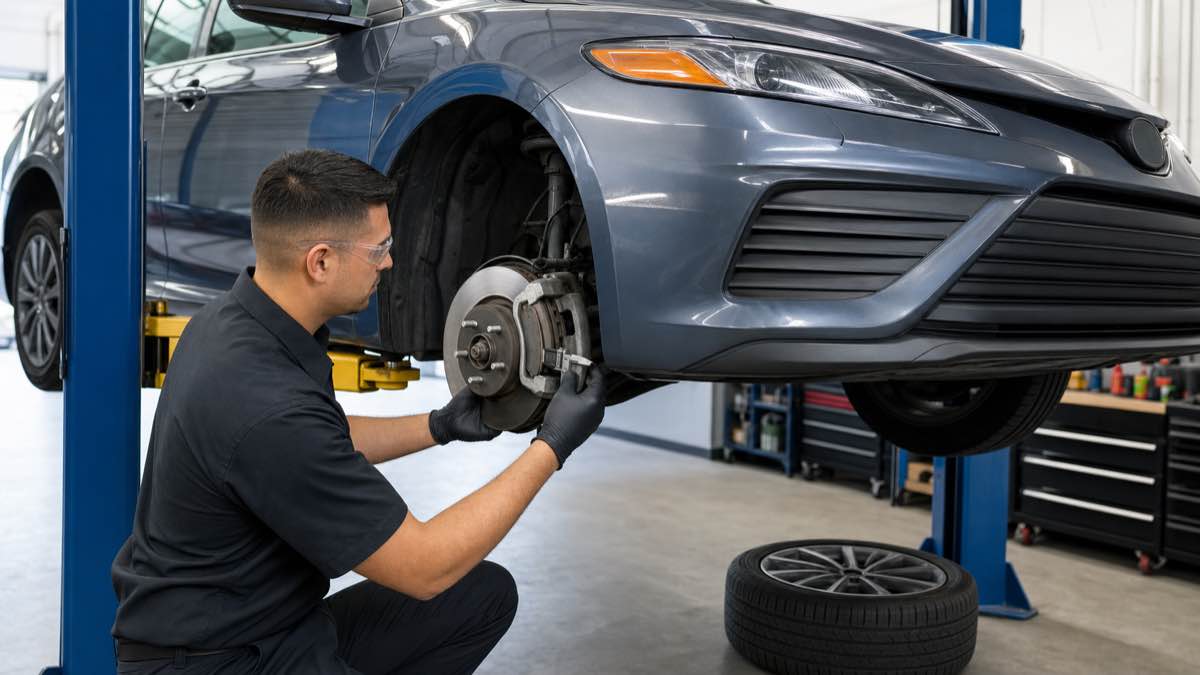
Toyota Camry brake replacement signs include persistent squealing, grinding or scraping, longer stopping distance, a pedal that feels unusually soft or low, pulling while braking, steering-wheel or pedal vibration, and a brake-system warning. These symptoms call for prompt inspection, but they do not prove the pads are the only failed parts.
Toyota does not give every Camry one guaranteed brake-pad replacement mileage. Pad life changes with traffic, hills, driving style, vehicle load, corrosion, rotor condition, caliper movement, and hybrid regenerative braking. The 2025 Camry Warranty & Maintenance Guide instead calls for inspection of brake pads/discs at each 5,000-mile or six-month maintenance checkpoint and replacement of deteriorated or damaged parts.
Camry Brake Signs at a Glance
| Sign | Possible meaning | Urgency |
|---|---|---|
| Light squeal during braking | Wear indicator, contamination, surface rust, glazing, or hardware | Schedule inspection soon if persistent |
| Grinding or metal scraping | Severe pad wear or damaged rotor/hardware | Stop unnecessary driving; inspect immediately |
| Longer stopping or more pedal effort | Pad, rotor, fluid, hydraulic, tire, assist, or other fault | Urgent safety inspection |
| Soft, sinking, or unusually low pedal | Hydraulic leak, air, master-cylinder or other serious issue | Do not keep driving; arrange towing |
| Pulling or vibration | Uneven braking, rotor variation, caliper, suspension, or tire issue | Prompt diagnosis |
| Red or yellow brake warning | Parking brake state, fluid level, electronic or hydraulic fault | Follow the owner’s manual immediately |
1. Persistent Squealing or Squeaking
Toyota identifies high-pitched squealing as a common worn-pad warning because some pads use a metal wear indicator. However, not every squeak means the pads are finished. Moisture, overnight surface rust, dust, glazing, pad material, or hardware can also create noise.
Notice when the sound occurs: first stop of the morning, light pedal pressure, every stop, forward only, or after the brakes warm up. Persistent or worsening noise deserves measurement of the inner and outer pads on both sides, not a diagnosis made through the wheel opening alone.
2. Grinding or Scraping
Grinding can mean the friction material is exhausted and metal is contacting the rotor. Toyota warns that severely worn pads can damage both pads and rotors. A stone, bent shield, corroded hardware, or another component can also scrape, so inspection still matters.
Do not continue ordinary driving to “see if it clears.” Metal contact can reduce braking performance and turn a pad service into pads, rotors, hardware, or caliper work. Move to a safe location and arrange inspection or towing when braking feels unsafe.
3. Longer Stopping Distance or Reduced Response
If the Camry needs more distance or pressure to stop, treat it as a safety problem. Worn or overheated friction material is possible, but so are contaminated pads, damaged rotors, failing assist, hydraulic trouble, old or overheated fluid, poor tires, or slick road conditions.
Driver-assistance and automatic emergency braking features do not replace a healthy foundation brake system. Avoid following closely, high speed, or a long drive to a shop when stopping performance has changed significantly.
4. Soft, Low, or Sinking Brake Pedal
A soft pedal is not a normal “pad replacement reminder.” It may involve air, a fluid leak, master cylinder, flexible hose, caliper, actuator, or another hydraulic/electronic problem. A pedal that sinks while steady pressure is applied is especially concerning.
Check the owner’s manual instructions and arrange professional diagnosis. Do not repeatedly pump the brakes and continue driving on public roads as a substitute for repair. If the pedal is near the floor or the vehicle does not stop normally, have it towed.
5. Pulling, Vibration, or Pulsation
Pulling during braking can involve uneven pad wear, a sticking caliper, contaminated friction surfaces, a restricted hose, tire pressure, alignment, or suspension. Pulsation may involve rotor thickness variation or runout, but ABS operation on a low-traction surface can create a normal temporary pulse.
A complete inspection compares pad thickness side-to-side, rotor condition and measurements, caliper movement, hardware, hoses, tires, and suspension. Replacing pads alone may not correct the underlying cause of uneven wear.
6. Brake Warning Light or Message
The 2025 Camry manual lists red and yellow brake-system warnings. A warning may involve the parking brake, brake fluid, electronic brake control, hydraulic system, ABS-related systems, or another malfunction. It is not a simple pad-thickness indicator.
If a brake warning remains on after the normal startup check, appears with a buzzer, or accompanies a pedal or stopping change, follow the owner’s manual immediately. Our brake warning light guide explains the distinction between routine pad wear and system warnings.
How Often Should Camry Brakes Be Inspected?
The 2025 Camry Warranty & Maintenance Guide lists inspection of brake pads/discs at every 5,000-mile or six-month checkpoint. It instructs technicians to check pads for excessive wear and discs for runout, excessive wear, and fluid leakage, replacing deteriorated or damaged parts.
Older model years may use different schedules, so use the guide for the exact year. Inspect sooner for noise, warning lights, changed pedal feel, heavy traffic, mountain driving, road salt, long storage, or repeated hard braking. Scheduled inspection is a maximum planning point, not a reason to ignore symptoms.
Why Camry Brake Pads Have No Fixed Lifespan
- Stop-and-go traffic creates more friction events than steady highway driving.
- Hills, high speed, and heavy loads increase heat and braking demand.
- One driver may coast early while another brakes late and hard.
- Road salt and moisture can restrict caliper slides and corrode hardware.
- A hybrid Camry can use regenerative braking, but friction brakes still operate and can suffer corrosion or uneven wear.
- Front and rear pads may not wear at the same rate.
- A sticking caliper or damaged hardware can destroy one pad early.
Ask for measured remaining friction material and the vehicle-specific minimum specification. “You are at 20%” is less useful than actual measurements for each inner and outer pad, rotor thickness, observed damage, and the reason replacement is recommended.
What a Complete Brake Inspection Should Include
- Inner and outer pad thickness at all four wheels
- Uneven or tapered wear
- Rotor thickness, surface, cracks, heat spots, scoring, and runout where needed
- Caliper piston, slide pins, brackets, and hardware
- Brake hoses, lines, connections, and fluid leakage
- Brake-fluid level and condition using the correct service criteria
- Parking brake and electronic brake functions
- Tire condition, pressure, and factors that can mimic a braking pull
- Warning codes and freeze-frame information before clearing anything
Pads Only or Pads and Rotors?
Rotors do not automatically need replacement with every set of pads, and they should not automatically be reused. The decision depends on thickness, minimum specification, runout, scoring, cracking, heat damage, corrosion, surface condition, and whether refinishing is permitted and leaves adequate material.
Compare quotes using the same scope: pad brand and formulation, rotor replacement or machining, hardware, caliper service, brake-fluid work, electronic parking-brake procedure, bedding procedure, warranty, and final road test. Our guide to signs you need new brake pads provides a broader non-model-specific overview.
Can You Replace Camry Brake Pads Yourself?
Brake work is safety-critical. A capable DIYer needs the exact model-year procedure, rated lifting equipment and stands, wheel chocks, torque specifications, measuring tools, correct parts, caliper-support method, and any required electronic parking-brake or scan procedure. Never work under a vehicle supported only by a jack.
Do not open the hydraulic system unless prepared to bleed and verify it correctly. Keep grease and brake fluid away from friction surfaces. After assembly, restore pedal height before moving, verify fluid level, check for leaks, torque the wheels, follow the pad maker’s bedding instructions, and test at low speed in a safe area.
Frequently Asked Questions
How many miles do Toyota Camry brake pads last?
There is no guaranteed mileage. Traffic, hills, driving style, corrosion, caliper condition, load, and hybrid regenerative braking all affect wear. Use scheduled inspections and actual pad measurements.
Does squealing always mean my Camry needs brake pads?
No. A wear indicator can squeal, but moisture, rust, glazing, dust, hardware, or pad material can also create noise. Persistent squealing should trigger inspection.
Can I drive a Camry with grinding brakes?
Avoid continued driving. Grinding may indicate metal contact and reduced performance, and it can damage rotors or other parts. Arrange immediate inspection or towing if braking is unsafe.
Do Camry rotors need replacement with every pad change?
No. Rotors should be measured and inspected. Replace or refinish them only when condition, specifications, and the approved repair procedure support that decision.
Why do hybrid Camry brakes sometimes rust?
Regenerative braking can reduce friction-brake use in some conditions. Moisture, road salt, storage, and limited use can then contribute to surface corrosion or restricted hardware. Inspection remains important even when pads wear slowly.
How often does a 2025 Camry need brake inspection?
Toyota’s 2025 maintenance guide lists brake pad/disc inspection at each 5,000-mile or six-month checkpoint. Inspect sooner whenever noise, warning, pedal, vibration, pulling, or stopping performance changes.
Bottom Line
Toyota Camry brake pads should be replaced based on measured wear, damage, and system condition—not a guessed mileage. Persistent squealing needs inspection; grinding, reduced stopping, a soft pedal, or brake warnings demand urgent attention. For a 2025 Camry, include pad and disc inspection at every 5,000-mile/six-month maintenance checkpoint and act sooner when symptoms appear.