
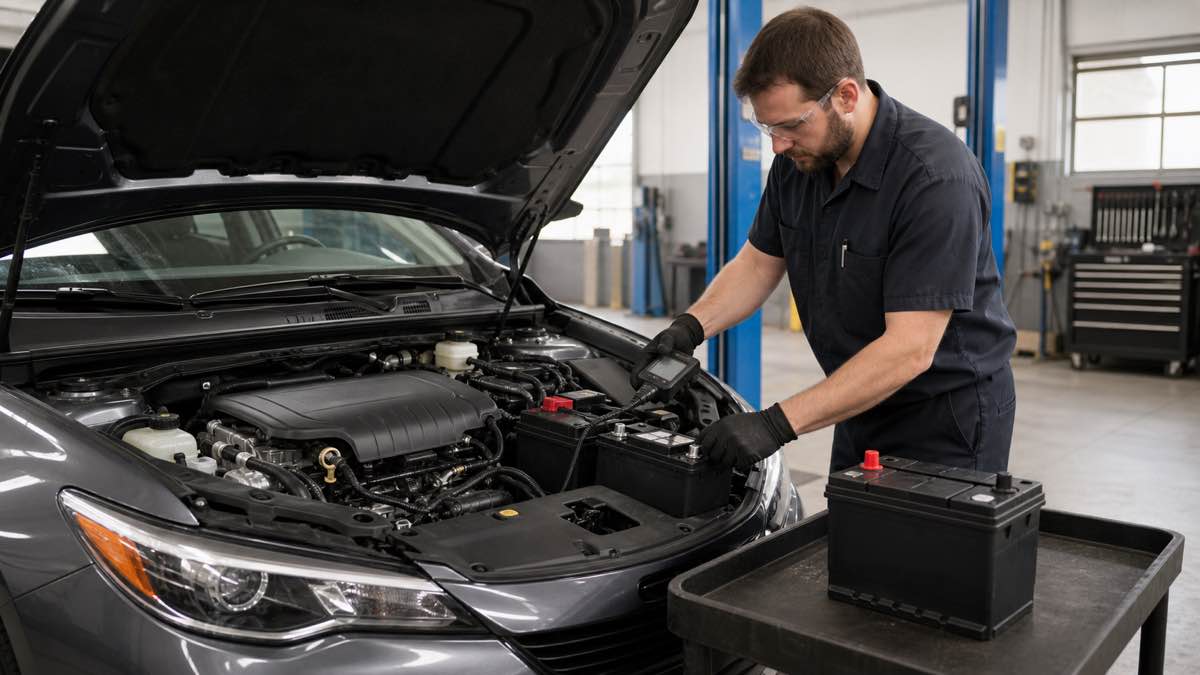
A Toyota Camry battery replacement begins by identifying which battery you mean. The conventional 12-volt auxiliary battery powers computers, locks, lights, and the control systems needed to start or ready the vehicle. A hybrid Camry also has a separate high-voltage traction battery. This guide covers the 12-volt battery—not the traction battery.
Replace the 12-volt battery only after testing confirms it is deteriorated and after matching the exact model year, powertrain, size, terminal layout, venting, capacity, and Toyota specification. A discharged battery, loose terminal, parasitic draw, or charging-system fault can imitate battery failure. For a 2025 Camry, Toyota’s manual says a no-start with dim lights or a weak horn may involve a discharged 12-volt battery or loose/corroded terminals.
Camry Battery Replacement at a Glance
| Question | Safe answer |
|---|---|
| Which battery does this guide cover? | The 12-volt auxiliary battery |
| Is it the hybrid traction battery? | No; high-voltage service requires separate procedures and qualified personnel |
| Should a no-start automatically mean replacement? | No; test charge, battery health, terminals, and system operation |
| Can any similar-size battery be installed? | No; use an exact vehicle-approved battery with correct venting and specifications |
| Can disconnecting power affect vehicle functions? | Yes; settings and systems may require initialization or relearning |
| Best approach for a 2025 hybrid Camry? | Follow its exact owner/service information; professional replacement is the low-risk choice |
12-Volt Battery vs. Hybrid Traction Battery
The 2025 US Camry is hybrid-only. Toyota’s maintenance guide states that it contains high-voltage DC and AC systems as well as a 12-volt system. The traction battery stores energy for hybrid propulsion; the 12-volt battery supports low-voltage electronics and allows the vehicle’s control systems to wake up.
Do not touch orange high-voltage cables, connectors, service plugs, the inverter, or the traction-battery assembly. High-voltage isolation and personal protective equipment are beyond an ordinary battery swap. If the warning or diagnosis involves the hybrid battery, use Toyota’s high-voltage service procedure and qualified technicians.
Signs the Camry 12-Volt Battery Needs Testing
- The power switch does not bring the hybrid system to READY.
- Interior lights or headlights are unusually dim.
- The horn sounds weak or does not sound.
- Locks, displays, or other electronics act erratically.
- The vehicle needs repeated jump starts.
- The battery case is swollen, cracked, leaking, or has a strong unusual odor.
- Terminals are loose or visibly corroded.
- A battery test shows poor capacity or health after proper charging.
Toyota’s 2025 Camry manual lists a discharged battery and loose or corroded terminals among possible causes when the hybrid system will not start and lights or the horn are weak. It also notes other possible causes, including key, fuse, immobilizer, fuel, hybrid-system, and very-low-temperature conditions. Diagnosis prevents replacing a good battery.
Test Before You Replace
First inspect the case, hold-down, terminals, cables, and grounds. Measure state of charge and use a test appropriate for the battery type. A deeply discharged but healthy battery may need slow charging before a meaningful health test. Testing immediately after a jump or charge can be misleading.
If the replacement also goes flat, investigate key-off draw, accessories, modules that fail to sleep, loose connections, and the vehicle’s 12-volt charging system. The hybrid system uses a DC-DC converter rather than a conventional alternator arrangement, so generic alternator advice does not describe every hybrid Camry.
Choose the Exact Replacement Battery
Use the VIN and model-year Toyota information to verify the battery. Match physical dimensions, hold-down design, terminal position and polarity, battery technology, electrical rating, and any vent connection. An interior or luggage-compartment installation may require a battery designed to vent safely through the vehicle’s system.
- Do not choose by price or case size alone.
- Do not reverse terminal orientation or stretch cables.
- Do not omit a vent hose or reuse damaged vent components.
- Do not downgrade battery technology without vehicle-specific approval.
- Check the manufacturing date and written warranty.
- Confirm whether registration, initialization, or scan-tool work is required.
Toyota hybrid manuals warn that a battery not designed for the vehicle can allow hydrogen gas into the passenger compartment, creating fire or explosion risk. That is a fitment and safety requirement, not an optional upgrade.
Safe Replacement Workflow
- Confirm the diagnosis. Save test results and any useful diagnostic codes.
- Verify the exact battery. Match VIN, specifications, terminals, hold-down, and venting.
- Prepare the vehicle. Park safely, select P, set the parking brake, turn the power off, remove the key from the work area, and follow the specified waiting procedure.
- Protect yourself. Wear safety glasses and gloves; remove jewelry; keep sparks, flames, and smoking materials away.
- Preserve information correctly. Use memory support only when the approved procedure permits it; it can keep circuits live.
- Disconnect in the specified order. Many procedures remove negative first and reconnect it last, but follow the exact Camry manual.
- Secure the battery. Install the hold-down and venting exactly; terminals must be clean, correctly oriented, and tight.
- Initialize and verify. Restore required settings, confirm READY operation, scan for relevant faults, and test 12-volt system performance.
Battery Safety You Should Not Skip
Lead-acid batteries contain corrosive electrolyte and can emit flammable hydrogen gas. Never bridge terminals with a tool, lean over a battery while connecting it, or charge in an enclosed poorly ventilated area. If electrolyte contacts eyes, flush with clean water for at least 15 minutes and obtain immediate medical care.
A hybrid vehicle can appear quiet while capable of entering READY mode. Make sure the vehicle is fully off before work. Keep hands and tools away from cooling fans and high-voltage components. If the previous power-switch state is unknown, the battery is damaged, or the procedure is unclear, stop and use a qualified technician.
What May Need Resetting After Replacement?
Power interruption can affect clocks, windows, locks, steering or driver-assistance information, stored settings, and diagnostic readiness. Some Toyota hybrid manuals note that smart-key operation may not return immediately and that the hybrid system may require a defined restart procedure after reconnection.
Do not repeatedly clear codes or disconnect the battery to hide a returning fault. Save the original evidence, perform the specified initialization, and investigate warnings that remain. Confirm that the vehicle enters READY, the charging system supports the 12-volt battery, and all safety systems complete their checks.
How Much Does Camry Battery Replacement Cost?
The total depends on model year, approved battery type, seller, access, venting, installation, diagnosis, and electronic setup. Compare the exact part number, warranty, core credit, installation scope, taxes, and final total. Our car battery replacement cost guide explains why retail battery prices and installed shop estimates can differ.
Age is useful for planning a test but not for condemning the battery. Our guide to how long a car battery lasts explains the effects of heat, storage, short trips, and charging conditions.
Do not confuse a 12-volt quote with a high-voltage hybrid battery quote. They are entirely different systems. If the estimate says only “battery,” ask the shop to identify the system, part number, test result, and warranty in writing.
Can You Replace a Camry Battery Yourself?
Some older Camry 12-volt batteries are straightforward for experienced owners. A modern hybrid Camry adds power-state, venting, access, and initialization concerns. Toyota’s general guidance says trained-technician replacement is safest for electrical-system work, and Toyota hybrid manuals may specifically recommend dealer replacement.
DIY only with the exact manual, correct battery, protective equipment, insulated care around terminals, and a clear initialization plan. Do not treat a video for another Camry generation as the service procedure for yours.
Common Replacement Mistakes
- Confusing the 12-volt battery with the hybrid traction battery
- Replacing before charging and testing
- Buying by dimensions without checking technology, rating, and venting
- Allowing the positive terminal or tool to contact body metal
- Working while the hybrid system can enter READY
- Leaving the battery or cables loose
- Failing to investigate a repeated discharge
- Clearing warnings without saving diagnostic information
- Skipping post-replacement initialization and system verification
Frequently Asked Questions
Does a Toyota Camry Hybrid have a 12-volt battery?
Yes. It has a low-voltage 12-volt auxiliary battery as well as a separate high-voltage traction battery. They serve different purposes and require different procedures.
Does a Camry no-start always mean the battery is bad?
No. Discharge, loose or corroded terminals, key or fuse problems, control-system faults, temperature, and other conditions can prevent starting. Test before replacing.
Can I install any battery that fits the Camry tray?
No. Match Toyota’s vehicle-specific battery technology, rating, terminal arrangement, hold-down, dimensions, and venting requirements.
Why did warning lights appear after battery replacement?
Low voltage and power interruption can set warnings or require initialization. Follow the exact post-reconnection procedure and diagnose warnings that remain instead of repeatedly clearing them.
Should the new Camry battery be tested after installation?
Yes. Verify terminal security, state of charge, READY operation, 12-volt charging support, warning status, and that the original discharge cause is resolved.
How long does a Camry 12-volt battery last?
There is no guaranteed lifespan. Heat, storage, short trips, electrical draw, state of charge, and battery design affect life. Age helps plan testing, but replacement should be based on condition and test results.
Bottom Line
A Toyota Camry battery replacement should solve a confirmed 12-volt battery failure with the exact approved battery and complete safety procedure. Keep it separate from high-voltage hybrid service, preserve diagnostic evidence, match venting and specifications, secure every connection, complete initialization, and verify why the old battery discharged before considering the job finished.