
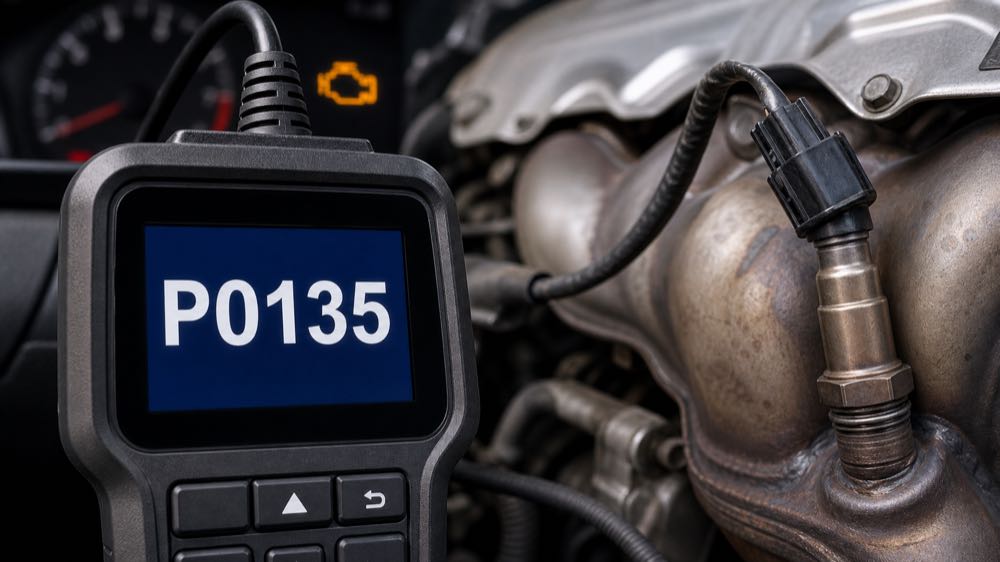
P0135 is an OBD2 diagnostic trouble code that means there is a problem with the oxygen sensor heater circuit for Bank 1 Sensor 1. This sensor is usually the upstream oxygen sensor, located before the catalytic converter on the side of the engine that contains cylinder number 1.
Most drivers see P0135 after the check engine light comes on. The vehicle may still run normally, especially once the engine is warm. But the code can affect emissions readiness, cold-start fuel control, and inspection results.
P0135 often involves the oxygen sensor itself, but it is not always just a bad sensor. A blown fuse, damaged wiring, corroded connector, poor ground, missing heater voltage, or control-circuit issue can also trigger the code.
P0135 Quick Facts
| Item | Details |
|---|---|
| Code | P0135 |
| Definition | Oxygen sensor heater circuit malfunction, Bank 1 Sensor 1 |
| Sensor location | Upstream oxygen sensor before the catalytic converter |
| System | Emissions / fuel control feedback |
| Common symptom | Check engine light on |
| Common mistake | Replacing the O2 sensor without checking heater power and wiring |
| Best first step | Confirm code, inspect wiring, check fuse/power/ground |
What P0135 Means
Modern oxygen sensors often have built-in heaters. The heater helps the sensor reach operating temperature quickly after startup. When the sensor heats up faster, the engine computer can enter closed loop sooner and control the air-fuel mixture more accurately.
P0135 means the engine control module sees a fault in that heater circuit. The fault may be in the heater element inside the sensor, the power feed, ground side, connector, wiring harness, fuse, relay, or computer control.
This is different from a code that says the oxygen sensor signal is lean, rich, slow, or stuck. P0135 is focused on the heater circuit.
You may also see the part described as a heated oxygen sensor or HO2S in service information. That wording matters because the code is not only about exhaust oxygen measurement; it is about whether the heater side of the sensor can warm up correctly.
What Bank 1 Sensor 1 Means
Bank 1 is the side of the engine that contains cylinder number 1. Sensor 1 means the sensor before the catalytic converter. On many inline four-cylinder engines, there is only one bank, so Bank 1 Sensor 1 is the upstream oxygen sensor in the exhaust manifold or front exhaust pipe.
On V6 and V8 engines, bank location varies by manufacturer. Do not guess from the driver side or passenger side. Use vehicle-specific repair information before replacing a sensor.
Common Symptoms of P0135
P0135 may not create obvious driving symptoms.
- Check engine light on
- Failed emissions or inspection readiness
- Slightly worse fuel economy
- Rougher cold start on some vehicles
- Longer time before closed-loop operation
- Other oxygen sensor or fuel-trim codes
If the vehicle also has lean-condition codes such as P0171, diagnose them together but do not assume P0135 and P0171 mean the same thing. P0135 is a heater circuit fault; P0171 is a fuel-control lean code.
Can You Drive With a P0135 Code?
You can usually drive short-term with P0135 if the vehicle runs normally and the check engine light is steady. The code is usually not an immediate engine-damage warning.
However, you should repair it soon. The engine may take longer to enter closed loop after cold starts, emissions may increase, and the vehicle may fail an emissions test. If the check engine light is flashing, the engine runs rough, or other serious codes are present, treat those problems as more urgent.
Common Causes of P0135
Failed Oxygen Sensor Heater Element
The heater element inside the oxygen sensor can fail with age, mileage, heat cycles, or contamination. If the heater circuit inside the sensor is open or shorted, P0135 can set.
This is a common cause, but it should still be confirmed with basic circuit checks when possible.
Blown Fuse or Missing Heater Power
Many oxygen sensor heater circuits receive battery voltage through a fuse or relay. If that fuse is blown, one or more heater circuits may stop working.
If multiple O2 heater codes appear at the same time, a shared fuse or power supply problem becomes more likely.
Damaged Wiring Harness
Oxygen sensor wiring lives near hot exhaust parts. Heat, oil, road debris, rodents, and previous repair work can damage the harness. Melted insulation, rubbed wires, or broken clips can create heater circuit faults.
Always inspect wiring near the exhaust carefully.
Corroded or Loose Connector
The oxygen sensor connector may corrode, loosen, or collect oil and water. A poor connection can interrupt heater power or ground. Connector problems are especially possible after exhaust work or sensor replacement.
Because the electrical connector sits close to heat, road splash, and engine movement, even a small terminal problem can create an intermittent heater fault.
Poor Ground or Control Circuit Issue
Some systems control the heater on the ground side through the engine control module. If the ground path, control wire, or module driver has a problem, the heater may not operate correctly.
This is less common than a bad sensor or wiring issue, but it matters when the sensor has already been replaced and the code returns.
A technician may check sensor ground quality and compare commanded heater operation with live data before condemning the computer side of the circuit.
Wrong or Low-Quality Replacement Sensor
An incorrect oxygen sensor can create heater resistance or connector issues. Universal sensors that require splicing can also create wiring mistakes if installed poorly.
Using the correct sensor and connector style helps avoid repeat codes.
Diagnostic Order: What to Check First
The best P0135 diagnosis treats it like an electrical circuit problem.
- Confirm P0135 with an OBD2 scanner.
- Check for other O2 heater codes or related fuse codes.
- Review freeze frame data to see when the code set.
- Identify the correct Bank 1 Sensor 1 location.
- Inspect the oxygen sensor wiring and connector near the exhaust.
- Check the O2 heater fuse and power supply.
- Check heater circuit ground or control side.
- Test heater resistance if service information gives a specification.
- Replace the oxygen sensor only after the circuit checks support it.
This order helps prevent replacing a good sensor when the real problem is a fuse or damaged wire.
If the scan tool shows the heater monitor failing quickly after startup, that supports a direct heater circuit issue more than a slow fuel trim problem.
P0135 vs P0171 and P0420
P0135 is an oxygen sensor heater circuit code. It does not automatically mean the engine is running lean and it does not automatically mean the catalytic converter is bad.
P0171 means the engine computer sees a lean air-fuel condition on bank 1. P0420 means catalyst efficiency is below threshold. Those codes may involve oxygen sensor data, but they are not the same as a heater circuit failure.
If several of these codes appear together, diagnose the electrical fault and fuel-control data carefully instead of replacing parts in a random order.
How Much Does P0135 Cost to Fix?
P0135 repair cost depends on the actual fault.
| Possible repair | Typical U.S. cost range |
|---|---|
| Diagnostic scan and inspection | $75-$180 |
| Fuse replacement | $10-$80 |
| Wiring or connector repair | $100-$500+ |
| Upstream oxygen sensor replacement | $150-$500+ |
| Exhaust access or seized sensor labor | $100-$400+ extra |
| PCM/control diagnosis | $150-$500+ |
Costs vary by vehicle. Some upstream sensors are easy to reach; others are tight, rusted, or close to hot exhaust parts.
What Not to Do
Do not replace the catalytic converter for P0135. Do not replace the oxygen sensor without checking for damaged wiring or a blown fuse. Do not splice in a universal sensor unless the wiring is done correctly and the part matches the vehicle.
P0135 is usually repairable, but guessing can turn a simple circuit problem into repeat parts replacement.
FAQ
What does code P0135 mean?
P0135 means the oxygen sensor heater circuit for Bank 1 Sensor 1 has a malfunction. It usually involves the upstream oxygen sensor heater circuit.
Is P0135 always a bad oxygen sensor?
No. A bad sensor is common, but a blown fuse, damaged wiring, corroded connector, poor ground, or control-circuit issue can also cause P0135.
Can I drive with a P0135 code?
You can usually drive short-term if the vehicle runs normally and the check engine light is steady. Repair it soon because emissions readiness and cold-start fuel control may be affected.
Where is Bank 1 Sensor 1?
Bank 1 Sensor 1 is the upstream oxygen sensor before the catalytic converter on the side of the engine with cylinder number 1. Exact location depends on the vehicle.
Will P0135 fail emissions?
Yes, it can. An active check engine light or incomplete readiness monitor can cause an emissions or inspection failure.
Can P0135 cause bad gas mileage?
It can contribute to worse fuel economy, especially during cold starts, because the engine may take longer to enter closed loop and control fuel precisely.