
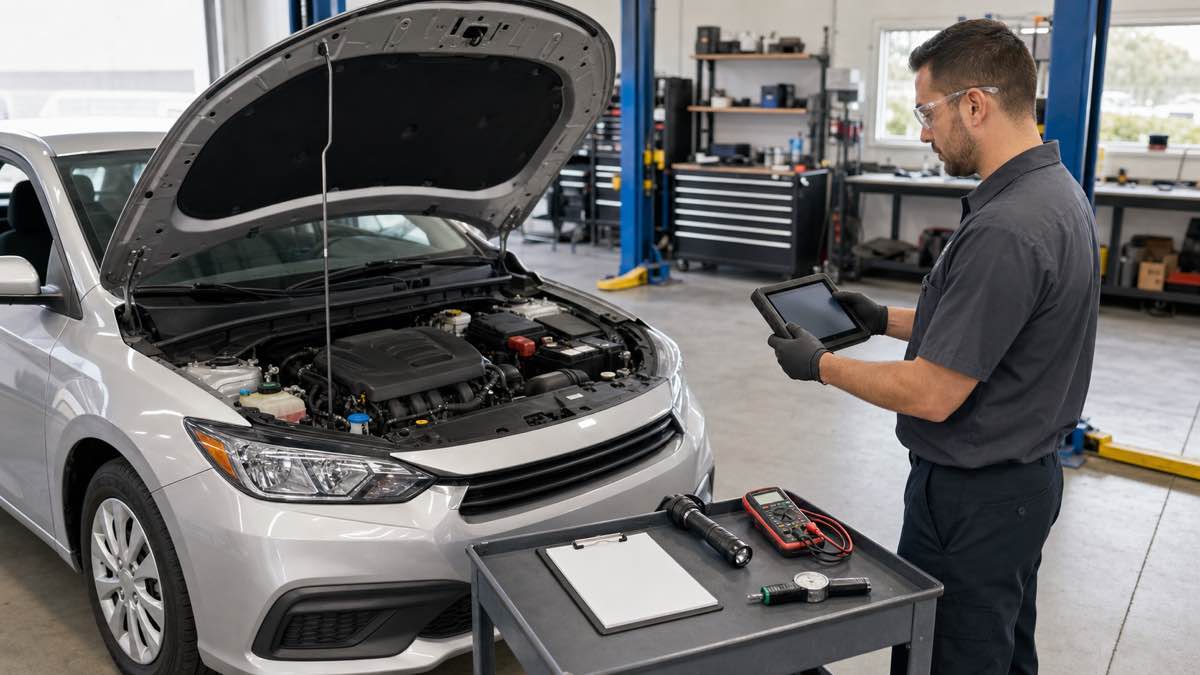
Toyota Corolla common problems depend heavily on model year, powertrain, body style, mileage, climate, and maintenance history. A 2004 sedan with a Takata airbag campaign, a 2019 hatchback with a specific CVT recall, and a 2024 Corolla Hybrid with modern driver-assistance systems should not be treated as the same car.
The issues worth checking include open recalls, rough running or stalling, CVT symptoms, steering or tire wear, brake changes, warning lights, coolant or oil leaks, 12-volt battery trouble, and hybrid-specific warnings. None of these proves that every Corolla will fail. Start with the VIN, exact symptoms, stored diagnostic codes, and service history.
Corolla Problems at a Glance
| Symptom or concern | Possible causes | Best first step |
|---|---|---|
| Engine stalls or runs rough | Fuel, ignition, air, sensor, battery-voltage, or recall-related issue | Stop safely, save codes, and check the VIN for recalls |
| CVT shudder, delay, or RPM flare | Normal CVT behavior, fluid issue, control fault, internal wear, or model-specific campaign | Document conditions and obtain a scan plus road test |
| Steering noise, looseness, or pull | Tire pressure, alignment, suspension, steering component, or recall | Inspect immediately if control or free play changes |
| Grinding, hard, or soft brake pedal | Pad or rotor wear, corrosion, hydraulic fault, software issue, or recall | Limit driving; urgent inspection |
| Multiple warning lights | Low 12-volt voltage, stored fault, blocked camera/radar, wheel-speed issue, or network fault | Do not clear codes before testing |
| Coolant loss or overheating | Hose, cap, radiator, pump, reservoir, or internal leak | Stop if temperature is high; pressure-test when cool |
| Oil spots or falling oil level | Seep, active leak, improper service, or oil consumption | Measure level and identify the source |
| No-start or weak electronics | Discharged 12-volt battery, loose terminals, key issue, fuse, starter circuit, or fuel problem | Test battery and connections before replacing parts |
First: Check the VIN for Open Recalls
A recall applies to specific vehicles, not automatically to every Corolla in the same year. Use Toyota’s recall lookup and the NHTSA lookup with the 17-character VIN. Recall repairs are performed free of charge, and the result is more useful than a generic “best” or “worst” model-year list.
| Example Corolla recall area | Vehicles described by official notices | Why it matters |
|---|---|---|
| Takata airbags | Certain older Corollas, including 2003–2013 vehicles across campaigns | Inflator rupture can cause severe injury; certain 2003–2004 cars received a Do Not Drive advisory |
| Fuel pump | Certain 2018–2020 Corollas and 2019 Corolla Hatchbacks | Pump may stop, causing rough running, warnings, stall, or no restart |
| Passenger-seat occupant sensor | Certain 2020–2021 Corollas within a larger 2020–2022 Toyota/Lexus recall | Front-passenger airbag may not deploy as designed |
| Steering intermediate shaft | Certain 2023–2024 Corolla and Corolla Hybrid vehicles | A fractured shaft could cause loss of steering control |
| Brake-control software | Certain 2023–2025 Corolla Hybrid vehicles in the applicable campaign | A hard pedal and longer stopping distance may occur in a defined turning-and-braking situation |
| Headlight markings | Certain 2026 Corollas | Missing aim markings can lead to incorrect headlight aiming during service |
Recall coverage changes as campaigns expand and VINs are added. Treat this table as examples, not a complete eligibility list. If Toyota issues a Do Not Drive instruction for your VIN, follow it and arrange the repair or towing through the dealer rather than driving the car.
1. Rough Running, Stalling, or No-Start
A Corolla that hesitates, loses power, runs rough, stalls, or will not restart can have several unrelated causes. Possibilities include a discharged 12-volt battery, loose terminals, contaminated or incorrect fuel, an ignition or air-metering fault, a failed sensor, fuel-delivery trouble, or another control-system problem.
The fuel-pump recall is an important example of why VIN checking matters. Toyota’s amended notice includes certain 2018–2020 Corollas and 2019 Corolla Hatchbacks. It says an affected pump may stop operating, with possible warning lights, rough running, stalling, and inability to restart. Those symptoms do not prove recall involvement; they justify a VIN check and diagnosis.
- Note fuel level, temperature, speed, and whether the problem follows refueling.
- Save diagnostic trouble codes and freeze-frame data before clearing anything.
- Check battery voltage and terminal condition.
- Do not repeatedly crank a car with unusual mechanical noise.
- If it stalls in traffic, move to safety if possible and use roadside assistance.
2. CVT Shudder, Delay, Whine, or RPM Flare
Many recent Corollas use a continuously variable transmission, but transmission design differs by year and model. A CVT can hold engine speed during acceleration in a way that feels different from a stepped automatic. That characteristic alone is not failure.
Symptoms that deserve inspection include delayed Drive or Reverse engagement, repeated shudder, slipping sensation, abnormal whining or grinding, harsh engagement, fluid leakage, warning messages, or engine speed rising without matching acceleration. Causes can include software, incorrect fluid level or type, mounts, wheel or engine problems, control faults, or internal transmission damage.
Certain 2019 Corolla Hatchbacks had a specific US safety recall involving a CVT torque-converter pump impeller that could fail and cause loss of motive power. It is not evidence that every Corolla CVT is defective. Confirm the VIN and transmission code, then use Toyota’s service procedure rather than approving a generic transmission flush.
3. Steering Noise, Pulling, or Loose Feel
A Corolla may pull because of tire pressure, uneven wear, road crown, alignment, a bent wheel, brake drag, or suspension wear. Clicking, clunking, binding, excessive free play, or a sudden steering-effort change requires more urgent inspection.
Certain 2023–2024 Corolla and Corolla Hybrid vehicles were recalled because manufacturing cracks could allow the intermediate steering shaft to fracture and possibly detach. If the VIN is involved, the recall remedy—not an alignment—is the required response. Any loss of steering control, major looseness, or steering-column separation risk means stop driving.
4. Brake Noise or Pedal Changes
Squealing can come from pad wear indicators, surface rust, dust, hardware, or pad material. Grinding, a sinking or soft pedal, fluid leakage, strong pulling, smoke, or a sudden increase in stopping distance is more serious. A proper inspection measures pads and rotors, checks caliper movement and hoses, and verifies fluid and warning-light status.
Certain 2023–2025 Corolla Hybrid vehicles were included in a brake-control software recall. Toyota described a situation where applying the brakes while turning could temporarily produce a hard pedal and more stopping distance than expected. Eligibility is VIN-specific. Do not assume every hard pedal is software, and do not drive normally with a changed brake feel.
5. Multiple Warning Lights and Driver-Assist Alerts
Modern Corollas can display several warnings from one underlying problem. Low 12-volt voltage, a wheel-speed sensor fault, network communication trouble, collision damage, a blocked camera or radar cover, or a true system malfunction can disable multiple features at once.
Toyota’s 2025 manual says driver-assistance systems may stop when battery voltage is low or sensors are covered. Dirt, snow, condensation, extreme camera temperature, or a blocked radar cover can also produce messages. Clean only as the manual directs. If the warning returns, save codes and have the system inspected; do not assume recalibration or parts are needed without testing.
Our dashboard warning lights guide explains why red, flashing, and amber alerts require different responses. A red oil-pressure, charging-system, brake, or high-temperature warning can require an immediate stop.
6. 12-Volt Battery and Electrical Problems
A weak 12-volt battery can cause slow cranking, clicking, dim lights, lost settings, smart-key trouble, or a cluster of unrelated-looking warnings. Short trips, long storage, accessories left active, loose terminals, parasitic draw, heat, and simple battery aging can all contribute.
Test battery state of charge and health after proper charging, then verify the charging system and key-off draw if the problem returns. Replacing the battery without finding repeated discharge can create the same no-start again. A Corolla Hybrid also has a 12-volt battery; it is separate from the high-voltage traction battery.
7. Coolant Seepage, Water-Pump Concerns, or Overheating
Coolant odor, colored residue, a falling reservoir level, damp hoses, pump-area staining, or overheating deserves inspection. A small dry stain is not the same as an active leak, but repeated coolant loss is not normal. Toyota has published diagnostic guidance for distinguishing water-pump seepage from leakage on various model years, including some Corollas.
Never remove a hot pressure cap. If the temperature warning appears, steam is visible, or the engine loses power while hot, stop safely and shut it down according to the manual. Pressure testing, inspection under the engine, and correct coolant identification are safer than adding stop-leak products.
8. Oil Leaks, Seepage, or Falling Oil Level
Oil around the valve cover, timing cover, oil pan, filter, or drain plug can be old residue, a slow seep, an active leak, or a service spill. Toyota’s leak-diagnosis bulletin distinguishes seepage that should be documented and monitored from leakage that requires repair.
Check the dipstick on level ground using the exact manual procedure, record how much oil is added and over how many miles, and inspect after cleaning the area. Low oil level, an oil-pressure warning, smoke, or oil reaching hot exhaust components needs prompt attention. Do not conclude that all Corollas of a generation “burn oil” from one owner report.
9. Tire Wear, Vibration, and Suspension Noise
Feathered tread, one-sided wear, steering-wheel vibration, humming, clunks, or a car that will not track straight can come from tire pressure, balance, alignment, a damaged wheel, wheel bearing, strut, bushing, ball joint, or prior collision repair. Rotating tires may reveal a pattern but cannot fix damaged components.
Ask for tread-depth and alignment measurements. On a used Corolla, compare all four tire brands, sizes, age codes, and wear patterns. Repeatedly aligning a car without finding a loose part or bent component wastes money and can hide a safety problem.
10. Hybrid-Specific Concerns
A Corolla Hybrid adds a traction battery, inverter, electric motors, regenerative braking, and battery-cooling airflow. A blocked cooling intake, cooling-system warning, high-voltage isolation fault, or hybrid-system message is not ordinary 12-volt service.
Keep the hybrid battery cooling intake unobstructed and follow the model-year maintenance guide. Do not touch orange cables, service plugs, or high-voltage assemblies. Regenerative braking can reduce pad wear, but the friction brakes still need inspection for rust, sticking hardware, and hydraulic faults.
How to Diagnose a Corolla Problem Without Guessing
- Identify the exact vehicle. Record VIN, model year, trim, engine, transmission, and hybrid status.
- Check recalls and campaigns. Use Toyota and NHTSA VIN tools.
- Describe the symptom. Note temperature, speed, fuel level, warning text, sounds, and when it occurs.
- Preserve evidence. Photograph warnings and save codes, freeze-frame data, and battery-test results.
- Inspect basics. Check fluids, leaks, terminals, tire pressure, recent work, and obvious damage.
- Use the correct service information. A procedure for another Corolla generation may not apply.
- Verify the repair. Repeat the conditions safely and confirm warnings and codes do not return.
Use our complete car maintenance schedule by mileage to separate routine service from symptom diagnosis. Maintenance can reduce wear, but it cannot prove why a warning or drivability problem occurred.
Used Corolla Inspection Checklist
- Run both Toyota and NHTSA VIN recall checks.
- Review maintenance invoices, not only dashboard reminder resets.
- Scan all modules for current, pending, permanent, and history codes.
- Cold-start the engine and road-test after full warm-up.
- Test Drive, Reverse, low-speed turns, braking, highway tracking, and driver-assistance operation.
- Inspect underneath for fresh oil, coolant, transmission fluid, or collision repairs.
- Measure tire tread, brake material, battery condition, and fluid levels.
- For a hybrid, obtain a hybrid-capable inspection and confirm cooling-intake condition.
A pre-purchase inspection cannot guarantee the future, but it can identify open recalls, neglected maintenance, active leaks, worn safety parts, poor repairs, and stored faults before money changes hands.
Frequently Asked Questions
What are the most common Toyota Corolla problems?
Issues owners may encounter include warning lights, battery trouble, brake or tire wear, leaks, drivability symptoms, CVT concerns, and model-specific recalls. Frequency and severity vary sharply by year and VIN.
Are Toyota Corolla CVTs unreliable?
That conclusion is too broad. Corolla CVT designs and model years differ. Diagnose shudder, delay, slipping, noise, leaks, or warning codes, and check whether the exact VIN has a campaign or recall.
Which Corolla years have airbag recalls?
Multiple older years were involved in Takata campaigns, including certain 2003–2013 Corollas. Other airbag-related recalls cover specific newer vehicles. Use the VIN lookup because year alone does not confirm eligibility.
Can a weak battery cause many Corolla warning lights?
Yes. Low 12-volt voltage can disrupt several control systems, but multiple lights can also indicate a real sensor, network, brake, or driver-assistance fault. Test and scan before replacing parts.
Is it safe to drive with a Corolla steering or brake warning?
Do not assume it is safe. A major steering change, hard or sinking brake pedal, longer stopping distance, red brake warning, or recall-related symptom requires an immediate safe stop and professional guidance.
How do I know whether my Corolla has a recall?
Enter the 17-character VIN at Toyota’s recall website and NHTSA.gov/recalls. Repeat the check periodically because campaigns and VIN populations can be updated.
Bottom Line
Toyota Corolla common problems are best handled as model-year and symptom questions, not as a single reliability verdict. Check the VIN first, distinguish recall work from normal repairs, preserve diagnostic evidence, and treat changes in steering, braking, oil pressure, temperature, or stalling as safety issues. Accurate diagnosis is cheaper and safer than replacing parts from an online problem list.