
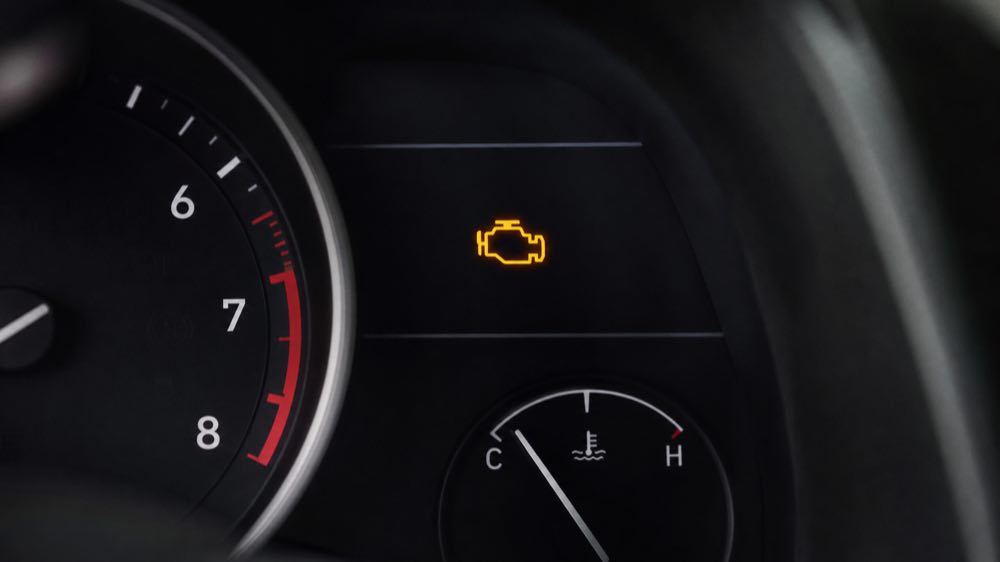
The check engine light means your car’s onboard diagnostics system found a problem it wants you to investigate. It might be something simple, like a loose gas cap, or something more serious, like an engine misfire, emissions-system fault, or catalytic converter problem. For a wider symbol-by-symbol overview, start with our dashboard warning lights guide.
The important question is not just “what does the light mean?” It is “how is the car acting right now?” A steady amber check engine light with no symptoms is usually less urgent. A flashing check engine light, shaking engine, fuel smell, overheating, or major power loss means you should stop driving as soon as it is safe.
Quick Answer: What Should You Do First?
If the check engine light comes on, do this before guessing at parts:
- Notice whether the light is steady or flashing.
- Pay attention to how the car feels.
- Check whether the gas cap is loose or missing.
- Avoid hard acceleration and high-speed driving.
- Use an OBD2 scanner to read diagnostic trouble codes.
- Do not clear the code until you understand why it appeared.
If the light is flashing or the vehicle is shaking, reduce driving and get help quickly.
Steady vs Flashing Check Engine Light
Not every check engine light has the same urgency.
| Check Engine Light Behavior | What It Usually Means | Driving Risk | Best First Step |
|---|---|---|---|
| Steady light, car feels normal | The computer stored a fault code | Usually lower, but still needs diagnosis | Check gas cap and scan codes |
| Steady light with rough running | Engine or fuel/air issue may be active | Medium to high | Scan codes and limit driving |
| Flashing light | Possible severe misfire | High | Stop driving as soon as safe |
| Light plus fuel smell | Possible fuel or EVAP issue | High | Pull over if smell is strong |
| Light plus overheating | Cooling system or engine issue | High | Stop and let the engine cool |
Why the Check Engine Light Comes On
The check engine light, also called the malfunction indicator lamp, is controlled by the vehicle’s onboard diagnostics system. Modern cars monitor the engine, emissions system, fuel system, ignition system, and parts of the powertrain. When the computer sees a fault outside the expected range, it stores a diagnostic trouble code and turns the light on.
The light itself does not tell you the exact failed part. It tells you the car detected a problem and needs diagnosis.
Common Causes of a Check Engine Light
Here are some of the most common reasons the light appears.
Loose or Bad Gas Cap
A loose gas cap can trigger an EVAP system code because fuel vapor is escaping from a sealed system. If the light came on shortly after refueling, this is one of the easiest things to check.
Tighten the cap until it clicks. If the cap is cracked, missing, or no longer seals well, replace it. The light may not turn off immediately because the car often needs several drive cycles to retest the system.
Oxygen Sensor Problem
Oxygen sensors measure exhaust oxygen so the computer can adjust fuel mixture. A failing oxygen sensor can hurt fuel economy, increase emissions, and sometimes contribute to catalytic converter damage if ignored.
An oxygen sensor code does not always mean the sensor itself is the only issue. Exhaust leaks, wiring faults, rich/lean fuel conditions, or engine problems can also affect sensor readings.
Catalytic Converter Efficiency Code
A code like P0420 or P0430 often points to catalytic converter efficiency. This can be expensive, so do not replace the converter blindly.
Before assuming the catalytic converter is bad, a technician may check oxygen sensor data, exhaust leaks, misfire history, fuel trim, and engine performance.
Misfire From Spark Plugs or Ignition Coils
A misfire happens when one or more cylinders do not burn fuel correctly. Common causes include worn spark plugs, weak ignition coils, fuel injector problems, vacuum leaks, or compression issues.
If the check engine light flashes, a misfire may be severe enough to damage the catalytic converter. That is a stop-driving warning, not a “check it next month” warning.
Mass Airflow Sensor or Air Intake Issue
The mass airflow sensor helps the computer measure how much air enters the engine. If it reads incorrectly, the air-fuel mixture can be wrong.
Symptoms may include rough idle, poor acceleration, stalling, or bad gas mileage. A dirty air filter, intake leak, or wiring issue can sometimes mimic a sensor problem.
EVAP System Leak
The EVAP system keeps fuel vapors from escaping into the air. Codes like P0442, P0455, or P0456 often relate to leaks in this system.
Some EVAP issues are simple, like a loose gas cap. Others involve hoses, purge valves, vent valves, or the charcoal canister.
Can You Drive With the Check Engine Light On?
Sometimes, yes. But it depends on the light and the symptoms.
You may be able to drive carefully if:
- the light is steady
- the car feels normal
- there is no shaking
- there is no fuel smell
- the temperature gauge is normal
- the oil pressure light is not on
You should stop driving or get help quickly if:
- the check engine light is flashing
- the engine is shaking badly
- the car smells like fuel
- the engine is overheating
- the car loses power or enters limp mode
- other red warning lights appear
If you are unsure, avoid long trips and have the car scanned as soon as possible. For a fuller safety breakdown, read can you drive with the check engine light on?
What an OBD2 Scanner Can Tell You
An OBD2 scanner reads diagnostic trouble codes from the vehicle’s onboard computer. These codes give you a starting point.
For example:
- P0300 may point to a random misfire
- P0420 may point to catalyst efficiency below threshold
- P0171 may point to a lean fuel condition
- P0455 may point to a large EVAP leak
- P0128 may point to coolant temperature below expected range
The code is not always the final diagnosis. Think of it as a clue. A P0171 lean code, for example, might be caused by a vacuum leak, weak fuel delivery, exhaust leak, dirty mass airflow sensor, or sensor issue.
Should You Clear the Check Engine Light?
Do not clear the code just to make the light disappear. If the problem is still there, the light will usually come back.
Clearing codes too early can also erase useful diagnostic information, including freeze-frame data that shows what was happening when the fault was stored. If your car needs an emissions inspection, clearing codes can reset readiness monitors and delay inspection readiness.
It is better to read the code, write it down, fix the cause, and then clear it if needed.
How Much Does Check Engine Light Diagnosis Cost?
The cost depends on the shop, location, vehicle, and problem. Some auto parts stores may read basic codes for free, but a code read is not the same as a full diagnosis.
A repair shop may charge a diagnostic fee because a technician needs to test the system, inspect live data, verify the cause, and avoid replacing parts unnecessarily.
Possible costs can range from a simple gas cap replacement to more expensive repairs like oxygen sensors, ignition coils, catalytic converter work, or fuel-system diagnosis.
Mistakes to Avoid
Avoid these common mistakes when the check engine light comes on:
- Replacing parts based only on a code
- Ignoring a flashing check engine light
- Clearing codes before saving them
- Driving long distances with rough running
- Assuming every code means the named part is bad
- Skipping diagnosis because the car still feels normal
The goal is not to panic. The goal is to respond in the right order.
When to Call a Mechanic
Call a mechanic or roadside assistance if the check engine light appears with:
- flashing light
- engine shaking
- fuel smell
- overheating
- major power loss
- stalling
- poor braking or steering
- other red warning lights
For a steady light with no symptoms, schedule diagnosis soon. The car may feel normal, but the stored code can still point to a problem that affects emissions, fuel economy, or long-term reliability.
FAQ
What does the check engine light mean?
It means the vehicle’s onboard diagnostics system detected a problem and stored a diagnostic trouble code. The problem may involve the engine, emissions system, fuel system, ignition system, or related sensors.
Is a steady check engine light serious?
A steady light is usually less urgent than a flashing one, especially if the car feels normal. It still needs diagnosis because small problems can become more expensive if ignored.
What does a flashing check engine light mean?
A flashing check engine light often points to a severe misfire. Reduce driving and get the vehicle checked quickly because continued driving may damage the catalytic converter.
Can a loose gas cap cause the check engine light?
Yes. A loose, missing, or damaged gas cap can trigger an EVAP system code because the fuel vapor system cannot seal properly.
Will the check engine light turn off by itself?
Sometimes it will turn off after the computer runs enough tests and no longer sees the fault. If the problem remains, the light will usually stay on or return.
Can I pass emissions with the check engine light on?
In many areas, a vehicle will not pass emissions inspection with the check engine light on or with readiness monitors incomplete. Rules vary by state and inspection program.
Final Takeaway
A check engine light is a warning, not a diagnosis. Start with the light behavior, how the car feels, and any other warnings on the dashboard. A steady light with no symptoms gives you more time, but it still needs attention. A flashing light, rough running, overheating, fuel smell, or power loss means you should stop driving and get help quickly.
Use an OBD2 scanner to find the code, but do not treat the code as a parts shopping list. Good diagnosis saves money and helps you avoid replacing the wrong part.
2 thoughts on “What Does the Check Engine Light Mean?”