
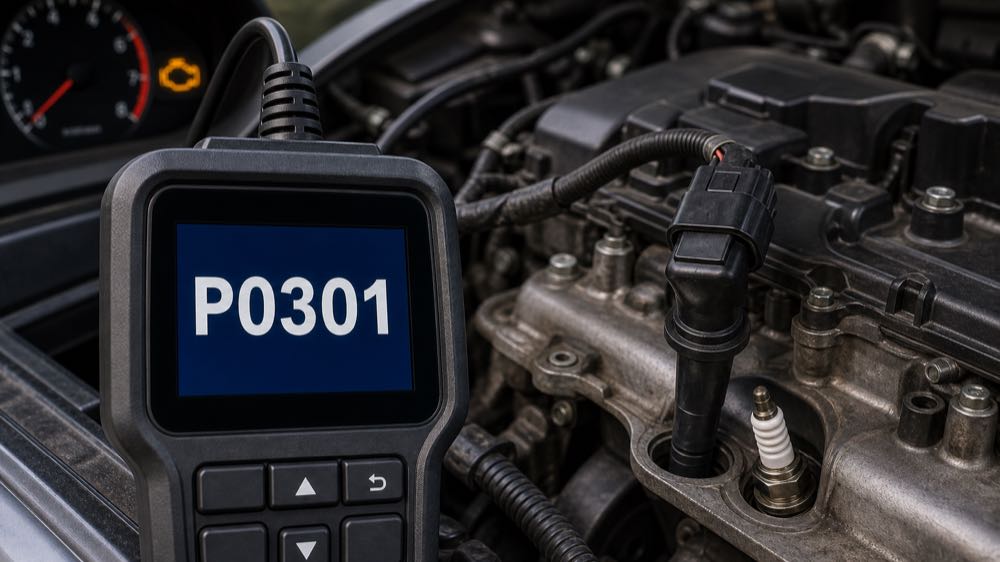
P0301 is an OBD2 diagnostic trouble code that means cylinder 1 misfire detected. In plain English, the engine computer has detected that cylinder 1 is not burning the air-fuel mixture correctly.
This is more specific than P0300, which means random or multiple cylinder misfire. P0301 points you toward one cylinder, but it still does not tell you which part has failed. The cause may be a spark plug, ignition coil, fuel injector, vacuum leak, compression problem, wiring issue, or mechanical fault.
If the check engine light is flashing, treat P0301 as urgent. A flashing light can mean active misfire severe enough to damage the catalytic converter.
P0301 Quick Facts
| Item | Details |
|---|---|
| Code | P0301 |
| Definition | Cylinder 1 misfire detected |
| System | Ignition, fuel, air, or mechanical engine operation |
| Common symptom | Rough idle, shaking, hesitation, check engine light |
| Severity | Medium to high depending on symptoms |
| Biggest risk | Catalytic converter damage from active misfire |
| Best first step | Confirm cylinder 1 location and inspect plug/coil/injector data |
What P0301 Means
A misfire happens when a cylinder does not produce normal combustion. The engine control module watches crankshaft speed changes and sensor data to detect when a cylinder is not contributing power correctly.
With P0301, the computer has identified cylinder 1 as the problem area. That makes diagnosis more focused than a random misfire code, but it does not automatically mean the spark plug is bad.
Cylinder 1 can misfire because it has weak spark, too much or too little fuel, unmetered air, low compression, or a control problem.
Find Cylinder 1 Before Replacing Parts
Cylinder 1 location depends on the engine. On an inline four-cylinder engine, it is often at one end of the engine, but the exact end can vary by manufacturer. On V6 and V8 engines, bank layout and cylinder numbering are even more important.
Do not guess by looking from the front of the car. Use a service diagram, repair manual, or reliable vehicle-specific reference before moving coils, plugs, or injectors.
Replacing parts on the wrong cylinder is one of the easiest ways to waste time on P0301.
Common Symptoms of P0301
P0301 symptoms can be mild or obvious.
- Check engine light on
- Flashing check engine light
- Rough idle
- Engine shaking
- Hesitation during acceleration
- Loss of power
- Fuel smell from exhaust
- Poor fuel economy
- Hard starting
- Failed emissions test
If the engine is shaking badly or the check engine light is flashing, read our flashing check engine light guide and avoid normal driving.
Can You Drive With a P0301 Code?
You may be able to drive a short distance with P0301 if the check engine light is steady and the engine runs smoothly. But if the engine shakes, hesitates badly, smells like fuel, or the light flashes, avoid normal driving.
An active misfire can send unburned fuel into the exhaust. That fuel can overheat and damage the catalytic converter. If converter damage happens, a later code such as P0420 may appear.
The safer rule is simple: steady light with mild symptoms means diagnose soon; flashing light or rough running means stop driving normally.
Common Causes of P0301
Worn or Fouled Spark Plug
The spark plug in cylinder 1 ignites the air-fuel mixture. If it is worn, oil-fouled, fuel-fouled, cracked, incorrectly gapped, or the wrong type, cylinder 1 can misfire.
Reading the spark plug can also give clues. Oil fouling may point to oil control problems. A white, overheated plug may suggest a lean condition or cooling issue.
Bad Ignition Coil or Coil Pack
Many modern vehicles use one ignition coil per cylinder. If the cylinder 1 coil is weak, cracked, oil-soaked, or failing under load, P0301 can set.
A common test is to swap the cylinder 1 coil with another cylinder and see whether the misfire code follows the coil. If P0301 changes to P0302 after moving the coil to cylinder 2, the coil is likely suspect.
Fuel Injector Problem
The cylinder 1 fuel injector may be clogged, leaking, stuck, or electrically faulty. A weak injector can make the cylinder run lean. A leaking injector can flood the cylinder or create fuel smell.
Injector diagnosis may include listening tests, injector balance testing, electrical checks, or moving the injector to see whether the misfire follows.
Vacuum Leak Near Cylinder 1
An intake manifold gasket leak or nearby vacuum leak can affect one cylinder more than the others. This can create a lean misfire on cylinder 1, especially at idle.
If fuel trims are high and the misfire is worse at idle, inspect for intake leaks around cylinder 1.
Low Compression
Cylinder 1 needs compression to burn properly. Low compression can come from worn rings, burned valves, valve timing issues, head gasket problems, or mechanical wear.
If spark and fuel checks do not explain P0301, a compression test or leak-down test may be needed.
Wiring or Connector Issue
The ignition coil or fuel injector connector for cylinder 1 may be loose, corroded, oil-soaked, or damaged. Wiring can also break near the connector due to heat and vibration.
This is especially worth checking if the misfire appeared after engine work.
Engine Control or Timing Issue
Less commonly, PCM control, cam/crank timing issues, or valve-train problems can cause cylinder-specific misfires. These should be considered after simpler ignition, fuel, air, and compression checks.
Diagnostic Order: What to Check First
Use this order to avoid random parts replacement.
- Confirm P0301 with an OBD2 scanner.
- Check for other codes, including P0300, fuel trim, oxygen sensor, or injector codes.
- Review freeze frame data to see when the misfire happened.
- Confirm the correct cylinder 1 location.
- Inspect the cylinder 1 spark plug.
- Inspect or swap-test the ignition coil.
- Check injector connector and injector operation.
- Look for intake or vacuum leaks near cylinder 1.
- Review misfire counters and live data.
- Perform compression or leak-down testing if ignition and fuel checks do not find the cause.
The goal is to see whether the problem follows a part, stays with cylinder 1, or points to a shared engine condition.
P0301 vs P0300
P0301 points to cylinder 1. P0300 means random or multiple cylinder misfire. If both codes appear together, cylinder 1 may be the worst cylinder, but there may also be a broader issue such as low fuel pressure, vacuum leak, bad MAF data, or poor ignition supply.
If only P0301 appears, start with cylinder 1-specific checks. If P0300 appears too, widen the diagnosis.
Repair Cost for P0301
P0301 repair cost depends on the cause.
| Possible repair | Typical U.S. cost range |
|---|---|
| Diagnostic scan and inspection | $75-$180 |
| Spark plug replacement | $100-$400+ |
| Ignition coil replacement | $120-$450+ |
| Fuel injector service or replacement | $150-$800+ |
| Vacuum or intake leak repair | $100-$900+ |
| Compression/leak-down diagnosis | $150-$400+ |
| Mechanical engine repair | $500-$3,000+ |
Costs vary by vehicle, engine layout, parts quality, and access. A simple coil-on-plug repair is very different from a compression-related repair.
What Not to Do
Do not keep driving with a flashing check engine light. Do not replace the catalytic converter before fixing the misfire. Do not replace all coils or injectors without testing. Do not guess cylinder 1 location.
P0301 is useful because it points to a specific cylinder. Use that advantage.
FAQ
What does code P0301 mean?
P0301 means cylinder 1 misfire detected. The engine computer has detected that cylinder 1 is not contributing power normally.
Is P0301 serious?
It can be serious. A steady check engine light with mild symptoms should be diagnosed soon. A flashing check engine light or rough-running engine can damage the catalytic converter.
Can I drive with a P0301 code?
You may be able to drive a short distance if the engine runs smoothly and the light is steady. Avoid normal driving if the engine shakes, smells like fuel, loses power, or the light flashes.
What is the most common cause of P0301?
Common causes include a worn spark plug, bad ignition coil, faulty fuel injector, vacuum leak near cylinder 1, wiring issue, or low compression.
Can a bad coil cause P0301?
Yes. A weak or failed cylinder 1 ignition coil can cause P0301. Swapping the coil to another cylinder can help confirm whether the misfire follows the coil.
Can P0301 damage the catalytic converter?
Yes. Active misfires can send unburned fuel into the exhaust and overheat the catalytic converter, especially if the check engine light is flashing.