
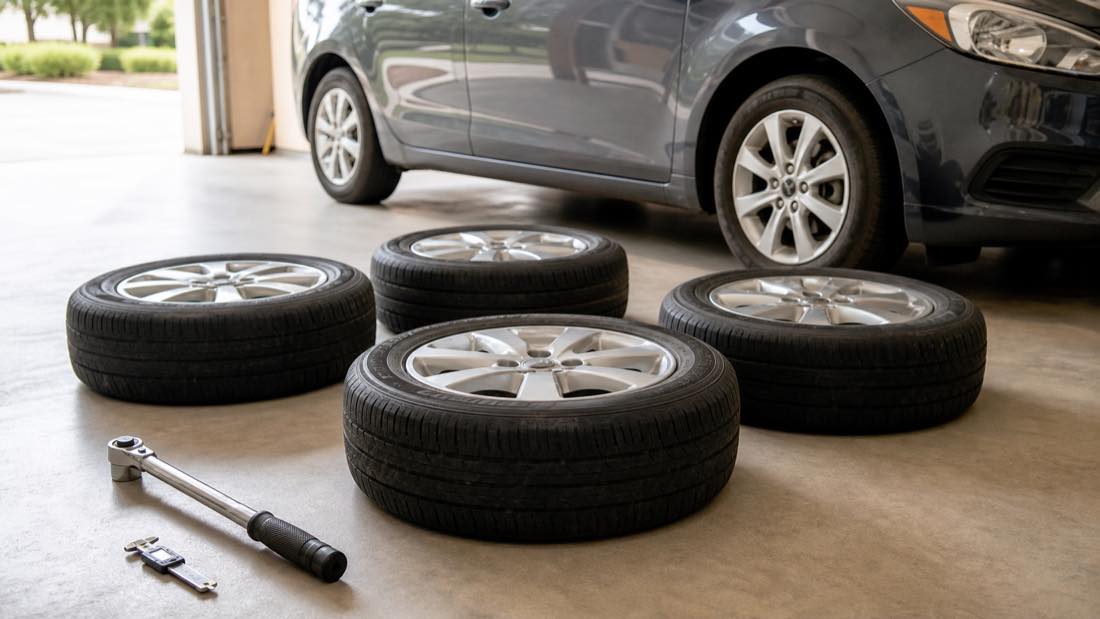
Most drivers should rotate their tires every 5,000 to 7,500 miles, or about every 6 months if they drive very little. The exact tire rotation interval depends on your owner’s manual, tire type, drivetrain, driving conditions, and whether your tires are directional or staggered.
If you want a simple rule, rotate tires at every oil change for many gas vehicles. That keeps the habit easy. But do not use the same pattern for every vehicle. A front wheel drive sedan, an all wheel drive SUV, a rear wheel drive truck, and a car with staggered performance tires may need different rotation patterns.
For the broader service plan, see our complete car maintenance schedule by mileage. If your TPMS light is on before or after rotation, use our TPMS light guide to understand what to check first.
Quick Tire Rotation Interval
| Vehicle or driving situation | Common rotation interval |
|---|---|
| Most passenger cars | Every 5,000-7,500 miles |
| Low-mileage driver | About every 6 months |
| AWD or 4WD vehicle | Often every 5,000-6,000 miles |
| Truck, SUV, towing, hauling | Use the severe-service schedule |
| New tires | First rotation often around 5,000 miles |
| EV or hybrid with heavy torque | Check tread often; many need close intervals |
| Staggered or directional tires | Rotation may be limited |
These are general ranges. The owner’s manual and tire warranty should come first.
Use the manufacturer’s tire rotation schedule as the main recommendation, especially for front wheel drive (FWD), all wheel drive, and four wheel drive vehicles where uneven tire wear can affect vehicle handling.
Why Tire Rotation Matters
Tires do not wear evenly from front to rear. Front tires usually handle steering, more braking load, and more cornering scrub. On front wheel drive cars, the front tires also handle engine power, so they often wear faster than the rear tires. On rear wheel drive vehicles, the rear tires can wear faster under acceleration. AWD and 4WD vehicles can be sensitive to tread depth differences between tires.
Rotation helps spread that work across all four tires. Done on schedule, it can:
- help tires last longer
- keep handling more predictable
- reduce vibration caused by uneven wear
- support wet-road traction
- protect tire warranty requirements
- give a shop a chance to spot tire, brake, alignment, or suspension issues early
Skipping rotations will not make a tire fail overnight, but it can slowly create uneven tread wear that cannot be fixed later. Once a tire develops cupping, feathering, shoulder wear, or a big tread-depth difference, rotating alone may not solve the problem.
Mileage vs Time
Mileage matters most because tread wear comes from road use. Time still matters because many drivers do not reach 5,000 miles quickly. If a car sits often or only makes short local trips, checking tires every 6 months is still smart. Rubber ages, tire pressure changes with temperature, and slow leaks can go unnoticed.
Pairing tire rotation with oil changes works well for many drivers. If your oil change interval is about 5,000 to 7,500 miles, do both services together. If your vehicle allows a longer oil interval, do not automatically wait 10,000 or 12,000 miles to rotate tires unless your manual and tire warranty allow it.
Read our oil change interval guide if you are trying to line up both services.
Which Rotation Pattern Do You Need?
The right tire rotation pattern depends on drivetrain and tire design.
| Setup | Common pattern | Important note |
|---|---|---|
| Front wheel drive | Forward cross | Front tires move straight back; rear tires cross to front |
| Rear wheel drive | Rearward cross | Rear tires move straight front; front tires cross to rear |
| AWD or 4WD | X pattern or rearward cross | Follow the manual because AWD systems can be sensitive |
| Directional tires | Front to rear on the same side | Do not cross sides unless tires are remounted |
| Staggered tires | Side to side if allowed | Different front/rear sizes limit rotation |
| Full-size spare | Five-tire pattern if allowed | Temporary spares are not rotated into service |
Never guess on performance cars, EVs, trucks with different tire sizes, or vehicles with directional tread. The tire sidewall, owner’s manual, and tire shop can confirm what is allowed.
AWD, 4WD, EV, and Truck Notes
AWD and 4WD vehicles often need closer attention because uneven tire diameter can stress the drivetrain. Even small tread-depth differences can matter on some systems. If your manual calls for rotation every 5,000 miles, take it seriously.
EVs can also wear tires quickly because they are heavy and deliver instant torque. That does not mean every EV destroys tires, but it does mean tire pressure, alignment, and rotation interval matter. If an EV starts showing shoulder wear or rapid rear-tire wear, shorten the inspection interval.
Trucks and SUVs used for towing, hauling, gravel roads, or job-site driving should follow severe-service guidance. Heavy loads can increase heat and tread wear. Rotate before a long road trip if you are already close to the interval.
Signs Your Tires Need Rotation Soon
You may be due for a tire rotation if you notice:
- the front tires look more worn than the rear tires
- the rear tires are wearing faster on a RWD vehicle
- one shoulder of a tire is wearing faster
- the steering wheel vibrates at highway speed
- road noise has become louder
- the vehicle pulls or feels less stable
- tread depth is uneven between tires
- your tire warranty requires a documented rotation
- you are past the mileage or time interval
Use a tread depth gauge if possible. The penny test can give a rough idea, but a cheap gauge gives clearer numbers.
Rotation, Alignment, and Balancing Are Different
Tire rotation, wheel alignment, and tire balancing often get mentioned together, but they are not the same service.
Tire rotation moves the tires to different positions on the vehicle. Wheel alignment adjusts suspension angles so the tires point the correct way. Tire balancing corrects heavy spots in the wheel and tire assembly so it spins smoothly.
| Symptom | Service to ask about | Why it matters |
|---|---|---|
| Front tires wearing faster than rear tires | Tire rotation | Normal front/rear wear can be evened out |
| Vehicle pulls to one side | Wheel alignment | Rotation will not fix bad alignment angles |
| Steering wheel shakes at highway speed | Tire balancing | A balanced wheel reduces vibration |
| One tire has cupping or scalloped wear | Inspection first | Suspension, alignment, or tire damage may be involved |
| All tires show low pressure | Tire pressure check | Rotation does not replace inflation maintenance |
If you rotate tires but ignore alignment or balancing symptoms, the same wear pattern can return. That is why a good mechanic or tire shop will look at tread wear before simply moving wheels around.
A Simple DIY Tire Rotation Checklist
DIY tire rotation can be beginner-friendly, but only if you can do it safely. Before you start, confirm the rotation pattern in the owner’s manual, check whether the tires are directional or staggered, and find the correct lug nut torque specification.
Basic DIY tire rotation steps:
- park on a flat surface
- set the parking brake
- use wheel chocks
- loosen lug nuts slightly before lifting
- lift the vehicle at approved jack points
- support it with jack stands
- rotate tires using the correct pattern
- tighten lug nuts in a star pattern
- torque lug nuts to specification
- check tire pressure after the vehicle is back on the ground
Do not work under or around a car supported only by a jack. If you do not have jack stands, a torque wrench, or a safe level workspace, use a shop. A low-cost rotation is cheaper than damaged wheels, broken studs, or an unsafe lift setup.
Service Records and Tire Warranty
Many tire warranties require regular rotation records. The tire maker or tire shop may ask for mileage, dates, tread depth readings, and proof that the tires were maintained correctly. If you skip service records, a warranty claim can become harder even when the tires wore out early.
Keep a simple service record with:
- date of rotation
- odometer mileage
- tire positions before and after rotation
- tire pressure after service
- tread depth if measured
- shop receipt or DIY notes
This is especially useful for AWD vehicles, EVs, trucks, and high-mileage cars where tire wear can change quickly. A short note in your phone is better than trying to remember the last rotation a year later.
When Rotation Is Not Enough
Do not treat every tire problem as a rotation problem. Rotation can spread normal wear, but it will not fix:
- badly underinflated tires
- tire bubbles, cuts, exposed cords, or sidewall damage
- severe cupping from bad shocks or suspension wear
- feathered tread from alignment problems
- a bent wheel
- separated tire belts
- mismatched tire sizes on vehicles that require matching tires
- tires already below the legal or safe tread depth
If a tire has visible damage, do not rotate it to another corner and hope for the best. Have it inspected. If your tire pressure light is on, diagnose the pressure or sensor issue before assuming rotation will solve it.
Tire Rotation Cost
Tire rotation is usually one of the cheaper maintenance services.
| Service option | Typical US cost |
|---|---|
| Included with tire purchase or maintenance plan | $0 |
| Standalone tire rotation | $20-$60 |
| Rotation with oil change | Often discounted or included |
| Rotation and balance | $40-$100+ |
| Dealer service visit | Varies widely by region and vehicle |
Some tire shops include free rotations if you bought the tires there. Keep receipts because tire warranties may require rotation records at specific mileage intervals.
DIY or Shop?
You can rotate tires yourself if you have the right equipment and a safe place to work. You need a jack, jack stands, wheel chocks, a lug wrench or breaker bar, and a torque wrench. The torque wrench matters because lug nuts should be tightened to the vehicle specification, not just “as tight as possible.”
A shop is the better choice if the vehicle is heavy, the wheels are stuck, the tires are directional or staggered, the lug nuts are damaged, or you also need balancing, alignment diagnosis, TPMS service, or brake inspection.
After any tire rotation, recheck lug nut torque if your manual or shop recommends it. Also check tire pressure because front and rear pressure specs can differ on some vehicles.
Common Mistakes
Avoid these tire rotation mistakes:
- waiting until tires are visibly uneven
- using the same pattern on every vehicle
- crossing directional tires incorrectly
- rotating staggered tires front to rear when sizes differ
- ignoring AWD tread-depth requirements
- forgetting to reset or relearn TPMS if required
- tightening lug nuts without a torque wrench
- skipping tire pressure after rotation
- failing to keep rotation records for warranty
- rotating damaged tires instead of replacing or repairing them
Good tire maintenance is small, repetitive, and a little boring. That is exactly why it works.
FAQ
How often should you rotate tires?
Most drivers should rotate tires every 5,000 to 7,500 miles. Low-mileage drivers should still check rotation needs about every 6 months.
Is it OK to rotate tires every 10,000 miles?
Sometimes, but it may be too long for many vehicles, especially AWD vehicles, EVs, trucks, or cars that show uneven wear. Check the owner’s manual and tire warranty.
Should I rotate tires with every oil change?
Often yes, especially if your oil change interval is around 5,000 to 7,500 miles. If your oil interval is much longer, rotate tires separately.
What happens if you do not rotate tires?
Tires can develop uneven tread wear, shorter tread life, more road noise, vibration, reduced traction, and possible warranty issues.
Do AWD vehicles need tire rotation more often?
Many AWD vehicles benefit from close rotation intervals because tread-depth differences can affect drivetrain behavior. Follow the owner’s manual.
Can I rotate directional tires?
Yes, but usually only front to rear on the same side unless the tire is dismounted and remounted. Directional tires should keep rolling in the correct direction.
Does tire rotation include balancing?
Not always. Rotation changes tire positions. Balancing corrects weight imbalance in a wheel and tire assembly. If you have vibration, ask whether balancing is needed.
Should the best tires go on the front or rear?
If replacing only two tires, many tire manufacturers and safety organizations recommend putting the better tires on the rear axle for stability in wet conditions. Ask a tire professional for your vehicle.