
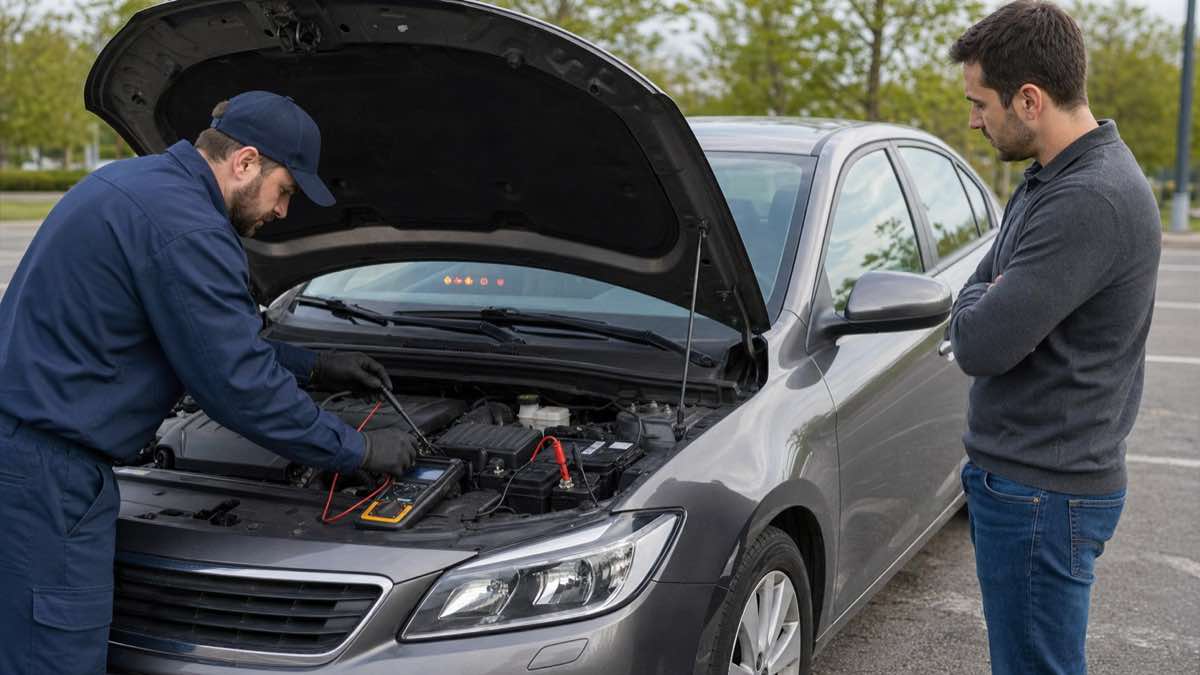
If your car won’t start but the lights come on, the battery may still be weak. Dashboard lights and a radio need far less electrical current than the starter motor. Other possibilities include loose battery connections, a starter-circuit fault, an unrecognized key, a Park/Neutral or pedal-switch problem, or—if the engine cranks normally—a fuel, ignition, sensor, or mechanical problem.
The fastest way to narrow it down is to describe exactly what happens when you turn the key or press Start. Does the engine remain silent, click rapidly, click once, crank slowly, or crank at normal speed without firing? Those are different fault paths.
Quick Symptom Guide
| What happens | Common areas to test | First safe action |
|---|---|---|
| Rapid clicking; lights dim heavily | Weak battery, poor terminal or ground connection | Stop repeated attempts; inspect visible connections and arrange a battery/load test |
| One solid click; engine does not turn | Battery/connection voltage drop, starter or solenoid, locked accessory or engine | Do not assume the starter; test the complete starting circuit |
| No click; lights stay bright | Park/Neutral input, brake or clutch switch, key recognition, relay, ignition/start command | Check messages, shifter position, pedal input, and owner’s manual |
| Slow cranking | Weak battery, resistance in cables, starter draw, cold/thick oil, mechanical drag | Stop before the battery is depleted; test battery and cables under load |
| Normal cranking but no start | Fuel, spark, injector command, crank/cam signal, security, compression or timing | Stop guessing parts; scan and follow a crank-no-start test plan |
| Grinding or harsh mechanical noise | Starter engagement, flywheel/flexplate, internal mechanical fault | Release the key immediately and arrange inspection |
No-Crank Versus Crank-No-Start
No-crank means the starter does not rotate the engine. You may hear silence, clicks, or a brief attempt. Diagnosis begins with battery condition, connections, starter control, starter current path, shifter or pedal interlocks, and mechanical ability to turn.
Crank-no-start means the engine rotates at a normal-looking speed but never runs. The starter is doing its basic job. Testing shifts toward fuel delivery, ignition or injector command, immobilizer authorization, crankshaft and camshaft signals, compression, and mechanical timing.
Drivers often say “it won’t turn over” for both conditions, so imitate the sound for the technician or record a short video from the driver’s seat. Do not stand in front of or behind a vehicle while another person attempts to start it.
Why Lights Can Work With a Weak Battery
A partially discharged or internally weak 12-volt battery can operate low-demand accessories yet fail when the starter requests much more current. Resting voltage alone does not fully measure starting ability; battery condition and voltage drop under load matter.
Clues include rapid clicking, lights that collapse during the start attempt, slow cranking, recent cold weather, long storage, an interior light left on, or a battery near the end of its service life. But a new battery is not proof that power delivery is good. Loose terminals, corrosion between contact surfaces, damaged cables, or a poor engine ground can mimic battery failure.
If the car starts with assistance and the battery or charging symbol stays on while running, follow our battery light while driving guide. The warning concerns the charging system; it does not simply mean “buy a battery.”
1. Loose, Corroded, or Damaged Connections
Battery terminals can look attached while making poor electrical contact under starter load. Grounds between the battery, body, and engine are equally important. Previous battery work, corrosion, loose hardware, damaged cable strands, or a hot connection can cause intermittent no-crank symptoms.
With the vehicle off, look for an obviously loose terminal, heavy corrosion, broken cable, melted insulation, or a battery that is swollen, leaking, frozen, or physically damaged. Do not handle a damaged battery or create sparks nearby. Cleaning and tightening procedures vary; use the manual and proper protection, or request roadside service.
2. Starter Motor, Solenoid, Relay, or Control Circuit
A single click can occur when a starter solenoid moves but the motor does not turn. That does not automatically condemn the starter. Low delivered voltage, cable resistance, a weak ground, relay or control fault, seized accessory, or mechanical engine problem can produce a similar result.
A proper test checks battery performance, voltage drop on positive and ground paths, start-command input, starter current behavior, and whether the engine can rotate by the prescribed method. Replacing the starter before those checks can be an expensive guess.
3. Park/Neutral, Brake, or Clutch Interlock
Automatic vehicles normally require Park or Neutral; manuals usually require the clutch pedal. Push-button systems often require a valid brake-pedal input. A misadjusted switch, shifter-position fault, floor mat interference, or wiring problem may prevent the start request even though accessories work.
Confirm the shifter is fully in Park and observe whether the cluster shows the expected position. If the owner’s manual permits, try Neutral with the parking brake firmly set and foot on the brake. Do not repeatedly move or force the shifter, and never bypass a safety interlock.
4. Key Fob or Immobilizer Recognition
A weak key-fob battery, damaged key, interference, aftermarket alarm, steering-lock issue, or immobilizer fault can block cranking or allow cranking while disabling fuel or ignition. Look for a key, security, or “key not detected” message.
Use the backup-key or emergency fob placement procedure in the owner’s manual. Avoid internet reset sequences for another make or model; an incorrect procedure can waste time or trigger additional lockout. If both valid keys fail, scan the appropriate security and body modules.
5. Cranks Normally but Does Not Fire
Normal cranking means the problem is broader than the starter. The engine needs the correct fuel, ignition or combustion event, sensor timing information, compression, and authorization. A failed fuel pump is possible, but so are a fuse, relay, wiring fault, crank sensor, flooded engine, empty tank, contaminated fuel, ignition fault, broken timing component, or immobilizer command.
Do not spray starting fluid into a modern engine or probe ignition and fuel circuits without the correct procedure. Gasoline vapor and high-pressure fuel systems create fire and injury risks. If you smell raw fuel, stop attempts, keep ignition sources away, and use our gas smell safety guide.
Safe Checks You Can Make First
- Set the parking brake, select Park or Neutral as specified, and switch off accessories.
- Read every dashboard message and note the security, key, brake, battery, and check-engine indicators.
- Listen once: silence, rapid clicks, one click, slow crank, normal crank, or grinding.
- Check whether headlights dim sharply during one brief start attempt.
- Inspect the battery only for obvious looseness, corrosion, swelling, leakage, or damaged cables without creating sparks.
- Confirm there is fuel using the gauge, while remembering a gauge or level sensor can be wrong.
- Try the spare key or manufacturer emergency fob procedure if a key warning appears.
- Record the symptom before disconnecting power or clearing codes.
Dashboard warning lamps commonly illuminate during the normal key-on self-test before the engine runs. Their presence at that moment does not prove every listed system has failed. Our dashboard warning lights guide explains colors and urgency after the engine starts.
Should You Try a Jump Start?
A jump start may help when a discharged 12-volt battery is likely, but use the exact owner’s-manual procedure. Connection points and sequences vary, especially on hybrids, EVs, vehicles with remote terminals, and batteries located away from the engine bay. Use compatible equipment and keep cables away from moving parts.
Do not attempt it if the battery is damaged, leaking, swollen, frozen, has an unusual odor, or the manual prohibits the procedure. Stop if cables heat, smoke, spark abnormally, or are connected incorrectly. A successful jump is evidence of a power-delivery problem, not proof that the battery alone caused it; the battery and charging system still need testing.
Why a New Battery May Not Fix It
A recently installed battery can be discharged, defective, incorrectly specified, poorly connected, or not charged by the vehicle. The original no-start may instead be a starter, cable, parasitic draw, security, interlock, or engine-management fault. Some vehicles also require battery registration or system initialization.
Check the installation and diagnose the symptom under load before exchanging more parts. If the old battery was replaced only because the lights worked but the engine did not, preserve that history for the technician.
Patterns That Help Narrow an Intermittent No-Start
A no-start only after an overnight cold soak may expose a weak battery, poor connection, temperature-sensitive relay, thick oil, or fuel-delivery issue. A failure only when the engine bay is hot can point the test plan toward heat-sensitive starter, relay, sensor, wiring, or fuel components. Neither pattern proves one part without measurements.
If it happens after refueling, record fuel level, station, fuel type, whether the engine cranks normally, and any vapor or check-engine messages. If it follows battery replacement, jump-starting, key work, collision repair, or accessory installation, tell the technician. Power interruption can expose connection, initialization, security, or aftermarket wiring problems.
For an intermittent event, note date, outside temperature, engine temperature, time parked, shifter display, key used, sound, light behavior, and whether moving the shifter or waiting changed anything. A short video and exact timeline often provide more diagnostic value than saying it “randomly wouldn’t start.” Avoid repeatedly disturbing connections before the fault is tested, because the evidence may disappear.
When to Stop Trying and Call for Help
- There is smoke, burning odor, raw fuel smell, leakage, melting, or a hot cable.
- The starter grinds, the engine stops abruptly while cranking, or a harsh mechanical noise appears.
- The battery is swollen, frozen, cracked, or leaking.
- The vehicle was flooded, crashed, or has a high-voltage warning.
- Repeated attempts are slowing down or overheating the starter and cables.
- The car is in an unsafe location or cannot be secured in Park.
- A jump attempt following the manual changes nothing and diagnosis is unavailable.
Tell roadside assistance whether the engine cranks, what sound it makes, whether a jump was attempted, and whether the vehicle is AWD, hybrid, EV, lowered, stuck in Park, or in a restricted garage. Those details affect towing and equipment.
What a Shop Should Test
For a no-crank, expect battery condition, terminal and ground integrity, voltage drop, starter command, relay or fuse path, shifter and pedal inputs, immobilizer status, starter behavior, and mechanical rotation to be evaluated. For crank-no-start, diagnosis may include module scans, live crank/cam data, fuel pressure or injector command, ignition testing, compression, and timing checks.
A trouble code is a clue, not a parts order. Ask what test confirms the recommendation and whether the quote includes diagnosis, programming, related cables, taxes, and warranty. Intermittent faults may require leaving the vehicle until the symptom occurs.
Frequently Asked Questions
Can the battery be dead if the lights still work?
Yes. A battery can supply low-current lights and accessories but fail under the much higher starter load. Poor terminals or grounds can produce the same symptom, so test the battery and connections under load.
What does rapid clicking usually mean?
Rapid clicking often indicates low delivered voltage from a weak battery or high resistance in a connection. It is a clue, not proof. Stop repeated attempts and test the battery, terminals, cables, and grounds.
What does one click with bright lights mean?
It can involve the starter or solenoid, but battery voltage drop, cable resistance, ground faults, relay control, or mechanical binding can imitate it. Test the complete starting circuit before replacing the starter.
Why does the engine crank but not start?
The engine may lack fuel, ignition or injector command, sensor timing information, compression, mechanical timing, or security authorization. Scanning and systematic tests are more reliable than guessing a fuel pump or sensor.
Will starting in Neutral help?
It may reveal a Park-position or range-switch issue on some automatic vehicles. Only try it if the owner’s manual allows it, with the parking brake set and brake pedal held. Never bypass the interlock.
How long should I keep trying to start the car?
Do not keep cranking repeatedly. Follow the owner’s-manual attempt duration and rest period. Stop immediately for grinding, smoke, fuel odor, cable heat, or a slowing battery, and arrange diagnosis.
Bottom Line
When a car won’t start but the lights come on, do not rule out the battery and do not automatically replace the starter. First decide whether the engine is not cranking or is cranking without starting. Record the sound and dashboard behavior, make only safe manual-approved checks, and stop for fuel odor, battery damage, heat, smoke, grinding, or high-voltage warnings. A load and voltage-drop test or a structured crank-no-start diagnosis will find more than parts guessing.