
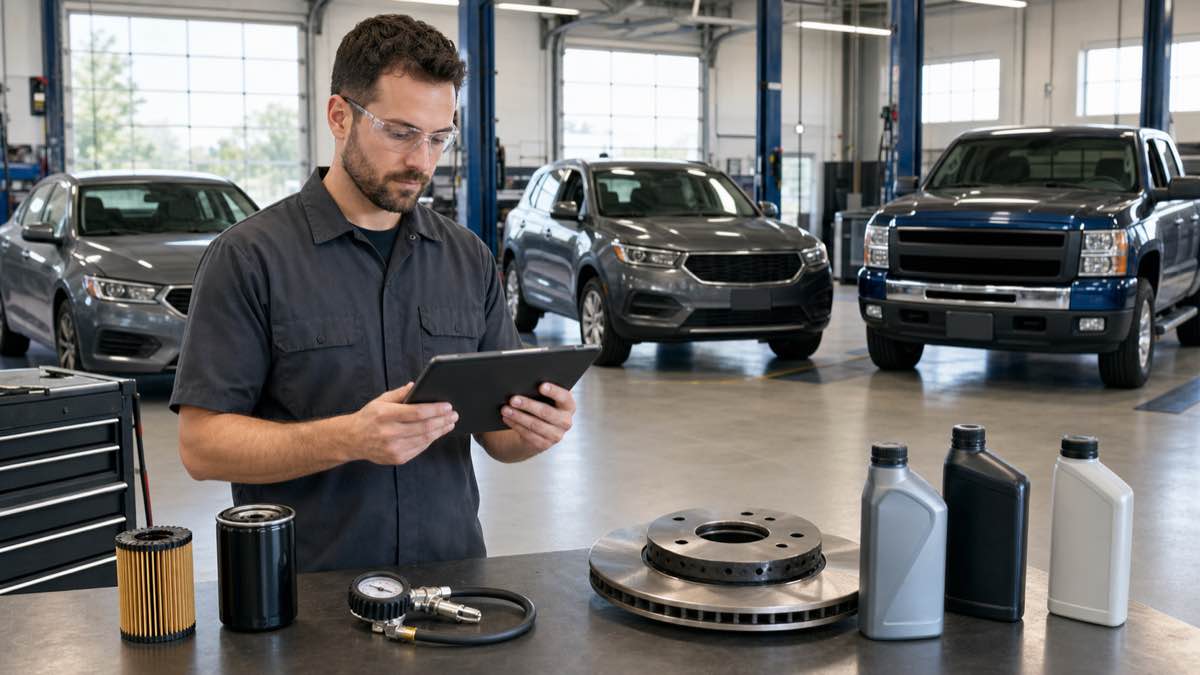
The best maintenance guide for a popular US car is the schedule for its exact model year, engine, drivetrain, and use—not a universal “service every 30,000 miles” chart. A Toyota Camry, Honda CR-V, Ford F-150, and Chevrolet Silverado may all need oil, tires, brakes, filters, fluids, and inspections, but their timing and procedures can differ substantially.
Use this guide as a planning hub for common cars and trucks, then confirm every service in the owner’s manual, warranty and maintenance guide, dashboard maintenance system, or manufacturer owner portal. Severe use such as towing, repeated short trips, dust, long idling, extreme temperatures, or low-speed mountain driving may require a different schedule.
Popular Car Maintenance Guide at a Glance
| Vehicle family | How maintenance is commonly tracked | Details that change the plan |
|---|---|---|
| Toyota Camry and Corolla | Model-year warranty and maintenance guide plus reminder system | Gas vs. hybrid, engine, age, driving conditions |
| Honda Civic and CR-V | Maintenance Minder oil-life percentage and service codes | Gas vs. hybrid, AWD, operating conditions, elapsed time |
| Ford F-150 | Owner’s manual, Ford maintenance schedule, oil-life monitor | Engine, 2WD/4WD, towing, payload, idling, dusty use |
| Chevrolet Silverado | Owner’s manual, Oil Life System, mileage- and condition-based inspections | Engine, transmission, 4WD, trailering, severe service |
Ford explicitly says its models and engine types have unique requirements and should be serviced according to their specific schedule. Chevrolet likewise directs owners to the owner’s manual for vehicle-specific information. Honda’s Maintenance Minder calculates remaining oil life from operating conditions and displays additional service codes. That is why a generic checklist is useful for organization but should never override the vehicle’s own instructions.
Start With the Exact Vehicle, Not Just the Model Name
Before building a maintenance plan, record the year, trim, engine, drivetrain, current mileage, in-service date, and VIN. The same model name can cover naturally aspirated, turbocharged, hybrid, diesel, two-wheel-drive, and four-wheel-drive versions. Fluid specifications, capacities, spark plugs, filters, cooling circuits, differentials, transfer cases, and replacement procedures can differ.
Download the correct owner’s manual and maintenance booklet from the manufacturer portal. Check open recalls separately; recall work is not routine maintenance. If the vehicle is used, collect receipts and service history before assuming a dashboard reminder proves all earlier work was completed.
Toyota Camry and Corolla Maintenance Planning
For a Camry or Corolla, begin with the model-year Toyota warranty and maintenance guide. Do not transfer an interval from a different generation or from a gas model to a hybrid without verification. Use the reminder as a prompt, but read the scheduled items and special operating-condition notes that apply at the current mileage and time.
- Verify the specified engine oil grade, capacity, and oil-filter procedure for the exact engine.
- Inspect tire pressure and wear monthly and follow the model-specific rotation pattern.
- Track engine and cabin filters by inspection, mileage, time, and dusty conditions.
- Inspect brakes rather than predicting pad life from mileage alone.
- Confirm coolant, spark plug, transmission, hybrid, and AWD fluid requirements in the correct guide.
- Record every service with date, mileage, parts, fluid specifications, and receipt.
A hybrid adds high-voltage components and cooling considerations, but it still has conventional maintenance needs such as tires, brakes, cabin filtration, wipers, and low-voltage electrical checks. Orange high-voltage cables and traction-battery components are not casual DIY service points.
Honda Civic and CR-V Maintenance Planning
Recent Civic and CR-V models use Honda Maintenance Minder. Honda states that messages begin appearing when calculated engine-oil life falls below 15%. The main and sub codes identify work due with the oil service, such as inspections, tire rotation, filters, transmission fluid, spark plugs, coolant, rear differential fluid on applicable models, or brake fluid.
Do not reset the display before the work is completed and recorded. An accidental reset removes useful timing information. Honda also notes time-based limits for certain services when a reminder does not appear, so a low-mileage vehicle cannot safely ignore elapsed time. Follow the code definitions in the exact manual because available sub-items vary by vehicle and drivetrain.
For a CR-V AWD model, verify rear differential service requirements. For Civic and CR-V hybrid versions, distinguish engine cooling from high-voltage-system cooling and follow model-specific procedures. Any unusual noise, smell, warning, fluid loss, or braking change deserves diagnosis rather than waiting for the next reminder.
Ford F-150 Maintenance Planning
An F-150 schedule depends heavily on engine, drivetrain, and duty cycle. Commuting in an unloaded truck is different from frequent towing, snowplow use, dusty job sites, long idle hours, or repeated low-speed operation. Use the owner’s manual’s normal and special operating-condition tables and monitor oil life rather than relying on one internet interval.
- Track engine hours and idle time when the truck’s work pattern makes mileage incomplete.
- Inspect tires, brakes, steering, suspension, and hitch equipment before towing.
- Check engine air filtration more often in dust and inspect for a properly sealed filter housing.
- Confirm transmission, transfer-case, and axle-fluid requirements for the drivetrain and use.
- Inspect cooling-system condition and leaks before heavy towing or hot-weather work.
- Use the exact engine’s oil specification; “F-150 oil” is not a complete fluid description.
Ford’s general guidance recommends checking lights, tires, engine-oil level, and washer fluid monthly, but its support material also tells owners to consult the specific schedule. Treat general mileage examples as prompts, not permission to delay a vehicle-specific alert or inspection finding.
Chevrolet Silverado Maintenance Planning
For a Silverado, combine the Oil Life System with the owner’s manual’s maintenance schedule. Chevrolet’s general guidance uses routine oil/filter service, tire rotation, seasonal wiper inspection, and multipoint inspections, while stressing that the manual contains the detailed schedule for the exact vehicle.
Engine choice, trailering, four-wheel drive, heavy payloads, dusty roads, and commercial operation can change the work required. Verify transmission, transfer case, differential, cooling system, fuel system, and diesel-specific items where applicable. Do not assume a gas 1500 schedule applies to a diesel or heavy-duty Silverado.
Maintenance Tasks Every Owner Should Track
| Task | Use this trigger | Do not rely on |
|---|---|---|
| Engine oil and filter | Vehicle oil-life system plus time and manual limits | A universal mileage for every engine |
| Tire pressure and condition | Monthly checks, cold-pressure label, visible wear or damage | TPMS alone |
| Tire rotation | Manual pattern and interval; measured wear | Guessing from appearance |
| Brakes | Inspection, measured friction material, symptoms | A fixed pad-life mileage |
| Filters | Manual, inspection, environment, reminder code | One interval in all climates |
| Fluids | Exact specification, condition, time/mileage/use schedule | Color alone or generic “lifetime” claims |
| Battery | Age, test result, terminals, starting and charging performance | Replacing solely because of a warning icon |
For a broader service framework, use our complete car maintenance schedule by mileage. It helps organize the work, while the manufacturer schedule supplies the final interval and specification. Our guide to how often to change your oil explains why oil-life systems, time, driving conditions, and oil specifications all matter.
Normal vs. Severe Service
“Severe” does not mean reckless driving. It may include repeated short trips, extensive idling, towing, heavy loads, dusty roads, mountain operation, very hot or cold temperatures, or low-speed commercial use. A vehicle can accumulate relatively few miles while its oil, brakes, cooling system, transmission, battery, and filters experience demanding conditions.
Read each manufacturer’s definition instead of self-labeling the vehicle. Different components may have different special-use rules. Document towing frequency, idle hours, trip length, terrain, and environment so a technician can apply the appropriate schedule.
Build a Maintenance Record That Protects You
- Save the correct owner’s manual and maintenance guide.
- Create a baseline using current mileage, date, warning messages, tire measurements, fluid levels, and known history.
- Record every service with the exact fluid or part specification.
- Keep invoices and DIY purchase receipts.
- Note declined recommendations and the measurement or test behind them.
- Reset a maintenance reminder only after the corresponding work is finished.
- Review the next scheduled items after each visit instead of waiting for a surprise.
A receipt that says only “full service” is weak documentation. A useful record identifies the oil specification and quantity, filter or part number, tire positions, brake measurements, inspection results, fluid services, date, and mileage. Good records reduce duplicate work, support warranty questions, and help a future buyer understand the vehicle.
Dealer, Independent Shop, or DIY?
Routine maintenance does not always require a dealership. A qualified independent shop can follow factory schedules and specifications, and capable owners can perform suitable tasks. The important questions are whether the correct information, tools, fluids, parts, torque procedures, resets, and records are used.
Dealer service can be useful for recalls, warranty repairs, software campaigns, model-specific diagnostics, and work requiring manufacturer tooling. Independent specialists may provide strong model knowledge at a different labor rate. DIY is reasonable only when the owner understands the procedure and safety risks. Hybrid high-voltage work, lifting, brake hydraulics, fuel systems, and complex diagnostics require appropriate training and equipment.
Maintenance Upsells and Common Mistakes
- Buying a generic mileage package without checking whether the manual requires each item.
- Ignoring a required service because a shop calls the fluid “lifetime.”
- Replacing parts solely by age or mileage without an inspection when the manual calls for inspection.
- Using an additive or flush that the manufacturer does not specify.
- Resetting reminders without completing all displayed service codes.
- Assuming a hybrid, turbo, diesel, AWD, or towing vehicle uses the base-model schedule.
- Waiting for a scheduled visit despite overheating, low oil pressure, brake changes, fluid loss, or another urgent warning.
Ask the shop to connect every recommendation to one of three things: a factory schedule, a measured condition, or a diagnosed fault. Then ask for the exact specification, price, urgency, and consequence of waiting. That separates necessary work from generic packages while avoiding the opposite mistake of declining valid maintenance.
Frequently Asked Questions
Do popular cars all use the same maintenance intervals?
No. Model year, engine, drivetrain, hybrid system, software, climate, and operating conditions can change the schedule. Use the exact owner’s manual, maintenance guide, and dashboard system for the vehicle.
Should I follow mileage or the oil-life monitor?
Follow the manufacturer’s instructions for using both. An oil-life monitor may calculate service from operating conditions, while the manual can add maximum time limits and services not represented by oil life alone.
Does a maintenance reminder mean the car is damaged?
Usually it is a scheduled-service reminder, not proof of a fault. Warning lights for oil pressure, overheating, brakes, charging, or other systems are different and may require immediate action.
Can an independent mechanic maintain my car?
Yes, provided the shop follows the correct schedule, specifications, procedures, and documentation. Warranty or recall work may still need an authorized dealer, depending on the situation.
What records should I keep?
Keep dated invoices and receipts showing mileage, work performed, part numbers, fluid specifications, quantities, inspection measurements, and reminder resets. Store recall and warranty records separately.
Which maintenance should never wait?
Do not wait on low oil pressure, overheating, serious brake symptoms, rapid fluid loss, unsafe tires, fuel leaks, or a manufacturer warning that directs you to stop. Move to a safe place, shut down when instructed, and arrange diagnosis or towing.
Bottom Line
Popular US cars share common maintenance categories, but not one universal schedule. Organize oil, tires, brakes, filters, fluids, inspections, and records with this guide, then let the exact manual, maintenance system, vehicle configuration, and operating conditions decide the timing. That approach is more accurate than a generic package and more defensible than waiting for something to fail.