
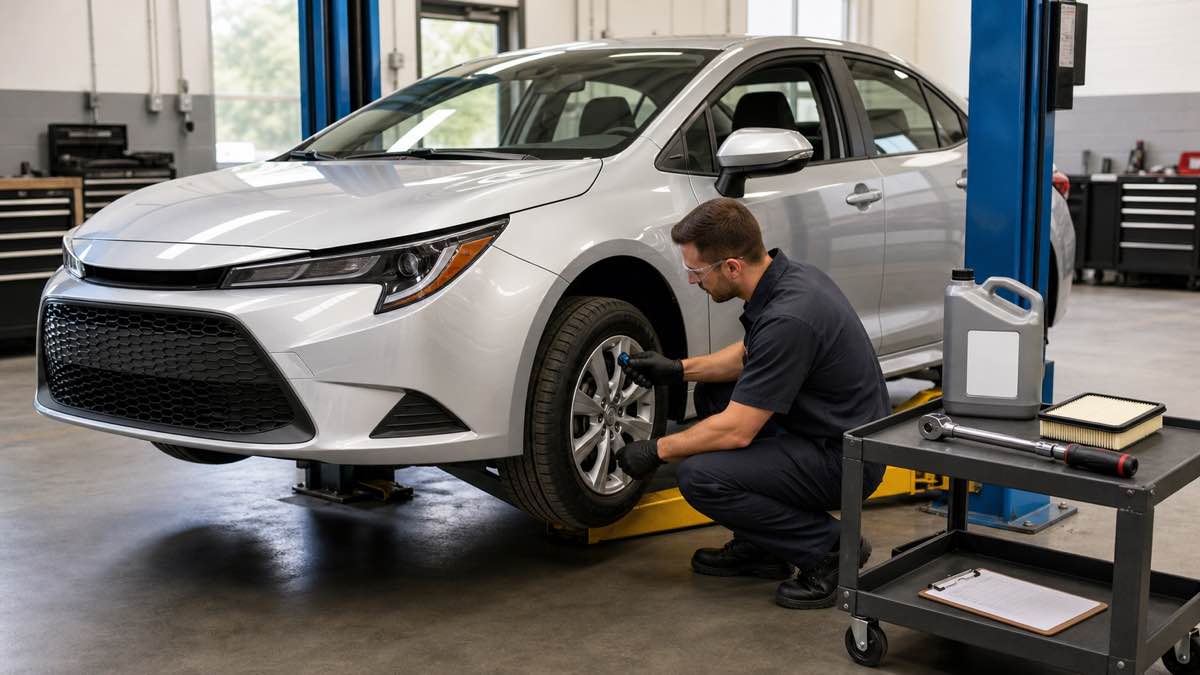
A Toyota Corolla maintenance schedule is built around repeated service visits, not one giant tune-up. For a recent US-market Corolla, Toyota generally calls for scheduled maintenance every 5,000 miles or six months, whichever comes first. The work changes at each visit: a 5,000-mile appointment may center on tire rotation and inspections, while later milestones add oil, filters, coolant, spark plugs, and more detailed checks.
The exact schedule depends on model year, engine, hybrid or gasoline powertrain, body style, and operating conditions. Use the chart below as a planning guide, then confirm every item in the Warranty & Maintenance Guide tied to your VIN. A Corolla sedan, Corolla Hybrid, Corolla Hatchback, Corolla Cross, and GR Corolla do not share one universal schedule.
Corolla Maintenance Schedule at a Glance
| Mileage or time | Typical late-model Corolla planning point |
|---|---|
| Every 5,000 miles / 6 months | Rotate tires; inspect fluids, wipers, and basic safety items; complete condition-specific work |
| Every 10,000 miles / 12 months | Engine oil and filter under normal qualifying service, plus the recurring 5,000-mile items |
| 15,000 miles / 18 months | Broader brake, steering, suspension, driveline, exhaust, and cooling-system inspections |
| 30,000 miles / 36 months | Replace engine and cabin air filters on the referenced schedule; repeat oil service and major inspections |
| 60,000 miles / 72 months | Repeat the 30,000-mile work and inspect age- and mileage-sensitive systems |
| 100,000 miles / 120 months | Common first engine-coolant replacement point on many recent Corollas; verify exact powertrain guide |
| 120,000 miles / 144 months | Common spark-plug replacement point on many recent gasoline engines; repeat major service |
This is not a substitute for the vehicle-specific booklet. Toyota’s official 2024 Corolla guide, for example, specifies maintenance every 5,000 miles or six months. Older generations and special models can use different fluids, intervals, and replacement points.
Every 5,000 Miles or 6 Months
The 5,000-mile visit is the backbone of a recent Corolla schedule. It normally includes rotating the tires, checking the driver’s floor-mat installation, inspecting wiper blades, and inspecting or adjusting fluid levels. The technician should also look for leaks, tire damage, uneven tread wear, warning lights, and anything the driver has noticed.
- Rotate tires using the pattern in the owner’s manual.
- Check cold tire pressures against the driver-door label.
- Inspect tread wear, cuts, bulges, and embedded objects.
- Check engine oil level, coolant reservoirs, brake fluid, and washer fluid.
- Inspect wiper condition and washer operation.
- Confirm exterior lights and warning indicators operate correctly.
- Record the date, mileage, work performed, and receipts.
The maintenance reminder is a distance counter, not an oil-quality sensor. Toyota’s 2025 Corolla manual says “Maintenance Required Soon” appears at about 4,500 miles after reset and the full maintenance message at about 5,000 miles. The message means the mileage-based schedule is due; it does not prove that every visit requires an oil change.
Every 10,000 Miles or 12 Months
For many recent Corollas using the specified synthetic oil and operating under normal qualifying conditions, engine oil and filter replacement appears at 10,000 miles or 12 months. The 5,000-mile inspections and tire rotation are repeated at the same visit.
Do not select oil by model name alone. Toyota has used different viscosity and performance specifications across Corolla years and engines. Check the oil cap and exact owner’s manual, use the specified filter, refill by measured level rather than guesswork, inspect for leaks, and reset the correct reminder only after service is complete.
15,000 Miles or 18 Months
This milestone adds a more detailed condition inspection. Depending on the year and configuration, the factory checklist can include brake lines and hoses, brake pads and discs, ball joints, dust covers, drive-shaft boots, exhaust pipes and mountings, radiator and condenser, steering gear, steering linkage, and related components.
Inspection does not mean automatic replacement. Brake pads have no single Corolla-wide replacement mileage because traffic, hills, driving style, corrosion, and caliper condition change wear rates. Ask for measured pad thickness and rotor condition instead of approving parts from mileage alone.
30,000 Miles or 36 Months
The 30,000-mile service is a larger checkpoint. On the referenced late-model schedule, it combines oil and filter service, tire rotation, fluid and wiper checks, engine air-filter replacement, cabin air-filter replacement, and a comprehensive inspection of brakes, steering, suspension, driveline, fuel-system connections, exhaust, and cooling components.
Dust, wildfire smoke, construction zones, and heavy pollen can load filters earlier. Replace a dirty filter when condition requires it, but do not pay for a clean filter merely because a quick-service package lists it. Ask to see the old part or a clear photo.
60,000 and 90,000 Miles
At 60,000 miles, repeat the appropriate 30,000-mile work and pay close attention to aging rubber, brakes, steering, suspension, cooling-system condition, and fluid leaks. At 90,000 miles, the same 30,000-mile cycle returns. A high-mileage inspection should also consider battery health, tire age, engine mounts, and any symptoms documented between visits.
A generic “60K fluid package” is not automatically the Toyota schedule. Some Corolla guides call for inspection of transmission or transaxle fluid and add replacement only for specific operating conditions. Ask the shop to show the applicable factory line before authorizing a CVT or automatic-transmission fluid service.
100,000 and 120,000 Miles
Many recent Corolla schedules place the first engine-coolant replacement around 100,000 miles or 120 months, followed by shorter intervals afterward. Hybrid models may have a separate inverter or power-control-unit cooling circuit with its own requirements. Use the correct Toyota-approved coolant chemistry; color alone does not establish compatibility.
Many recent gasoline Corollas list spark-plug replacement at 120,000 miles or 144 months. The plug type, torque procedure, and interval are engine-specific. Misfire, hard starting, or a flashing check-engine light requires diagnosis now rather than waiting for the scheduled mileage.
Normal vs. Special Operating Conditions
Toyota’s schedule adds certain services when the car is driven primarily under defined demanding conditions. Examples can include dirt or dusty roads, heavy loading or use of a car-top carrier, repeated short trips in freezing weather, and extensive idling or low-speed use such as taxi or delivery work. The exact list and added work vary by model.
Under qualifying special conditions, oil and filter service may move to the 5,000-mile or six-month visit, and transmission-fluid, chassis-fastener, or other services may be added. Do not rely on a dealer’s loose use of the word “severe.” Match your actual driving to the definitions printed in your guide.
Corolla Hybrid Maintenance Differences
A Corolla Hybrid still needs engine oil, filters, tires, brakes, coolant checks, and normal low-voltage maintenance. It also has high-voltage components, an inverter cooling system, and a hybrid-battery cooling intake that may require inspection or cleaning. Regenerative braking can reduce friction-brake wear, but rust, sticking hardware, and fluid problems remain possible.
Do not touch orange high-voltage cables, service plugs, or traction-battery components. Follow the separate Corolla Hybrid Warranty & Maintenance Guide, especially for cooling circuits and battery-airflow items. A gasoline Corolla schedule cannot safely substitute for it.
Monthly and Before-Trip Checks
- Check engine oil level on level ground using the manual’s procedure.
- Check cold tire pressure and inspect tread.
- Look for fluid spots under the car.
- Verify coolant is between the reservoir marks when the system is cold.
- Test lights, horn, wipers, and washers.
- Listen for new brake, wheel-bearing, exhaust, or suspension noises.
- Check that cameras and driver-assistance sensors are clean and unobstructed.
Toyota emphasizes checking engine oil level regularly, commonly monthly. Scheduled service cannot protect an engine that loses oil between appointments. Never open a hot cooling system, crawl under a vehicle supported only by a jack, or ignore a red oil-pressure, brake, or temperature warning.
DIY Tasks vs. Professional Service
Many owners can check fluids, pressure, lights, wipers, and filters. Oil service and tire rotation require proper lifting points, jack stands, wheel chocks, correct drain-plug and wheel-nut torque, and responsible fluid disposal. A shop is the better choice when inspections require wheel removal, scan data, brake measurements, coolant handling, or hybrid-system knowledge.
For a broader planning framework, compare this model-specific guide with our complete car maintenance schedule by mileage. Our guide to how often you should rotate tires explains wear patterns, rotation timing, and when rotation cannot fix a damaged tire.
How to Avoid Unnecessary Maintenance
- Bring the VIN-specific guide or save the official PDF on your phone.
- Ask whether a recommendation is factory-required, condition-based, or shop-preferred.
- Request measurements for brakes, tires, battery, and fluids where applicable.
- Do not authorize universal flush packages without the correct Toyota procedure.
- Keep invoices with mileage, date, part numbers, fluid specifications, and technician findings.
- Reset reminders only after the corresponding work is finished.
Toyota states that maintenance may be performed by the owner or another service provider; dealer service is not automatically required. However, damage caused by improper maintenance is not covered. Good records help establish what was done and prevent duplicated service.
When to Service the Corolla Early
Do not wait for a mileage milestone if the car develops a leak, overheating, grinding brakes, a soft brake pedal, steering play, repeated battery discharge, abnormal vibration, a burning smell, severe tire damage, or a warning light. Scheduled maintenance prevents predictable deterioration; it does not replace diagnosis.
Frequently Asked Questions
How often should a Toyota Corolla be serviced?
A recent US-market Corolla commonly has scheduled maintenance every 5,000 miles or six months, whichever comes first. The exact work varies by visit and model year.
Does a Corolla need an oil change every 5,000 miles?
Not always. Many recent Corollas specify 10,000 miles or 12 months under normal qualifying use, but certain special operating conditions can require 5,000-mile or six-month oil service. Follow the exact guide.
What is included in a 30,000-mile Corolla service?
A late-model schedule may include oil and filter service, tire rotation, engine and cabin air filters, fluid and wiper checks, and broader brake, steering, suspension, driveline, exhaust, fuel, and cooling inspections.
When does a Corolla need transmission fluid?
There is no universal Corolla interval. Some schedules emphasize inspection and specify replacement for defined special operating conditions. Use the model-year and powertrain guide instead of a generic flush interval.
When should Corolla coolant be replaced?
Many recent models use a first engine-coolant replacement near 100,000 miles or 120 months, but hybrid cooling circuits and older models can differ. Confirm the exact guide and coolant specification.
Do I have to use a Toyota dealer for maintenance?
No. Toyota says maintenance may be performed by you or another service provider. Keep detailed records and use the correct parts, fluids, specifications, and procedures.
Bottom Line
Build your Toyota Corolla maintenance schedule around 5,000-mile or six-month checkpoints, but authorize only the work required for that specific mileage, year, powertrain, and driving condition. Verify oil specifications, separate inspection from automatic replacement, account for hybrid-only items, keep records, and respond to symptoms before the next scheduled visit.